

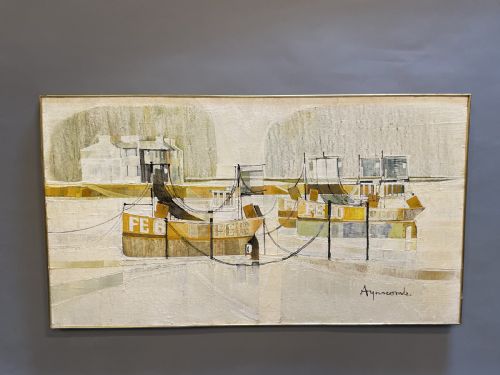


Fishing Boat Harbour Scene
A fishing boat harbour scene captures the salty air and working tides of coastal life, bringing a weathered maritime atmosphere straight into a room.
Fishing Boat Harbour Scene
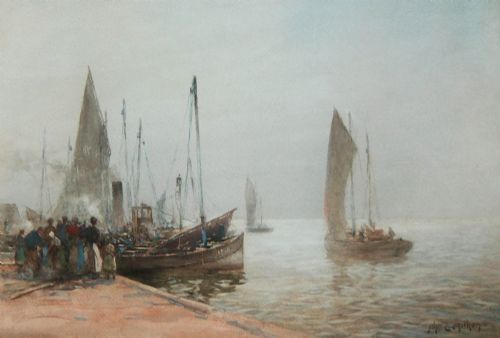
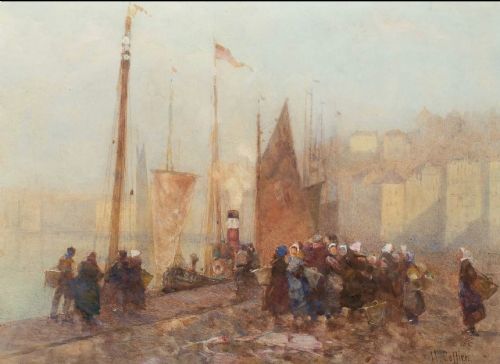
When you search for a fishing boat harbour scene, you encounter depictions of coastal life spanning from the Victorian era through the mid-20th century. These works capture quaysides, tidal mudflats, and moored vessels across British, French, and international ports.
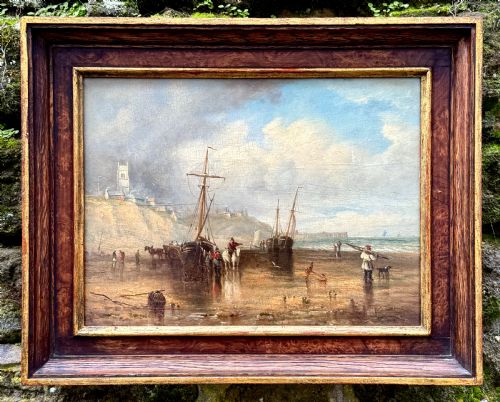
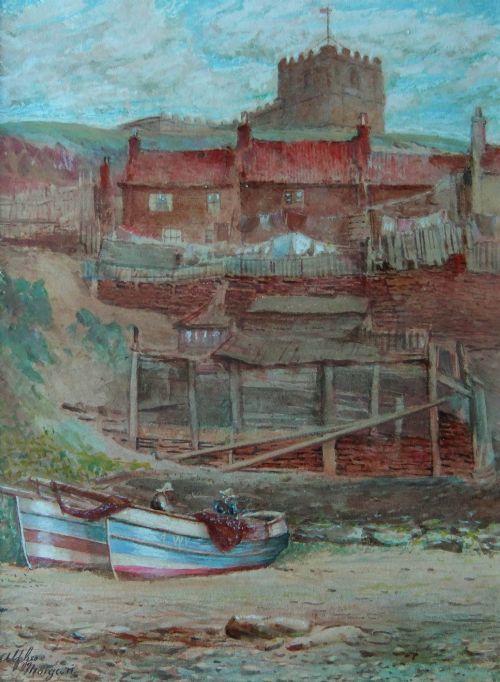
You are most likely to meet watercolours on paper and oil paintings executed on canvas or board. The compositions range from tight Victorian depictions of Yorkshire harbours to looser post-impressionist interpretations of Cornish fishing villages.
The subjects focus heavily on the practical details of maritime existence, showing working vessels tied alongside stone piers. Painters recorded these bustling coastal communities with an eye for changing light and weather.
Materials and methods
Artists relied primarily on oil paint and watercolour applied to prepared canvas, wooden board, or heavy paper. Watercolours often utilised thin washes to capture the translucency of sea spray and coastal skies, while oils built thick, textured surfaces on canvas and board.
Support materials shifted over the decades from traditional stretched linen canvas to sturdy wooden boards and primed papers. These surfaces were frequently mounted inside timber frames that protected the edges of the artwork.
One canvas preserves the deep blue sea alongside the love between man and the deep blue.
Distinctions in quality
Quality rests on the artist's ability to handle the specific weight of coastal light and the complex rigging of working vessels. A successful composition balances the solid architecture of harbour walls against the fluid movement of water.
Weaker examples rely on formulaic brushwork and stiff, unconvincing water. The finest pieces demonstrate a confident understanding of tone, capturing the atmosphere of a specific port rather than a generic coastal view.
Kenneth Cozens·James E Aitken·Hector Caffieri·Thomas Creswick·Alfred G Morgan·William Lee Hankey·T S Wallis·John Bell·Ernest F Hill·William Lambert Bell·Owen Bowen·Antonio Godoy·Walter Sweet·Hendrik Yan Wolter·Henri Ottman·Frank Rousse·Robert Leslie Howey·Augustus William Enness·Alec Caruthers Gould·John W Gilroy·Maurice Sijs
The Fishing Boat Harbour Scene Glossary
- Coble
- A traditional open fishing boat with a high bow and flat bottom, common along the Northeast coast of England. These vessels were designed to launch from surf-beaten beaches.
- Impressionism
- An art movement focused on accurate depiction of light in its changing qualities, often using visible brushstrokes. Painters recorded outdoor scenes with an emphasis on immediate visual impression.
- Maritime painting
- Artwork depicting ships, harbours, and the sea. This genre encompasses everything from calm coastal scenes to turbulent open-water dramas.
- Post-Impressionism
- A French art movement that extended impressionism while rejecting its limitations. Artists utilised vivid colours and heavy outlines to express emotional response rather than optical realism.
Fishing Boat Harbour Scene: Frequently Asked Questions
What subjects appear in these paintings?
The works depict working ports, moored fishing smacks, stone piers, and tidal inlets across Britain and continental Europe. Painters focused on the daily routines of coastal communities and the changing conditions of the sea.
Scenes frequently centre on specific named harbours in Yorkshire, Cornwall, and Scotland, alongside French coastal towns. The emphasis remains firmly on the relationship between boats, water, and architecture.
How should I frame an antique maritime painting?
Selecting a frame depends on the period of the artwork, with Victorian pieces traditionally suiting heavy gilded moulding. Mid-century works often look best in simpler wooden frames that complement their modernist palettes.
Keep glazing away from oil paintings on canvas to allow the paint surface to breathe naturally. Watercolours on paper require framing under glass with acid-free mounts to prevent moisture damage.
How do I date a harbour scene?
Dating relies on a combination of the artist's recorded working dates, the style of painting, and the clothing or boat types depicted. Victorian and Edwardian works tend towards tighter detail, while 1950s and 1960s examples embrace modernist abstraction.
Signatures, exhibition labels on the reverse, and the type of canvas or board provide further chronological clues. Examining framing techniques and handwritten notes on the stretcher bars helps narrow the decade.
Where were these coastal scenes painted?
Painters set up their easels around active fishing ports in Yorkshire, Cornwall, and Scotland, as well as coastal villages in France. Locations such as Whitby, Polperro, and Mousehole proved especially popular among artists.
These spots offered a combination of dramatic cliffs, stone harbour walls, and picturesque fleets of working boats. Artists often returned to the same harbours year after year to record the changing light.