

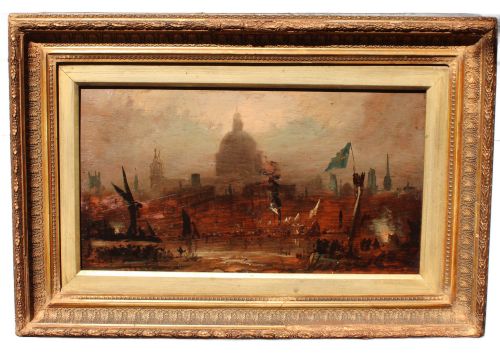
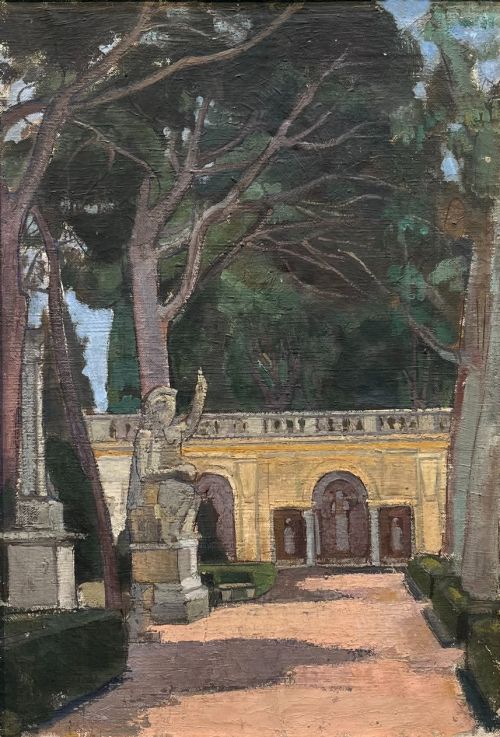
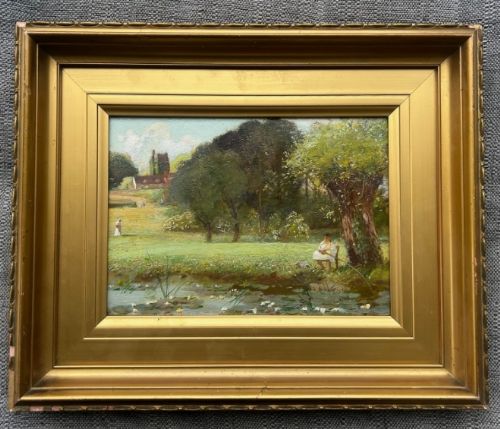


Fine Art Landscape Study
A fine art landscape study captures a fleeting view of nature, offering the intimate directness of a painter's private encounter with light and place.
Fine Art Landscape Study
A fine art landscape study represents a focused exploration of terrain, weather and atmosphere by artists working from the nineteenth century into the mid twentieth century. Buyers encounter works executed in oil or watercolour, ranging from rapid en plein air notations to composed cabinet pictures.
The material record spans traditional paper and canvas alongside wood panels prepared with gesso. Many examples preserve the immediate gesture of British Impressionism, Romanticism and the 19th Century French School.
Subjects stretch from rural river fishing scenes and wooded slopes to classical Italian vistas associated with the Grand Tour and Edwardian sensibility. Each piece functions as a direct record of an artist observing the natural world.
Materials and execution
Painters applied oil paint or watercolour across canvas, paper and timber panels to capture shifting light and weather. Wooden panels frequently received a gesso ground to prepare a smooth, stable surface for fine brushwork.
Watercolour works rely on transparent washes upon paper support, while oil compositions build texture and depth directly onto canvas or wood. Frames often incorporate gold leaf ornamentation to complement the palette of the painting within.
Several landscapes include tiny hidden figures wandering through vast painted forests and historical Roman ruins.
Distinguishing quality
Quality rests upon the sureness of the brushwork and the artist's ability to render atmosphere and light with economy. Superior studies demonstrate a confident handling of pigment that conveys movement and space without overworking the surface.
The relationship between the support and the medium dictates longevity and visual clarity. Well-preserved panels and sheets maintain vibrant pigments and secure grounds, whereas lesser examples suffer from heavy restoration or obscured detail.
Thomas Ellison·Sir David Murray·Ernest Higgins Rigg·Peter Jackson·Kershaw Schofield·Rowland Henry Hill·John J. Hamer·Tom Dudley·William Cave Day·Henri Joseph Harpignies
The Fine Art Landscape Study Glossary
- Gesso
- A traditional mixture of plaster of Paris, chalk and size used to prepare wood panels for painting. It provides a bright, uniform ground that accepts oil media cleanly.
- British Impressionism
- A late nineteenth and early twentieth century movement focused on capturing light and contemporary life outdoors. Artists adopted broken brushstrokes and brighter palettes inspired by French innovators.
- Grand Tour
- A traditional extended journey through Europe undertaken by upper-class young men for educational and cultural accumulation. Associated artworks typically recorded classical monuments and Italian landscapes.
- Watercolour
- A painting method where coloured pigments are suspended in a water-soluble vehicle. The technique depends upon the luminosity of the white paper showing through transparent washes.
- Wood Panel
- A rigid support used by painters before stretched canvas became dominant. Timber boards were joined and prepared to provide a stable plane for oil pigments.
Fine Art Landscape Study: Frequently Asked Questions
What is a study compared to a finished painting?
A study is typically a preparatory or direct observation piece created to capture light, composition, or atmosphere quickly. These works often display a looser, more expressive application of paint than a highly polished gallery submission.
Collectors prize studies for their immediacy and insight into the working method of the artist. They reveal the initial creative decisions before any formal studio refinement takes place.
How do I identify the period of a landscape?
Dating often relies on stylistic clues, framing techniques, and the type of material supports used by the artist. Nineteenth-century works frequently employ heavy gold leaf frames and specific canvas weaves.
Signatures, exhibition labels, and inscriptions on the reverse of panels or stretchers offer definitive clues. Comparing the handling of paint to documented works from particular schools helps narrow the timeframe.
Can I hang oil paintings on wood panels in any room?
Oil paintings on wood panels prefer environments with minimal fluctuations in temperature and humidity to prevent the timber from splitting. Avoid placing them near active heat sources or exterior damp walls.
Panels respond naturally to atmospheric changes, so stable interior spaces ensure the wood and gesso ground remain secure. Proper hanging protects both the structural support and the paint layer.