




Figural Mantel Clock Garniture
A figural mantel clock garniture brings sculptural presence to a room, combining a central timekeeper with matching side pieces.

Figural Mantel Clock Garniture
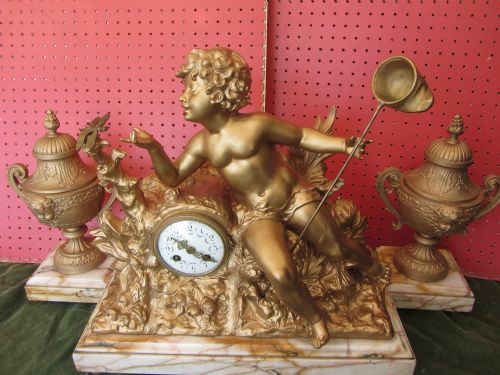
A figural mantel clock garniture comprises a central clock flanked by matching decorative side pieces, forming a complete decorative ensemble for a fireplace mantel or sideboard. These sets frequently date from the nineteenth century, including Victorian and French periods, often arranged as a trio of matching or complementary objects.
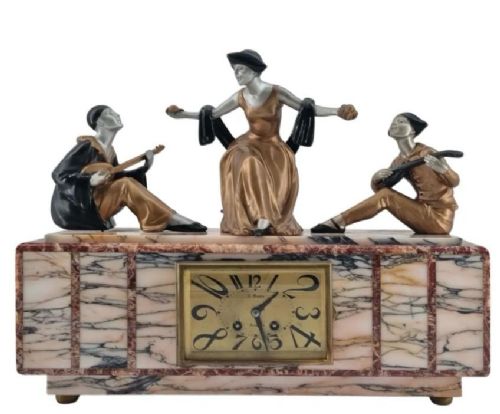
Buyers encounter various interpretations, ranging from grand French Louis XVI style gilt bronze compositions to refined Regency marble sets and later Art Deco pierrot groupings. The central timepiece anchors the arrangement, while the flanking urns or companion figures complete the symmetrical display.
The forms span strict classical revivals through to theatrical character studies, reflecting the shifting tastes of nineteenth and early twentieth century interiors. Each configuration provides a balanced focal point designed specifically for prominent display in principal reception rooms.
Materials and construction
These garnitures rely heavily on contrasting heavy media, pairing dense marble bases with cast metal figures in bronze, ormolu, gilt bronze, and spelter. Enamel dials provide crisp legibility against the ornate metalwork and stone bodies, whilst glass covers protect the delicate clock faces.
Foundries employed intricate casting and chasing techniques to render the figurative elements, applying rich gilding or patination to the bronze and brass surfaces. Marble bases were precision-cut and polished to support the substantial weight of the metal components and mechanical movements housed within.
Figural Mantel Clock Garniture Retail Price Guide 2026
Typical asking prices for figural mantel clock garniture among the pieces listed under this phrase on Sellingantiques today, from the lower quarter to the upper quarter. They describe what is for sale here now, not the wider market.
Current listings feature materials including marble, brass, enamel, bronze, spelter, glass, ormolu, and gilt bronze across the nineteenth and early twentieth centuries.
Assessing craftsmanship and execution
Quality rests primarily in the crispness of the metal chasing and the depth of the casting, where superior examples exhibit sharp facial expressions and refined drapery on the figures. Lesser pieces rely on softer cast spelter with superficial patination rather than substantial bronze or fire-gilt ormolu.
The integration of the materials dictates the tier of the piece, particularly the selection and veining of the marble used for the plinths and bodies. Heavier, finely fitted stone bases combined with robust mechanical movements separate standard production sets from the finest workshop outputs.
Sega
The Figural Mantel Clock Garniture Glossary
- Garniture
- A set of matching decorative objects designed to be displayed together on a mantelpiece or sideboard, typically comprising a clock flanked by urns, vases, or companion figures. This arrangement creates a balanced, symmetrical display popular in formal interiors.
- Ormolu
- Finely chopped and ground gold applied to a bronze base using a mercury amalgam technique, producing a rich golden finish characteristic of high-end French decorative arts. Genuine ormolu retains its lustre and subtle texture over centuries.
- Spelter
- A zinc alloy commonly utilised as a less expensive substitute for bronze in the manufacture of decorative figures and clock components. It takes patination well but lacks the weight and tensile strength of true bronze.
- Louis XVI Style
- A neoclassical design vocabulary characterised by straight lines, symmetrical proportions, classical motifs such as urns and floral garlands, and restrained architectural forms. This style experienced several nineteenth-century revivals.
Figural Mantel Clock Garniture: Frequently Asked Questions
What is a clock garniture?
A clock garniture is a matched set of decorative objects designed to sit together, featuring a central mantel clock accompanied by two matching side pieces such as urns or figures.
These sets provide a unified decorative scheme, traditionally placed on a fireplace mantel to create a balanced architectural focal point.
How do I date a French clock set?
Dating relies on examining the stylistic markers, such as classical Louis XVI revival details or later Art Deco forms, alongside the materials and dial construction.
Period indicators also include the casting techniques used for the bronze or spelter figures and the specific formulation of the marble bases.
Where should I place a garniture?
These sets require a deep, stable surface such as a mantelpiece, grand sideboard, or pier table to safely support the substantial weight of the marble and metal components.
Arranging the central clock with the matching side pieces spaced evenly outwards ensures the intended symmetrical visual impact.
What is the difference between bronze and spelter?
Bronze is a heavy, durable copper alloy that accepts fine chasing and rich patination or gilding, representing high-quality nineteenth-century metalwork.
Spelter is a lighter zinc-based alternative that was cheaper to produce and cast, often identified by a softer level of detail in the figurative elements.