



Executive Office Seating
Executive office seating brings together the gravity of the Victorian study and the practical comfort demanded by the working room.
Executive Office Seating
Executive office seating covers heavy-duty desk chairs and library armchairs designed for administrative and scholarly work. These seats are found in formats such as revolving swivel chairs, stationary armchairs, and matching pairs.
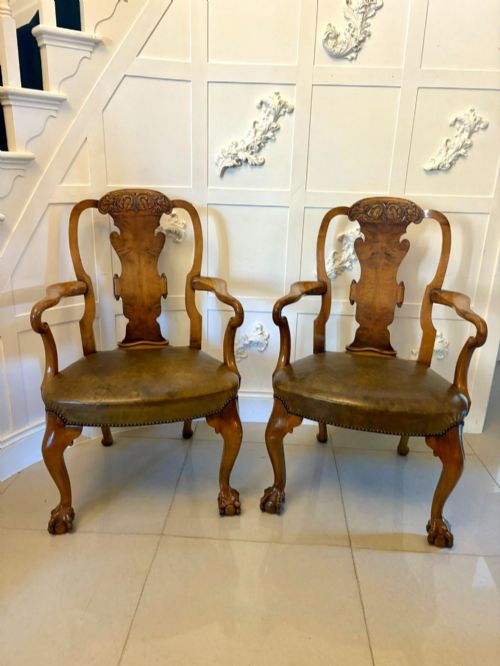
The pieces on this page span the Victorian era, the Edwardian period, and the early twentieth century, alongside specific revivals like the Queen Anne style and the Gainsborough model. Buyers encounter solid timber frames paired with upholstered seats and backs.
Mahogany, walnut, and oak dominate the construction, frequently accented with brass hardware and upholstered in leather or fabric. Forms range from stationary library armchairs to mechanical swivel desk chairs with height adjustment.
Materials and construction
Cabinetmakers constructed these frames using hardwoods including mahogany, walnut, oak, and general hardwood, often carving details directly into the timber. Frames were built to endure heavy daily use in offices and libraries.
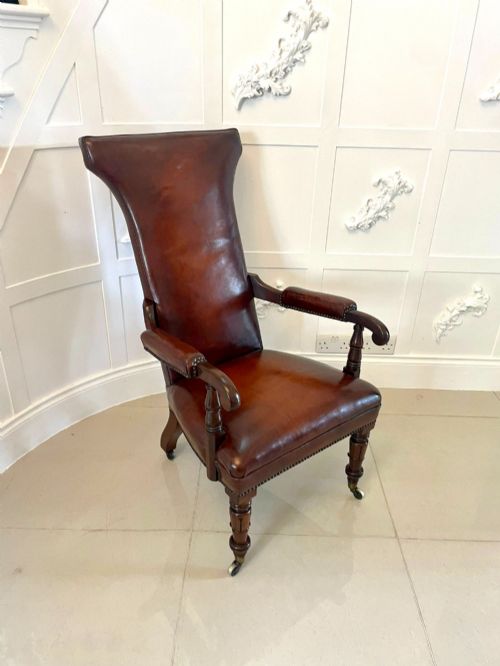
Upholstery involved mounting leather or fabric over interior padding, secured with brass tacks or studs along the edges. Swivel mechanisms relied on iron and brass engineering to allow smooth rotation and movement.
Executive Office Seating Retail Price Guide 2026
Typical asking prices for executive office seating among the pieces listed under this phrase on Sellingantiques today, from the lower quarter to the upper quarter. They describe what is for sale here now, not the wider market.
The listings on this page span the Victorian period, Edwardian era, and the early twentieth century, featuring mahogany, walnut, and oak.
Judging quality in office seating
Quality rests on the selection of timber and the depth of carving, where finely figured mahogany or walnut and deep relief work distinguish superior pieces from plain utilitarian examples. The integration of mechanical swivel systems also dictates value.
Proportion and comfort separate standard seating from exceptional desk chairs, particularly in pieces designed as library armchairs or Gainsborough models. The condition of the leather and the stability of the hardwood frame govern the overall standard.
The Executive Office Seating Glossary
- Swivel desk chair
- A seat mounted on a mechanical pivot that allows the user to rotate without moving the base. These chairs often incorporate iron and brass mechanisms beneath the wooden seat.
- Library armchair
- A comfortable, upholstered seat designed for reading rooms and studies rather than active writing at a desk. These typically feature solid wooden armrests and sturdy hardwood frames.
- Gainsborough style
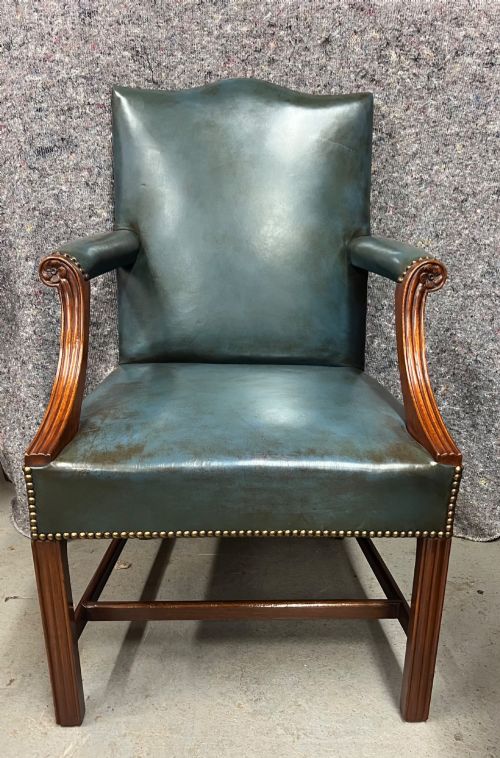
- A roomy, upholstered armchair with open arms and a low back, traditionally set in front of a writing table. The design references eighteenth-century forms revived in later periods.
- Queen Anne Revival
- A late nineteenth and early twentieth-century design movement that reinterprets eighteenth-century domestic furniture characteristics. Pieces in this style often feature cabriole legs and shaped walnut or mahogany backs.
Executive Office Seating: Frequently Asked Questions
What is executive office seating?
Executive office seating comprises antique desk chairs, library armchairs, and revolving office seats designed for traditional studies and workspaces. These pieces combine supportive wooden frames with upholstered leather or fabric.
Originating primarily from the Victorian and Edwardian eras, they offer practical seating solutions built from durable hardwoods like mahogany, walnut, and oak.
How do I use a swivel desk chair?
Antique swivel desk chairs function similarly to modern office chairs by allowing the user to rotate at the desk. The iron and brass mechanisms beneath the seat provide movement while maintaining a sturdy wooden base.
Place them at partners desks or large writing tables where mobility and accessibility are required during administrative tasks.
What materials were used for these chairs?
Cabinetmakers relied heavily on dense hardwoods including mahogany, walnut, oak, and solid hardwood for the structural frames. These timbers were selected for strength and their ability to take a deep polish.
Upholstery surfaces were typically finished in leather or fabric, secured with brass tacks, while internal mechanics utilised iron and brass components for swivel functions.