




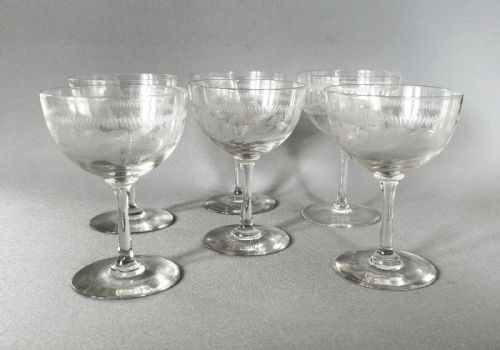



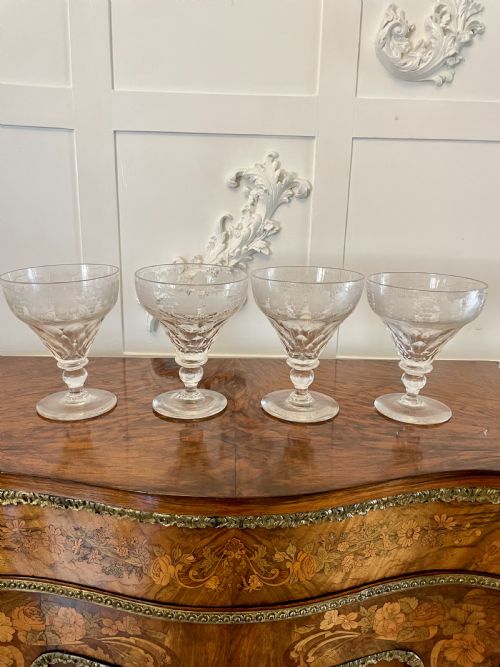
Engraved Glassware Set
These engraved glassware set pieces bring genuine period character to the table, offering a tangible link to Georgian, Victorian, and Edwardian dining traditions.
Engraved Glassware Set
When you search for an engraved glassware set, you encounter matched drinking vessels and serving pieces spanning the Georgian, Victorian, Edwardian, and Art Deco periods. These collections comprise forms ranging from champagne coupes and dessert wine glasses to rummers, finger bowls, custard cups, and decanters.
The most prevalent examples on this page are Victorian and Edwardian services in clear glass, lead crystal, or crystal glass. Sets vary considerably in scale, from intimate groupings of four dram glasses to large suites containing over thirty matching drinking vessels.
Origin and period heavily influence what appears, with French makers such as Baccarat and English glasshouses like Webb Corbett and James Powell represented alongside unbranded domestic tableware. Each grouping reflects the prevailing decorative tastes of its era, from Georgian faceted stems to Art Nouveau motifs.
Materials and production
The primary material across these listings is glass, frequently specified as lead crystal, crystal glass, or clear glass, alongside occasional coloured variants like amber glass. Artisans utilised techniques such as optical blowing, faceting, and intaglio carving to shape and pattern the material.
Engraved Glassware Set Retail Price Guide 2026
Typical asking prices for engraved glassware set among the pieces listed under this phrase on Sellingantiques today, from the lower quarter to the upper quarter. They describe what is for sale here now, not the wider market.
Listings feature items spanning the Georgian period through to the Art Deco era, encompassing lead crystal, amber glass, and clear glass forms.
Judging quality and execution
Quality in these services rests upon the clarity of the metal, the precision of the wheel-cut or engraved decoration, and the uniformity across the entire suite. Superior sets display crisp, deep lines in the intaglio or engraving and consistent wall thickness across every vessel.
The distinction between standard domestic tableware and higher tier production lies in the weight of the crystal, the complexity of the cutting on stems and feet, and the reputation of the glasshouse or maker.
Baccarat·Webb Corbett·James Powell
The Engraved Glassware Set Glossary
- Intaglio
- A design incised into the surface of the glass so that the pattern sits below the outer plane. This technique requires considerable skill with the cutting wheel.
- Rummer
- A large, heavy-stemmed drinking glass popular in the late eighteenth and nineteenth centuries, often used for ale or wine. They typically feature thick bowls and sturdy bases.
- Champagne coupe
- A shallow, broad-bowled stemmed glass designed originally for sparkling wine. Edwardian and Victorian versions frequently feature delicate etched or engraved rims.
- Lemon squeezer foot
- A square, moulded glass base with sloping sides resembling a traditional kitchen juicer. These are characteristic of late Georgian and early nineteenth-century stemware.
- Finger bowl
- A small, bowl-shaped vessel used for rinsing fingers between courses at formal dinners. They appear in matched sets with decorative engraved bands.
Engraved Glassware Set: Frequently Asked Questions
How do I clean antique crystal safely?
Wash each piece by hand in warm water using a mild detergent, placing a towel in the bottom of the sink to cushion the glass. Avoid sudden temperature changes to prevent cracking the material.
Dry the glassware immediately with a lint-free cloth to maintain clarity and prevent water spots from forming on the engraved surfaces.
Can I use these glasses for daily dining?
Many people enjoy using antique glassware for special occasions rather than daily meals, owing to the delicate nature of lead crystal and hand-engraved rims. Careful handling helps preserve the condition of older services.
Hand washing is essential, as modern dishwashers can cloud the glass and weaken thin stems or engraved details over time.
How do I identify a Georgian glass?
Georgian pieces often display distinctive characteristics such as heavy lead metal, pontil marks on the underside, and faceted stems. The proportions tend to be sturdy, particularly on rummers and wine glasses.
Foot styles from this era frequently include wide flat bases or square lemon squeezer formations rather than modern rounded feet.
What is the difference between etching and engraving?
Etching typically involves using acid to eat away the exposed surface of the glass through a resist, creating a frosted or matte pattern. It allows for consistent repeating motifs across large suites.
Engraving is a mechanical process where the glass is held against a rotating stone or copper wheel, cutting deeper lines into the material with sharper definition.