





English Wood Barometer
An english wood barometer measures atmospheric pressure while bringing rich timber grain and precision brass work directly onto the wall.
English Wood Barometer
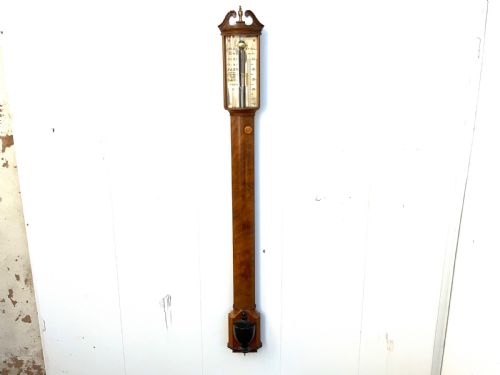
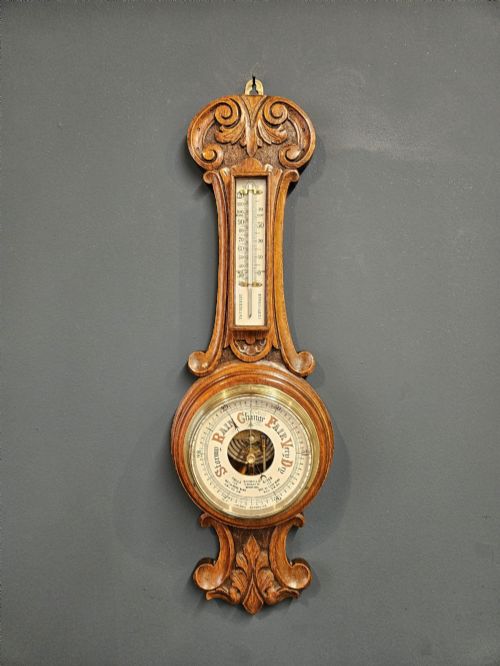
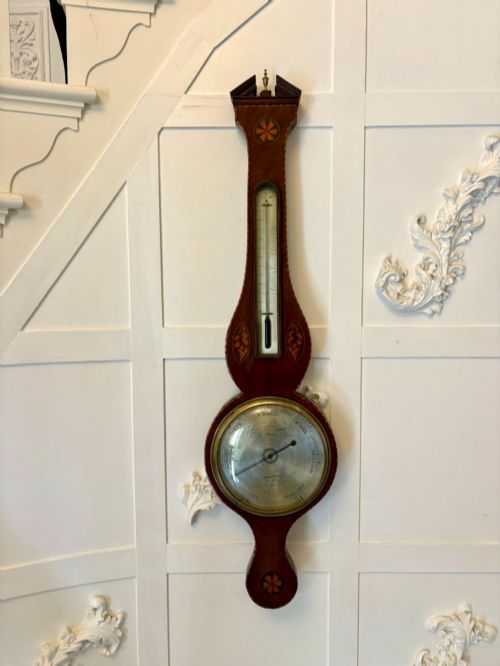
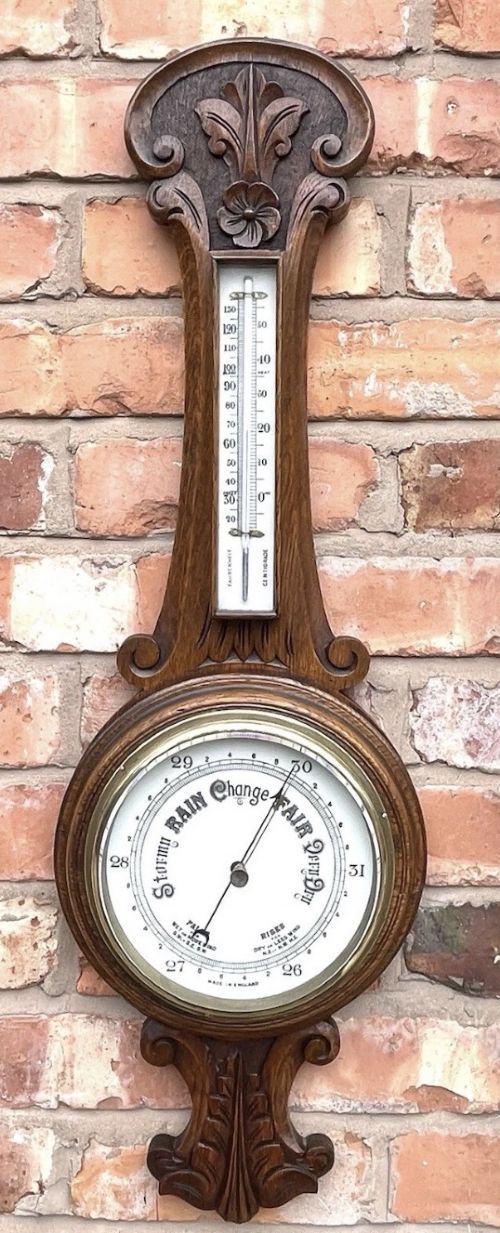
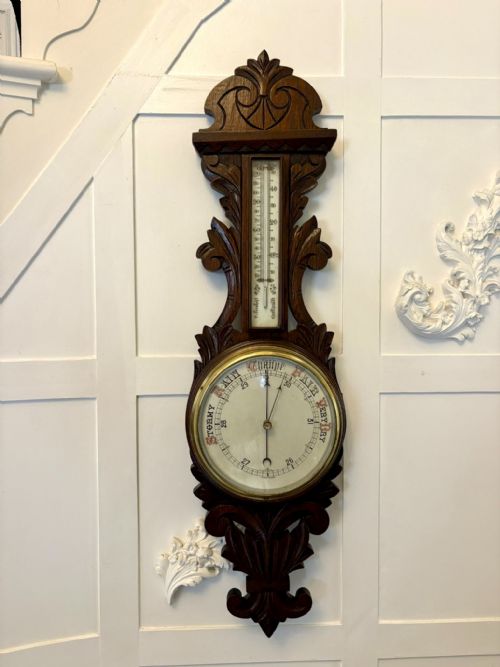
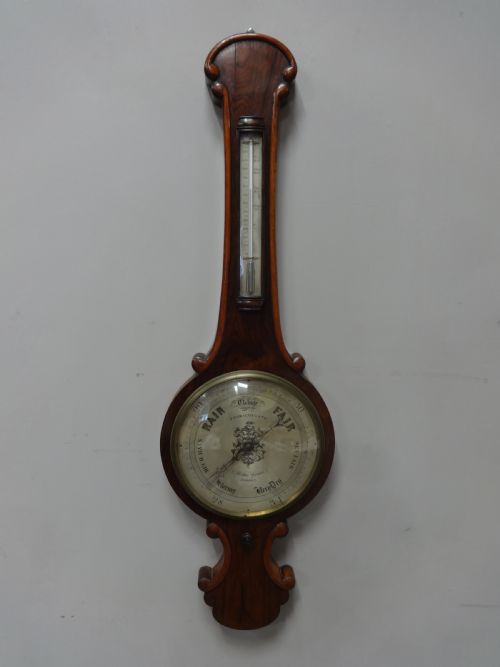
An english wood barometer appears in several distinct architectural silhouettes, ranging from the slender vertical line of a stick barometer to the rounded shoulders of a wheel banjo barometer. Wall-mounted instruments dominate the selection, often incorporating a thermometer alongside the main dial or tube.
Makers housed these scientific movements in rich cabinet timbers such as mahogany, oak, walnut, and satinwood. Examples stretch across the Georgian, Victorian, and Edwardian eras, displaying period-specific carving, string inlay, and onion top profiles.
Materials and construction methods
Cabinetmakers constructed the wooden housings using solid and veneered hardwoods, frequently shaping mahogany, walnut, and oak into steam-bent bows or flat panels with shell inlay. Satinwood and rosewood provided contrasting borders, whilst carved oak cases exhibited deep relief work typical of later Victorian workshops.
Scientific instrument makers fitted glass dial covers, silvered brass scale plates, and mercury or aneroid movements into the wooden frames. Specialised models utilised skeletonised brass mechanisms or porcelain dials, securing the delicate internal linkages directly to the timber backplates.
English Wood Barometer Retail Price Guide 2026
Typical asking prices for english wood barometer among the pieces listed under this phrase on Sellingantiques today, from the lower quarter to the upper quarter. They describe what is for sale here now, not the wider market.
Railway and Southend interest barometer records prove that Victorians took holiday weather forecasting remarkably seriously.
Assessing quality in construction and movement
Quality rests in the crispness of the timber carving, the choice of figured grain veneers, and the legibility of the engraved brass scales. Superior instruments feature well-balanced cabinet proportions, intact original mercury tubes or clean aneroid linkages, and finely turned bezels.
The presence of named maker signatures engraved upon the dial plates elevates an example above anonymous workshop production. Retaining the original glass, thermometer tubes, and matching wooden cistern covers indicates a high degree of preservation.
Short And Mason·W Watson And Sons·Blake And Son·W E Pain·Sandrino·Gilbert·Charles Aiano·Joseph Somalvico And Co
The English Wood Barometer Glossary
- Stick barometer
- A vertical instrument utilising an exposed or enclosed tube of mercury against a measured scale to register atmospheric pressure. This form represents the earlier traditional method of weather forecasting.
- Wheel barometer
- A circular dial instrument often shaped as a banjo, translating the rise and fall of mercury through a pulley and weight system to move a pointer. These frequently incorporate damp and dry hygrometers or spirit thermometers.
- Aneroid barometer
- A mechanism using a sealed corrugated metal box that expands or contracts with pressure changes, removing the need for liquid mercury. This design allowed for more compact and varied wall cases.
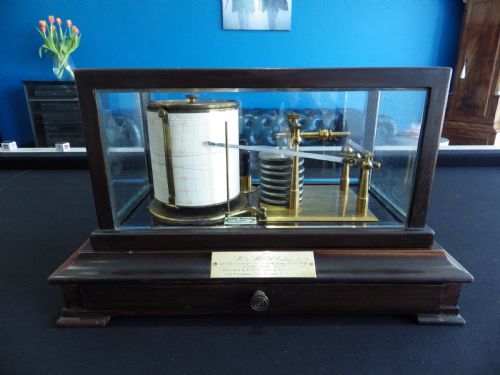
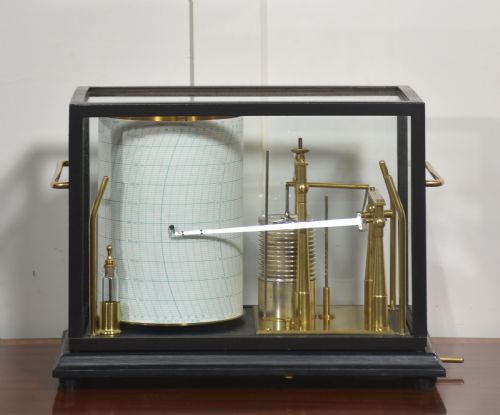
- Barograph
- A self-recording meteorological instrument that draws continuous pressure readings onto a rotating paper chart driven by clockwork. These mechanical devices are housed in glazed wooden cases.
- Skeletonised movement
- A design where the brass plates of the mechanism are cut away to reveal the internal wheels, escapements, and springs. This allows direct viewing of the working parts through the dial.
English Wood Barometer: Frequently Asked Questions
How do I read an english wood barometer?
Read the main pointer against the pressure scale marked in inches or millibars to see current weather tendencies. Many models feature a manual set needle that you align with the primary pointer to track whether pressure rises or falls.
Consult the weather words written on the dial face, such as rain, change, or fair, for general guidance. Thermometers mounted on the wooden trunk provide supplementary temperature readings in Fahrenheit or Celsius.
Where should I hang a wall barometer?
Hang your instrument on an interior wall away from direct sunlight, central heating radiators, and damp draughts. Rapid temperature fluctuations can affect the wood case and the internal mechanical response.
Ensure the wall fixing is secure because wooden barometers carry significant weight from their brass movements, glass bezels, and hardwood housings. Position the dial at eye level to make daily readings straightforward.
What is an aneroid barometer?
An aneroid barometer measures atmospheric pressure using a flexible metal vacuum chamber rather than liquid mercury. Changes in air pressure compress or expand the sealed capsule, moving mechanical linkages connected to the dial pointer.
This design became common during the Victorian era and allowed makers to build barometers in horizontal table formats as well as robust carved oak wall cases.