





English Silver Frame
An English silver frame holds a cherished portrait or photograph, bringing substance and bright metal detail to a desk, mantelpiece or wall.
English Silver Frame
When you search for an english silver frame, you encounter picture frames, photograph frames and wall mirrors spanning several centuries of British design. The selection includes compact tabletop pieces alongside substantial wall-hung overmantel mirrors.
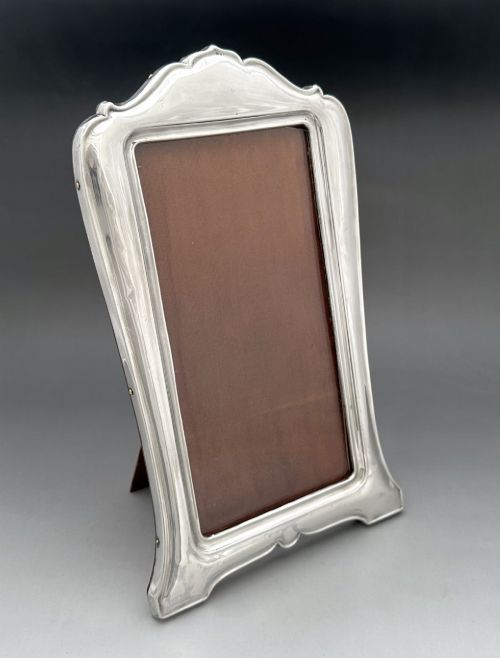
The most frequently seen versions on this page date from the Edwardian era and the reign of George V, often featuring hallmark dates from the early twentieth century. These domestic items range from plain polished profiles to decorative rectangular and heart-shaped formats designed to hold photographs.
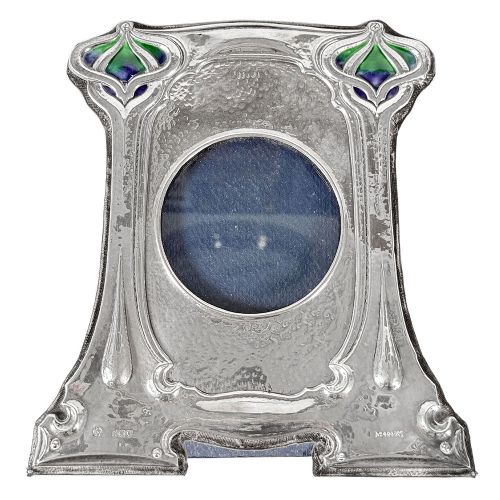
Makers adapted the form across notable stylistic movements, producing Arts and Crafts examples with enamel highlights, linear Art Deco models with engine-turned surfaces, and ornate Victorian interpretations. Alongside these, occasional silver-plated military frames and novelty pieces appear.
Materials and construction
Silversmiths constructed these pieces using sterling silver, solid silver or silver plate over a supportive core, often pairing the metalwork with wooden backs and protective glass panels. Structural stability relied on hinged wooden struts or easel backs covered in fabric.
Decoration techniques involved hand-beating, engine-turning to create geometric surface patterns, and the application of coloured enamel accents. Makers stamped hallmarks onto the silver border to denote the assay office, standard and year of manufacture.
English Silver Frame Retail Price Guide 2026
Typical asking prices for english silver frame among the pieces listed under this phrase on Sellingantiques today, from the lower quarter to the upper quarter. They describe what is for sale here now, not the wider market.
A specialised tennis-themed silver frame from the early twentieth century proves that sporting enthusiasm found its way onto the mantelpiece long ago.
Distinctions in quality
Quality rests on the thickness of the silver sheet, the crispness of the engine-turning or repoussé ornament, and the original integrity of the wooden or fabric backing. Pieces that retain clear city hallmarks, original glass and sturdy structural pins demonstrate superior original manufacture.
Design ambition separates standard commercial production from workshops associated with the Arts and Crafts movement or specific named silversmiths. The incorporation of hand-applied enamel or figural casting elevates an object above plain stamped borders.
William Hutton and Sons·Thwaites of London
The English Silver Frame Glossary
- Sterling silver
- A silver alloy containing 92.5 percent pure silver and 7.5 percent other metals, usually copper, to increase durability. This standard metal appears frequently across British silver frames.
- Engine-turned
- A decorative technique involving precise geometric patterns cut mechanically into a metal surface. It provides texture and light-catching detail on many Art Deco items.
- Hallmark
- A series of official marks stamped onto precious metals in Britain to indicate the standard of purity, the assay office, and the year of production. These stamps enable precise dating.
- Overmantel mirror
- A large mirror designed to hang directly above a mantelpiece, often framed in silvered wood or metal. They expand visual space in a room.
- Repoussé
- A method of shaping metal by hammering the reverse side to form a raised design in relief. This technique creates dimensional floral or abstract borders.
English Silver Frame: Frequently Asked Questions
How do I clean an english silver frame?
Use a soft microfibre cloth and a reputable silver polish formulated to remove tarnish without abrading the metal surface. Take care to avoid getting polish on surrounding wooden backs, fabric linings or glass panels.
Apply the cleaner with gentle circular motions, then buff the silver to restore its reflective shine. Regular light dusting helps prevent heavy tarnish accumulation.
How do I read the hallmarks on my frame?
British hallmarks typically consist of a standard mark such as a lion passant for sterling silver, a city mark indicating the assay office, and a date letter corresponding to a specific year. Reference charts assist in matching the date letter shape to the correct alphabetical cycle.
Assay offices include Birmingham and Chester, both of which feature prominently on early twentieth-century domestic silver. These small stamps usually sit near the outer edge of the frame border.
Can I replace the glass in a vintage frame?
A local glazier can cut replacement glass to fit the exact rebate of the frame if the original panel is cracked or missing. Flat float glass or conservation-grade glass works well for protecting historic photographs.
Retain the original glass whenever possible, as antique panes often exhibit subtle surface waves and bubbles characteristic of their period of manufacture.
How were these frames displayed originally?
Tabletop photograph frames stood on desks, dressing tables and mantelpieces, supported by folding easel struts attached to the reverse. They served to display portraits of family members, military personnel or notable public figures.
Larger variants and mirrors hung on interior walls to reflect light and complement the surrounding decorative scheme of Victorian or Edwardian drawing rooms.