
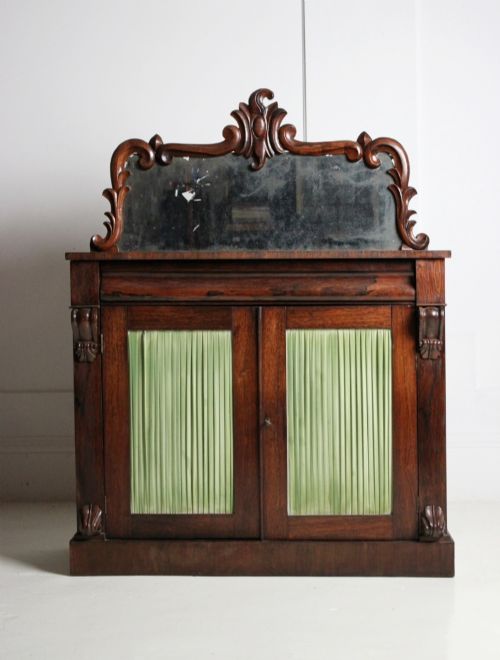


English Regency Rosewood Cabinet
These English Regency rosewood cabinet pieces bring the dark warmth and clean lines of the early nineteenth century straight into a room.
English Regency Rosewood Cabinet
When someone searches for an english regency rosewood cabinet, they are looking at case furniture made during the Regency, Grand Regency, George IV, and William IV periods, alongside later nineteenth-century examples and a 1930 reproduction. These items function as side cabinets, bookcases, chiffoniers, sideboards, secretaire cabinets, and music cabinets with stands.
The version most commonly met on this page is the side cabinet or chiffonier, often fitted with brass inlay or grill fronts. They originate principally from the early nineteenth century, showcasing the formal balance and dense timber typical of the era.
Form and utility merge in these designs, which range from dwarf bookcases to breakfront cabinets with four doors. Each piece reflects the functional requirements of polite society, providing storage or display space built with heavy architectural presence.
Materials and technique
Rosewood forms the primary visual and structural body of these items, selected for its deep grain and dark coloration. Cabinet makers paired this dense timber with contrasting brass inlay, boxwood stringing, and mirror glass panels.
Internal and functional elements incorporate secondary woods, fabric panels, and silk linings behind glass or brass grilles. Marble tops occasionally cap the stone or timber bases, while brass mounts and hinges secure the doors and shelving.
Library clocks tick quietly alongside the sideboards, measuring out the hours in rosewood.
What varies in quality
The distinction between tiers of work rests on the precision of the brass inlay and the selection of the rosewood veneer. Finer examples display meticulous joinery and thoughtful grain matching across large surfaces such as breakfront doors.
Attribution to documented makers or workshops elevates the standing of a piece, as seen in items bearing specific cabinet-making traits. The crispness of carved mouldings and the integrity of original surface finishes also divide standard production from exceptional execution.
Gillows·John McLean
The English Regency Rosewood Cabinet Glossary
- Chiffonier
- A low sideboard or cabinet featuring shelves or enclosed storage, typically surmounted by a small gallery or shelf. This form gained popularity during the Regency period for dining and drawing rooms.
- Breakfront
- A piece of furniture whose central section projects forward from the flanking wings. This architectural arrangement creates depth and shadow on large sideboards and bookcases.
- Brass Inlay
- The technique of cutting thin brass into wood veneers to form geometric patterns or classical motifs. It defines much of the decorative work seen on Regency rosewood furniture.
- Grained Finish
- A painted surface treatment designed to imitate the appearance of more expensive or exotic wood. Examples from the period utilise this method to mimic rosewood or other fine timbers.
- Secretaire
- A cabinet incorporating a fitted writing drawer with a drop-front fall. It combines the utility of a desk with the enclosed storage of a side cabinet.
English Regency Rosewood Cabinet: Frequently Asked Questions
What is a Regency chiffonier?
A Regency chiffonier is a low cabinet designed for the storage of dining or drawing room items, usually featuring enclosed lower doors and open or enclosed upper shelving.
These pieces often include fabric-backed brass grilles or mirror glass panels, reflecting the refined interior taste of the early nineteenth century.
How do I spot a George IV cabinet?
Cabinets from the George IV period share stylistic traits with earlier Regency pieces, focusing on heavy rosewood veneers and classical proportions.
They frequently employ brass inlay and architectural mouldings that bridge the shift from Regency restraint to the bolder forms of the William IV era.
Where were these cabinets placed?
These cabinets served primarily in dining rooms, libraries, and drawing rooms as sideboards, bookcase bases, or general storage units.
Their finished backs and compact proportions allowed them to sit flush against drawing room walls or beneath pier glasses.
What timber is used?
Rosewood is the defining timber for this group of furniture, valued for its dark, highly figured grain patterns.
Cabinet makers combined it with contrasting materials like boxwood and brass to highlight the structural lines of the case.