

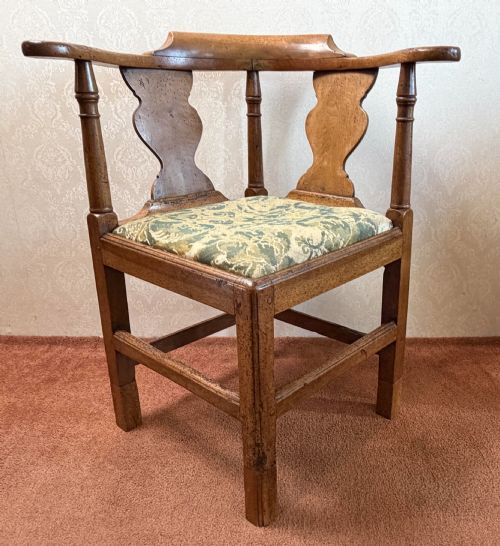


English Corner Chair
An english corner chair offers a clever, curved design built to fit snugly into a room junction while providing a sturdy seat.
English Corner Chair
An english corner chair is a specialised seating form engineered to fit into room angles, featuring a semicircular backrest supported by three or four legs. These pieces emerge in various forms across multiple eras, designed to maximise space without sacrificing comfort.
The versions most frequently met on this page include robust examples from the eighteenth century alongside later revivals from the Victorian and Edwardian periods. Makers adapt the fundamental diagonal plan into functional armchair and dressing seat variants.
Makers construct these chairs using sturdy timbers shaped to accommodate tight spatial constraints. The design positions a single primary leg at the front with corresponding supports at the rear and sides, creating a stable triangular or diamond footprint.
Materials and Construction
Carpenters build these chairs using dense hardwoods like oak, English oak, mahogany, and beech to ensure structural integrity across the angled frame. These traditional timbers provide the necessary strength to support the sweeping curved armrests and spindle arrangements.
Selected examples incorporate woven rush seating or traditional upholstery finished with fabric coverings. Joinery techniques involve precise turning and jointing to secure the complex geometry required for a functional corner seat.
English Corner Chair Retail Price Guide 2026
Typical asking prices for english corner chair among the pieces listed under this phrase on Sellingantiques today, from the lower quarter to the upper quarter. They describe what is for sale here now, not the wider market.
Factors of Quality
Quality in these chairs depends on the crispness of the timber turning, the integrity of the structural joints, and the sophistication of the revival style applied. Finer examples display harmonious proportions across the curved back rail and well-defined structural turning.
The choice of primary wood dictates the refinement of the piece, with dense mahogonys and figured oaks representing more ambitious workshop output than utility beech alternatives. Period authenticity and the retention of original rush or structural elements further distinguish the grade.
The English Corner Chair Glossary
- Corner chair
- A chair designed specifically to fit into the corner of a room, featuring a diagonal orientation with a semicircular backrest.
- Turner's chair
- A traditional heavy armchair constructed predominantly from turned wooden spindles and members, often associated with vernacular English forms.
- Elbow seat
- An alternative historic term for an armchair, describing a seat furnished with armrests for supporting the elbows.
- Rush
- Dried marsh grass utilised for traditional seat weaving, providing a durable and flexible matted surface.
English Corner Chair: Frequently Asked Questions
What is an english corner chair?
An english corner chair is a seating design created to occupy the junction of two walls, using a diagonal footprint and a curved back rail.
These pieces combine space-saving utility with traditional carpentry, appearing in forms ranging from plain vernacular seating to ornate revival styles.
How were corner chairs used?
Historically, these chairs served as functional seating in studies, bedrooms, and parlours where standard rectangular furniture would obstruct walkways.
The angled design allowed sitters to converse or write comfortably while utilising otherwise wasted room perimeters.
How do I date a corner chair?
Dating relies on examining the timber species, joinery methods, and stylistic cues such as Georgian curves or Victorian Gothic revival motifs.
Comparing the turning patterns and structural wear helps distinguish eighteenth-century originals from later nineteenth-century interpretations.
Are all corner chairs armchairs?
Most examples function as armchairs due to the continuous curved backrest that wraps around to form elbow supports, though variations exist.
Certain forms adapt the corner footprint into specific domestic roles like dressing seats or library chairs.