

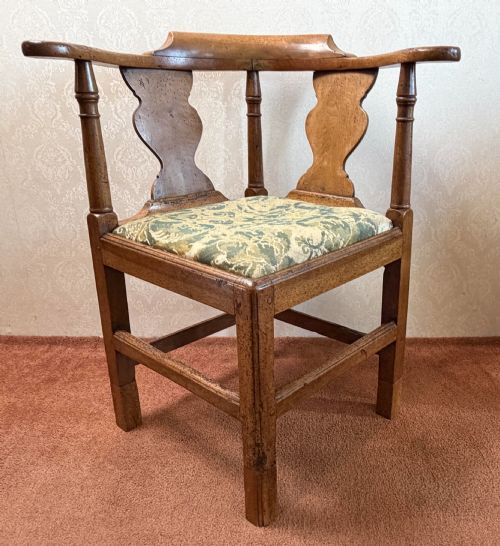


English Corner Armchair
An English corner armchair offers a snug seat designed to fit neatly into a room intersection, combining clever joinery with compact comfort.
English Corner Armchair
The English corner armchair presents a distinctive diagonal design, built specifically to tuck into room angles while providing a supportive backrest that wraps around the user. These seating pieces typically feature a square seat set lozenge-wise, supported by four legs with one positioned directly at the front.
Buyers browsing this selection will frequently encounter examples dating from the eighteenth century through to the Edwardian era, alongside revival pieces spanning Gothic, Saxon, and Georgian idioms. The forms range from vernacular oak elbow seats to finely turned spindle-backed library chairs and upholstered dressing seats.
Materials and construction
Cabinet makers relied heavily on robust timbers like English oak, mahogany, and beech to construct the complex intersecting rails and curved arm supports required for a corner chair. These woods were often left with a natural finish or turned on a lathe to create the traditional spindlework seen in Saxon and vernacular revival models.
Upholstery and rush seating appear frequently across the pieces, providing padded comfort or woven texture that complements the rigid timber frames. Joinery techniques involved sturdy pegging and mortise and tenon joints to ensure the diagonal stress placed on the single front leg was adequately managed.
English Corner Armchair Retail Price Guide 2026
Typical asking prices for english corner armchair among the pieces listed under this phrase on Sellingantiques today, from the lower quarter to the upper quarter. They describe what is for sale here now, not the wider market.
Several armchairs proudly bear the 'Old Saxon' label, proving that Victorian craftsmen loved a good historical fantasy just as much as we do.
Assessing quality and character
Quality in these armchairs rests upon the crispness of the turnings, the selection of figured timber such as mahogany or well-grained oak, and the integrity of the original frame construction. Pieces displaying intricate carved details or harmonious proportions distinguish themselves from simpler vernacular variants.
The survival of original surface patination and authentic rush or fabric elements elevates an example above those that have undergone extensive timber replacement or unsympathetic modern rebuilding over the centuries.
The English Corner Armchair Glossary
- Corner chair
- A seating form designed with a diagonal orientation to fit into room angles, featuring a semicircular back rail supported by turned columns. This layout maximises seating capacity in smaller spaces.
- Turner's armchair
- A heavy wooden chair constructed predominantly from turned spindles and posts, often associated with vernacular traditions and early revival styles. These pieces rely entirely on cylindrical woodworking rather than flat panels.
- Glastonbury chair
- A distinctive folding armchair design with X-framed supports and a sloping panel back, revived during the nineteenth-century Gothic movement. It draws inspiration from medieval ecclesiastical seating.
- Vernacular
- An architectural and furniture-making style rooted in local traditions and practical utility rather than high-court fashion. These objects utilise regional timbers and straightforward construction methods.
- George II
- A mid-eighteenth-century design period characterised by robust proportions, understated carved ornamentation, and the prominent use of mahogany. Furniture from this era emphasises structural strength alongside classical restraint.
English Corner Armchair: Frequently Asked Questions
What is a corner armchair used for?
These chairs were historically utilised in studies, bedchambers, and parlours where space was at a premium and standard seating proved too cumbersome for room intersections. They provided a comfortable, supportive place for writing, dressing, or social conversation.
Today, they serve a similar functional role in modern interiors, easily filling awkward dead corners while adding distinct period character to a hallway or living room.
How do I identify an 18th-century model?
Eighteenth-century examples are distinguished by honest timber shrinkage, peg construction methods, and patination that develops naturally over centuries of handling. The turning and joinery reflect the hand tools of the period rather than industrial manufacturing.
Later revival pieces from the Victorian and Edwardian eras often emulate these earlier forms but can be identified by wood selection, machine-sawn components, and differing wear patterns on the feet and armrests.
Are these chairs comfortable for daily use?
Many feature wide elbow rests and curved back rails designed to wrap around the torso, offering a surprisingly ergonomic seat. The inclusion of upholstered pads or woven rush adds to the physical comfort of the design.
While some early vernacular or stick-backed variants feel firm, they remain entirely practical for casual sitting when paired with a matching cushion.
What is a Turner's armchair?
A Turner's armchair is an archaic chair type constructed almost entirely from shaped and turned wooden members rather than flat planks or upholstery. They take their inspiration from early medieval and Saxon seating traditions.
Victorian makers revived this heavy, spindle-heavy aesthetic to satisfy a growing nineteenth-century appetite for historical domestic furnishings.