






English Etagere
An english antique etagere brings tiered display elegance to any room, offering open shelving designed to showcase prized objects with undeniable architectural grace.
English Etagere
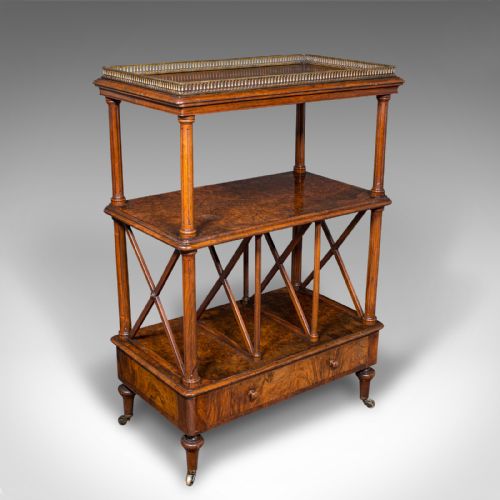
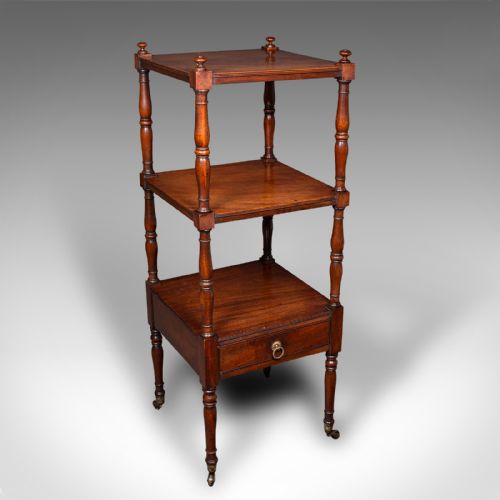
An english antique etagere is a multi-tiered display stand designed for holding books, ornaments, and precious items in period interiors. These pieces appear in forms such as open display stands, multi-tiered whatnots, console tables, and corner units.
Makers and cabinetmakers of the nineteenth century constructed these versatile items to serve multiple domestic functions, including serving food as dumb waiters or displaying collectibles in country houses.
How they were made
Cabinetmakers utilised dense and figured hardwoods, notably mahogany, rosewood, and burr walnut, often embellished with contrasting satinwood stringing or intricate brass details. These materials provided the structural integrity required to support multiple stacked platforms.
Construction techniques involved precision joinery for tiered shelves supported by delicate turned columns, bobbin turnings, or scroll-work iron frames. Iron and brass elements appear alongside mirror glass panels to enhance the reflective and structural quality of industrial and domestic pieces.
English Etagere Retail Price Guide 2026
Typical asking prices for english etagere among the pieces listed under this phrase on Sellingantiques today, from the lower quarter to the upper quarter. They describe what is for sale here now, not the wider market.
Listings feature mahogany, rosewood, walnut, and satinwood alongside brass and iron across Georgian, Regency, and Victorian periods.
What varies in quality
Quality in these tiered stands rests upon the selection of timber veneers and the crispness of turned supports rather than sheer size. Superior examples exhibit tightly grained mahogany or richly figured burr walnut with harmonious grain matching across each tier.
Refinement of detail distinguishes the finest pieces, from finely carved scroll-work to the precise execution of brass galleries and column mounts. Lesser examples rely on simpler construction without the sophisticated tapering forms or intricate inlay found at the top of the range.
The English Etagere Glossary
- Whatnot
- A multi-tiered piece of furniture designed for the display of ornaments and books, popular throughout the nineteenth century. This term is frequently used interchangeably with etagere.
- Dumb waiter
- A tiered serving stand fitted with revolving or stationary shelves used in dining rooms. These items allowed food and utensils to be kept close at hand during meals.
- Regency
- An English design period spanning the early nineteenth century defined by classical restraint and influence from archaeological discoveries. Pieces from this era often feature elegant tapering supports and rosewood veneers.
- Satinwood
- A lustrous, yellow-toned timber utilised by cabinetmakers for contrasting inlay, banding, and stringing on dark mahogany furniture. It adds a bright visual accent to tiered surfaces.
- Bobbin turning
- A form of lathe-work featuring spherical or spool-shaped swellings along the length of a furniture leg or support. This decorative technique appears on nineteenth-century shelving units.
English Etagere: Frequently Asked Questions
How were these stands used?
Historically, these tiered units served to hold books, ceramics, and personal collections in drawing rooms and parlours. Some variations, such as dumb waiters, functioned near dining tables to hold serving dishes.
Today, buyers utilise them in living spaces and hallways to display plants, sculptures, and modern collections while maintaining an open, airy aesthetic.
What woods were used?
English cabinetmakers relied heavily on dense hardwoods such as mahogany and rosewood throughout the Georgian and Victorian periods. Burr walnut also provided richly patterned surfaces for decorative effect.
Secondary materials often included brass for gallery rails and mounts, satinwood for contrasting stringing, and occasionally iron for industrial or bakery-style racks.
How do I date an etagere?
Dating relies upon observing the stylistic characteristics, timber choices, and construction methods associated with specific periods. Georgian and Regency pieces often display restrained classical lines and fine rosewood veneers.
Later Victorian examples introduce heavier proportions, bobbin turnings, or elaborate walnut and satinwood revival styles that reflect evolving nineteenth-century tastes.