



Empire Tripod Side Table
These are empire tripod side table pieces, structural small tables defined by classical form and rich mahogany, walnut or birch.
Empire Tripod Side Table
An empire tripod side table brings a distinct classical silhouette to a room, resting on three legs and a central column. You will frequently encounter French examples alongside later revival pieces, spanning the nineteenth century and into the early twentieth century.
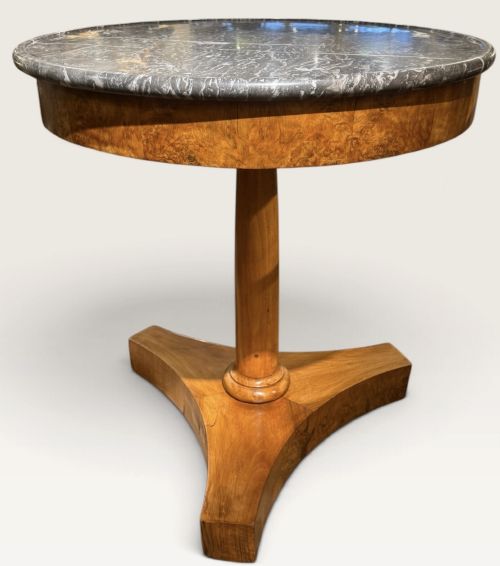
The form functions primarily as a guéridon or occasional table, suited for holding a lamp or displaying decorative objects. Makers often worked with mahogany, burr walnut or birch, frequently pairing the timber with contrasting marble tops and metallic mounts.
Geographic origins cluster around French workshops, though Swedish and English interpretations appear with regional decorative details. Neoclassical influences shape the design vocabulary, drawing upon ancient Greek and Roman motifs.
How they were made
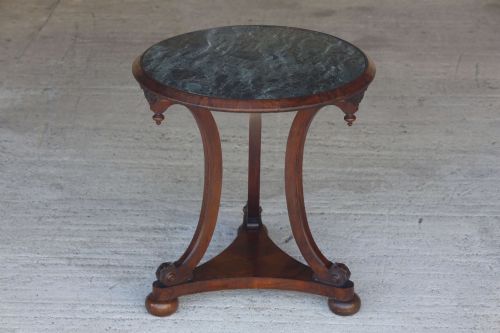
Cabinetmakers constructed these tables using solid and veneered timbers such as mahogany, birch and walnut over sturdy carcases. Tops often feature inset slabs of white or black marble, requiring precise joinery to support the heavy stone safely.
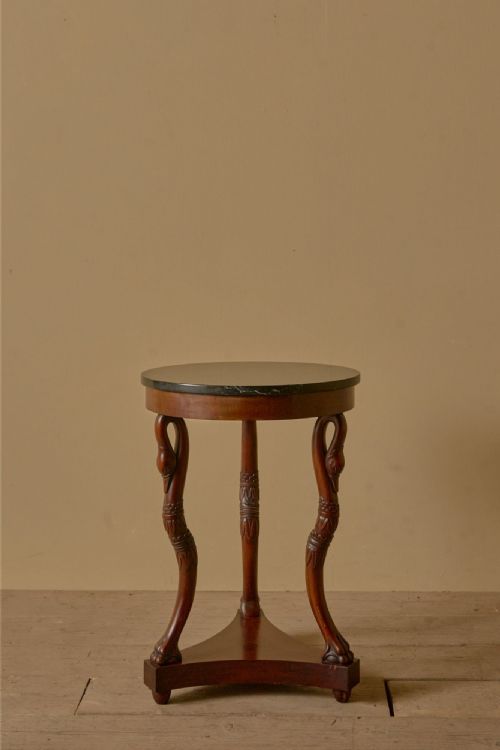
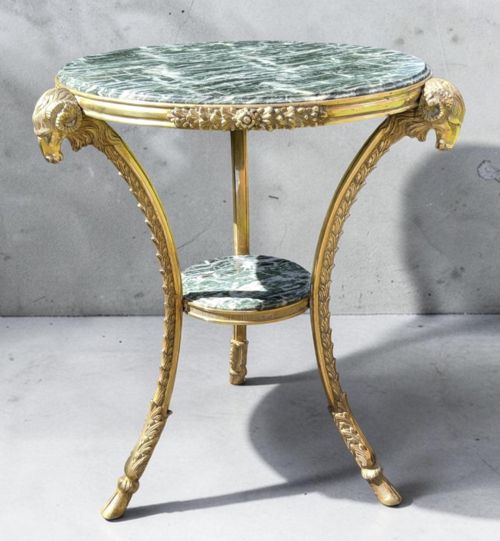
Decorative elements relied on cast brass or giltwood mounts, often taking the form of swans, rams heads or classical scrollwork. Skilled artisans also utilised inlay and parcel silvering to enrich the wooden surfaces of revival pieces.
Empire Tripod Side Table Retail Price Guide 2026
Typical asking prices for empire tripod side table among the pieces listed under this phrase on Sellingantiques today, from the lower quarter to the upper quarter. They describe what is for sale here now, not the wider market.
Listings feature periods from the early nineteenth-century Regency and Restauration eras through to 1920s revival pieces.
What varies in quality
The distinction between ordinary and exceptional tables lies in the crispness of the cast brass mounts and the selection of timber veneers. Master craftsmen achieved fluid lines in the carved details, particularly around the swan necks and pillar capitals.
Heft and stability reflect the underlying construction, where thicker marble tops and dense hardwoods provide a solid stance. Finer pieces demonstrate superior integration between the wooden tripod base and the metallic ornaments.
The Empire Tripod Side Table Glossary
- Gueridon
- A small circular table on a central pillar, originating in seventeenth-century France and evolving into the classic tripod form. These pieces served variously as candle stands or decorative display surfaces.
- Restauration
- A French design period bridging the fall of the Empire and the July Monarchy, noted for simpler mahogany surfaces and restrained classical lines. Pieces from this era often feature lighter wood grains.
- Giltwood
- Timber that has been coated with a thin layer of gold leaf or gold paint to simulate solid gold enrichment. This technique highlights carved details on mounts and table trim.
- Tilt top
- A mechanism allowing the tabletop to pivot into a vertical position for storage when not in use. This feature appears on English interpretations influenced by the style.
- Neoclassical
- An artistic movement drawing inspiration from the art and culture of classical antiquity. It provides the foundational design language for the ornamentation seen on these tables.
Empire Tripod Side Table: Frequently Asked Questions
What is an empire tripod side table?
An empire tripod side table is a small, circular freestanding table supported by a central column and three feet, drawing on classical design vocabulary.
These pieces typically function as accent furniture in a reception room or hallway, providing a stable surface for lighting or display.
How do I date an empire tripod side table?
Dating relies on examining the timber species, construction methods, and the style of the cast brass mounts. Earlier nineteenth-century examples often feature dense mahogany and hand-chased bronze details.
Revival pieces from later decades may employ birch or walnut, reflecting the aesthetic preferences of their specific production era.
Where should I place this table in a room?
These tables suit placement beside a sofa or chair, or standing alone as a centre table in a smaller space. Their circular footprint allows for easy movement around them.
Consider protecting wooden or marble surfaces from moisture if you intend to use the table for drinks or plants.
Are these tables French or English?
The listings show a strong French presence, particularly French Empire and Restauration guéridons with marble tops and mahogany carcases. Swedish and English makers also produced similar forms under neoclassical and Regency influences.
Regional differences appear mainly in the choice of secondary timbers and the specific motifs used in the mounts.