

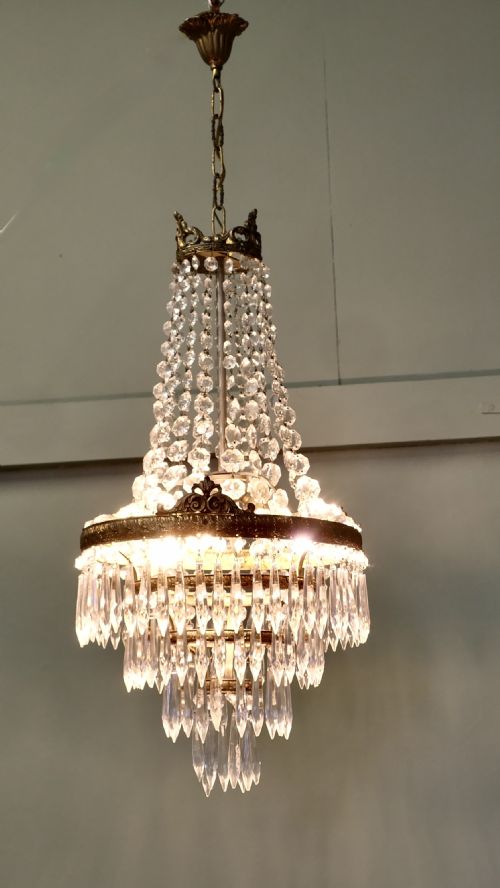
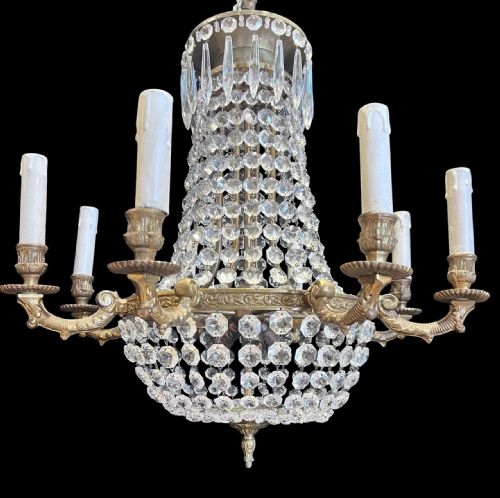
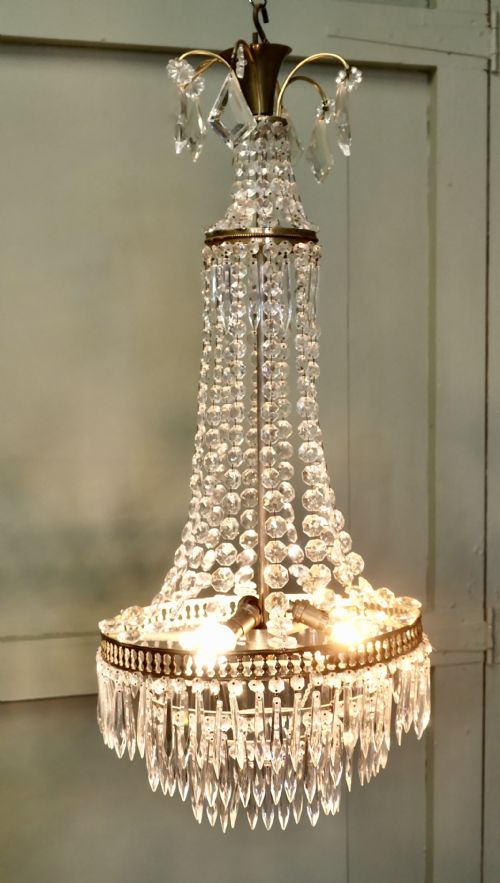


Empire Ceiling Lamp
These empire ceiling lamp examples bring formal French Neoclassical symmetry and tiered crystal to a room.
Empire Ceiling Lamp
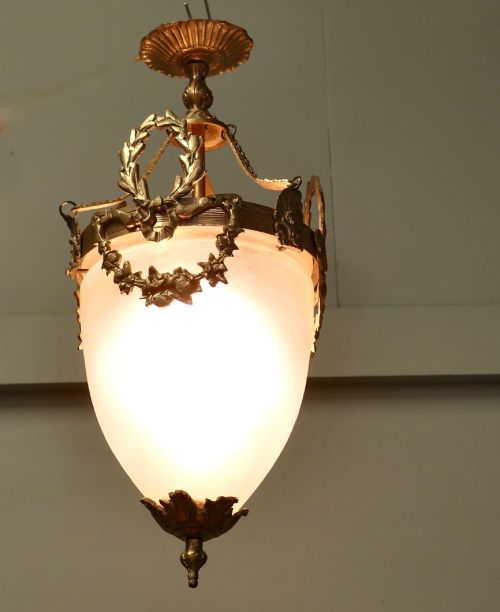
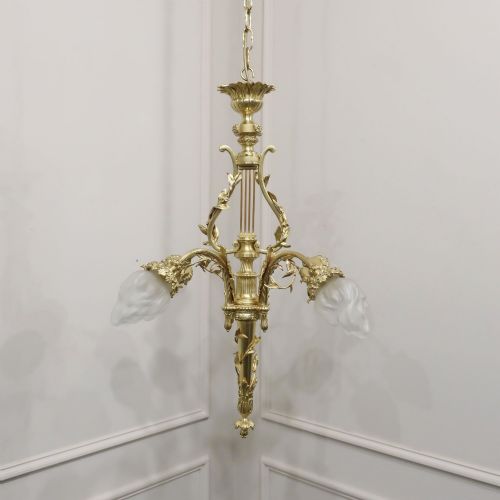
An empire ceiling lamp takes the classical vocabulary of 18th and 19th-century France and scales it for domestic suspension, appearing here as tent-and-waterfall chandeliers, basket fixtures, and single-light pendants. The pieces range from the 18th century through the Edwardian era and the 1920s, drawing on French Empire, Regency, and Neoclassical styles.
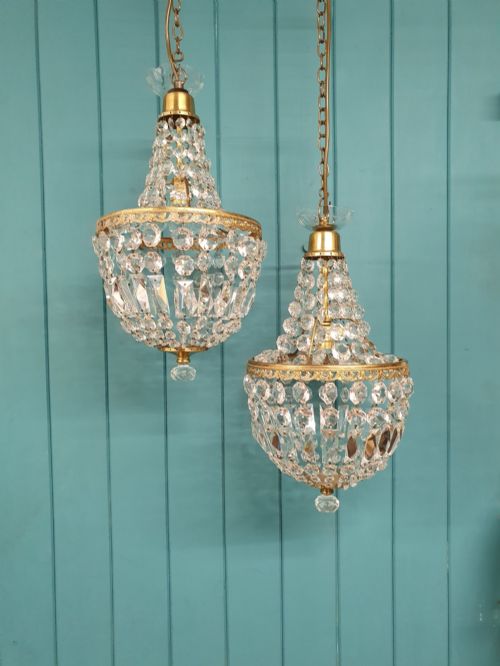
Most examples on this page cluster around the early 20th century, offering Empire Revival brass, copper, and gilt bronze frames dressed with cut glass and crystal beads. Formats vary from diminutive ten-inch bead chandeliers with blue prisms to substantial sixteen-light fixtures designed for high ceilings.
How they were made
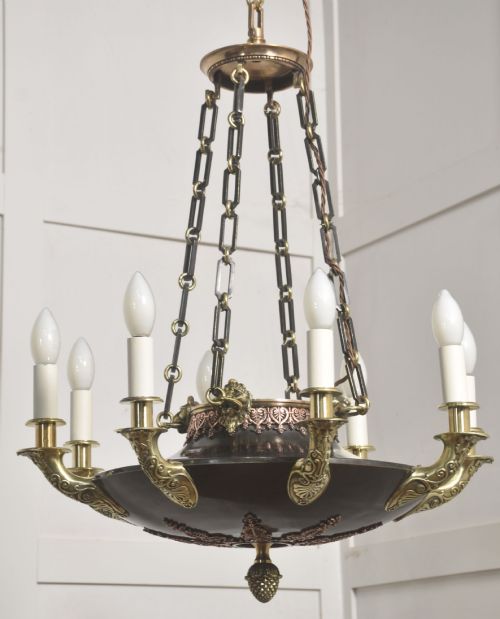
Foundry work provides the structural bones, utilising cast brass, gilt bronze, and patinated metal to form lyres, rams' heads, and bands. These metallic frames are built to support the downward pull of heavy glass components.
Glaziers and lapidaries supplied the hanging elements, cutting crystal and press-moulding glass into waterfalls, tents, drops, and beads. Individual strands are wired or pinned to the metal tiers, creating layered refractive surfaces.
Empire Ceiling Lamp Retail Price Guide 2026
Typical asking prices for empire ceiling lamp among the pieces listed under this phrase on Sellingantiques today, from the lower quarter to the upper quarter. They describe what is for sale here now, not the wider market.
Current listings span from the 18th century to 1930, uniting Edwardian bead work with heavy French gilt bronze and cut crystal.
What varies in quality
The precision of the metalwork defines the upper tier, where chased gilt bronze and crisply cast brass components display sharp definition in motifs such as rams' heads and classical swags. Simpler Empire Revival pieces utilise plainer sheet brass and standard casting methods.
Glass selection sets the grade of the fixture's sparkle, distinguishing heavy hand-cut crystal prisms with deep facets from lighter, machine-pressed glass drops. The density and clarity of the crystal directly influence how light scatters across the room.
The Empire Ceiling Lamp Glossary
- Tent and waterfall
- A lighting configuration where an upper conical section of strung beads drops down into a cascading tier of looser crystal prisms. This arrangement defines many French Empire chandeliers.
- Gilt bronze
- Metal alloy covered with a thin layer of gold, providing a rich, matte metallic surface that resists tarnish. It is frequently called ormolu in finer antique pieces.
- Colza hanging lamp
- A type of suspension light engineered to burn colza oil before conversion to electricity. They appear in period settings with patinated metal reservoirs.
- Prism
- A cut glass pendant designed to refract light into spectral colours. These hang from the frame in various geometric shapes.
- Lyre
- A symmetrical musical instrument motif incorporated into the brass or bronze frame of Neoclassical light fittings. It sits centrally above the main burner or bulb cluster.
Empire Ceiling Lamp: Frequently Asked Questions
Are these lamps wired for modern UK electrics?
Many surviving light fittings retain older wiring or require rewiring to meet current safety standards. A qualified electrician can adapt the internal channels for standard modern lamp holders.
Rewiring also allows for the safe integration of low-wattage LED candle bulbs that mimic historic candle light.
How do I clean crystal prisms safely?
Prisms and glass drops are best cleaned in situ using a specialist spray and a soft cloth beneath to catch drips. For thorough cleaning, individual glass elements can be unhooked and washed in lukewarm soapy water.
Avoid harsh chemical cleaners that can strip gilt surfaces or degrade historic metal lacquer.
What rooms suit an empire ceiling lamp?
The formal symmetry of Neoclassical and Empire lighting suits high-ceilinged drawing rooms, dining spaces, and grand hallways. Their vertical drop commands attention in rooms with generous proportions.
Smaller basket or single-light variants can introduce classical proportion to more compact bedrooms and studies.