

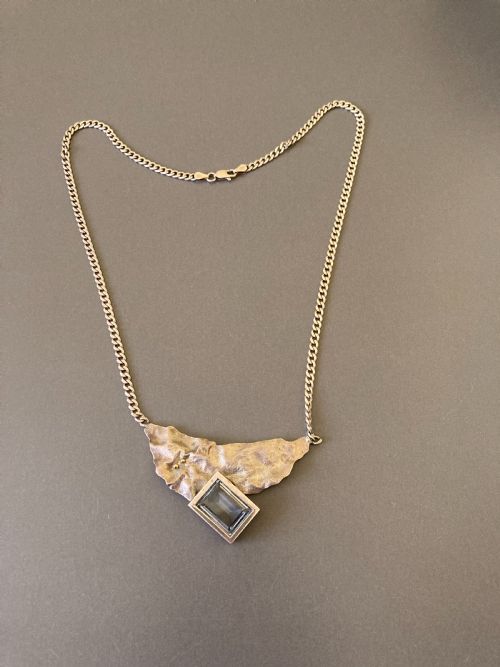


Emerald Cut Pendant
An emerald cut pendant brings together geometric stone cutting and precious metalwork across periods from the Georgian era to the mid-twentieth century.
Emerald Cut Pendant
Art Deco examples dominate the aesthetic range, combining platinum or white gold with sharp geometric lines and stepped stone arrangements. Mid-century pieces introduce bolder carat weights in yellow and white gold settings, while earlier Georgian and Victorian interpretations employ closed-back foils or intricate hand-forged mounts. The selection moves fluidly from minimalist single-stone drops to complex multi-gem clusters that function as both necklaces and convertible brooches.
Materials and construction methods
The metalwork relies on platinum, silver, and gold variants ranging from nine to twenty-two carats, selected to support the weight of substantial central stones. Platinum and white gold gain prominence in twentieth-century pieces for their strength in holding delicate diamond pavé and channel-set borders around large aquamarines and emeralds. Earlier yellow gold and silver mounts utilise hand-beaten techniques and custom prong configurations tailored to the irregular depths of antique gems.
Gemstones are shaped with characteristic stepped facets that emphasise clarity and depth over sheer brilliance, often paired with brilliant-cut or old European-cut diamonds as secondary stones. Master lapidaries cut the primary beryl, quartz, or tourmaline crystals into rectangular steps that demand high material purity. Setting techniques shift from early bezel and collet work to twentieth-century platinum claw mounts and pierced gallery frames.
A charming Victorian bird perched on a branch holds court among the geometric stones.
Separating grades of execution
Quality rests upon the optical clarity and saturation of the central stone, particularly in significant aquamarines and emeralds where inclusions dictate value and visual depth. Superior examples demonstrate expert symmetry in the step-cut facets and minimal internal obstruction, whereas lower grades settle for cloudy material or uneven facet junctions. The integration of secondary diamonds also separates tiers, with top-tier work utilising uniform old European or round cuts rather than mismatched filler stones.
The discipline of the metalwork governs the structural integrity of the piece, distinguishing finely pierced galleries from heavy, unrefined castings. Premium twentieth-century platinum mounts maintain razor-sharp geometric edges and secure stone settings without excess solder or clumsy claw work. Balance and suspension matter profoundly; a well-executed pendant hangs plumb from its bail, aligning the focal stone correctly against the wearer.
C'est Laudier
The Emerald Cut Pendant Glossary
- Emerald cut
- A rectangular or square stone shape characterised by stepped facets and cropped corners designed to highlight stone clarity. This geometry defines the visual language of twentieth-century modernist and Art Deco jewellery.
- Step cut
- A gemstone facet arrangement featuring long, parallel planes that resemble stairs, typical of emeralds and large aquamarines. This style prioritises light reflection off broad surfaces over scattered sparkle.
- Columbian emerald
- A naturally occurring beryl originating from specific South American mines renowned for rich chromatic depth. These stones often command attention for their distinct internal characteristics and intense green hue.
- Old European cut
- A round diamond cutting style prevalent before the twentieth century, featuring a small table, high crown, and large culet. These stones impart a soft, candlelit glow distinct from modern brilliant cuts.
- Convertible brooch
- An item engineered with a detachable pin mechanism to function as either a pendant on a chain or a lapel ornament. This versatility appears frequently across antique and mid-century designs.
Emerald Cut Pendant: Frequently Asked Questions
What defines an emerald cut pendant?
An emerald cut pendant centres on a rectangular or square gemstone with stepped facets and diagonal corner truncations. The design directs the eye into the depth of the stone rather than dispersing surface brilliance.
Such pieces range from antique Georgian and Victorian iterations to streamlined Art Deco platinum mounts and substantial mid-century gold creations.
How do I date an emerald cut pendant?
Dating relies on combining material evidence with stylistic markers, such as platinum use and geometric symmetry in Art Deco pieces versus foil-backed stones in Georgian work. Hallmarks stamped into the metal provide official assay office stamps and maker marks when legible.
Secondary stones like old European-cut diamonds or rose-cut diamonds also offer firm chronological indicators alongside the primary gem species.
Are these pendants supplied with chains?
Listings vary between pieces sold as standalone pendants, complete necklace configurations, and convertible brooch-pendant combinations. A bail or loop at the top accommodates various chain thicknesses.
Original period chains seldom survive intact, meaning many items are paired with complementary contemporary or period-appropriate neckchains.
How should I care for antique emerald cut jewellery?
Care depends entirely on the specific gemstone species and metal composition, noting that soft stones like emeralds and aquamarines require gentle treatment. Ultrasonic cleaners risk damaging treated emeralds or shaking loose stones from aged claw settings.
Professional inspection of the prongs and gallery work ensures the security of substantial centre stones over decades of regular wear.