
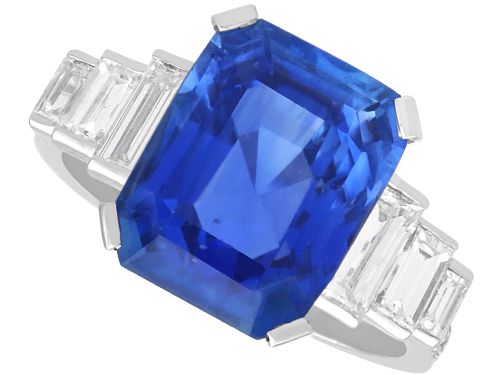
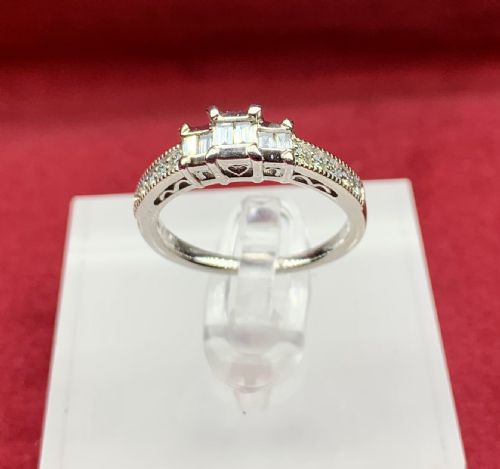


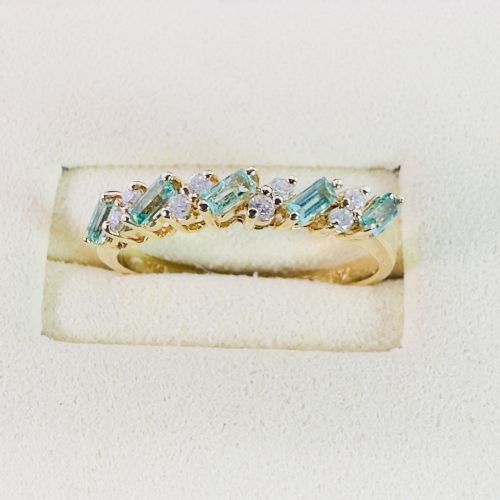


Emerald Baguette Ring
An emerald baguette ring brings sharp geometric lines and rich green colour together, anchored primarily in Art Deco and Mid-Century designs.
Emerald Baguette Ring
When you search for an emerald baguette ring, you encounter jewels defined by step-cut stones arranged in architectural patterns. The forms span Art Deco, Mid-Century, Retro, and later twentieth-century periods.
The version most commonly met on this page pairs a central emerald with baguette-cut diamonds in platinum or white gold settings. These pieces often take the form of cluster, trilogy, or cocktail rings originating from the 1930s through to the 1960s.
How they were made
The makers of these rings relied heavily on platinum and white gold, alongside yellow gold, to mount the stones securely. Metalwork often involved crisp channel or prong settings designed to hold rectangular and step-cut gems.
Diamonds and emeralds are cut specifically into baguettes or emerald cuts to create linear facets. Additional support comes from brilliant or var-cut diamonds framing the central emerald.
Listings span the 1930s, 1940s, 1950s, 1960s, and later twentieth century, utilising platinum, white gold, and yellow gold.
What varies in quality
Quality rests upon the saturation and clarity of the emerald, with Colombian stones and those accompanied by certification holding particular distinction. The treatment level of the emerald, ranging from minor oil to no oil, significantly influences desirability.
The precision of the metalwork and the matching of the accompanying baguette-cut diamonds set the finer pieces apart. Weight distribution and the architectural balance of the platinum or gold mounting dictate the overall presence of the ring.
The Emerald Baguette Ring Glossary
- Baguette
- A small, rectangular cut of gemstone with stepped facets and sharp corners. It is frequently utilised as a side stone in ring design.
- Art Deco
- A design style prominent in the 1920s and 1930s characterised by symmetry, geometric lines, and modernist influences. Platinum was a favoured metal during this period.
- Trilogy ring
- A ring featuring three main stones set in a row, often interpreted as representing the past, present, and future. These frequently combine emeralds and diamonds.
- Ballerina ring
- A cluster ring style featuring a central stone surrounded by a flared halo of tapered baguette-cut diamonds that resembles a tutu. It creates a pronounced radial silhouette.
Emerald Baguette Ring: Frequently Asked Questions
How do I care for an emerald ring?
Emeralds are softer than diamonds and require gentle cleaning using warm water and a soft cloth rather than harsh ultrasonic cleaners.
Storing the ring separately prevents scratching from harder gemstones like diamonds set alongside it.
How can I tell an Art Deco ring from a Mid-Century one?
Art Deco rings from the 1930s typically feature intricate platinum geometric filigree work and stark symmetrical contrasts.
Mid-Century examples from the 1950s and 1960s often introduce bolder cluster forms, such as ballerina settings, and warmer yellow gold tones alongside white metals.
What does a trilogy ring mean?
A trilogy ring incorporates three primary stones mounted side by side in a single setting.
In these listings, the configuration often pairs a central emerald flanked by baguette-cut diamonds.