

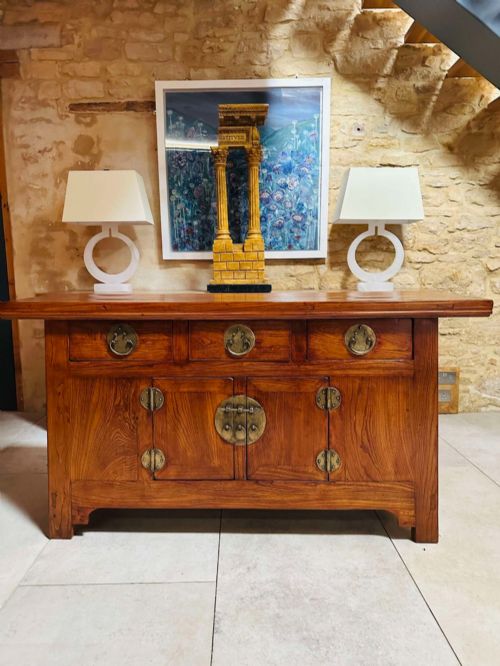
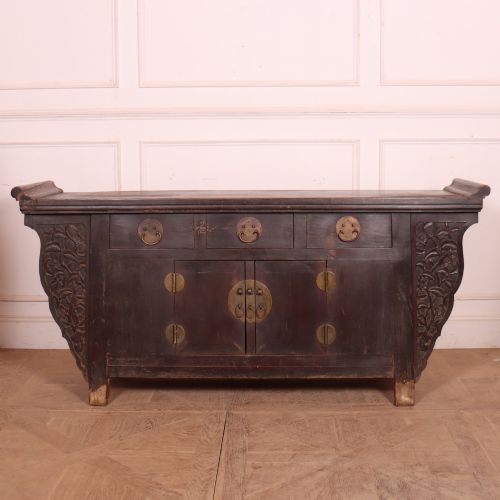


Elm Wood Credenza
Elm wood credenza options combine rich timber grains with practical storage, offering a characterful focal point for modern interiors.
Elm Wood Credenza
The selection ranges from Georgian and French provincial dresser bases to Chinese provincial sideboards and Art Deco low bookcases. Many examples incorporate burr elm veneers or marquetry details to accentuate the natural figuring of the timber.
Originating largely from the eighteenth, nineteenth, and early twentieth centuries, these forms serve as substantial storage units while displaying distinct regional cabinetmaking styles. Pieces vary from rustic Chinese console tables to sophisticated George III commodes.
Materials and construction methods
Makers utilised solid elm and burr elm alongside supportive secondary timbers such as oak for internal structures. Selected sections feature decorative wood inlay and marquetry to create contrast across doors and drawer fronts.
Hardware frequently includes brass pulls and hinges, complementing the warm tones of the wood. European examples often employ cabinetry techniques like dovetailing, whereas Asian pieces utilise traditional frame and panel construction.
Elm Wood Credenza Retail Price Guide 2026
Typical asking prices for elm wood credenza among the pieces listed under this phrase on Sellingantiques today, from the lower quarter to the upper quarter. They describe what is for sale here now, not the wider market.
Early cabinetmakers prized unruly tree growths, transforming bizarre wood burls into mesmerizing swirls of burr elm furniture.
Assessing quality and craftsmanship
The visual impact depends largely on the choice of timber, with highly figured burr elm veneers commanding greater aesthetic interest than plain stock. The crispness of carved details on Chinese cupboards or the precision of marquetry on Georgian pieces distinguishes finer workshops.
Structural integrity relies on sound joinery and the survival of original hardware such as brass handles and hinges. Surface patination accumulated over centuries adds depth to the finish, separating untouched surfaces from heavily restored examples.
The Elm Wood Credenza Glossary
- Elm
- A durable hardwood known for its interlocking grain and resistance to splitting, making it suitable for large furniture bases. It often exhibits a warm, honey-brown colour with distinctive figuring.
- Burr elm
- A growth deformity in the tree that produces highly decorative, swirling grain patterns. Cabinetmakers slice this wood into thin veneers for decorative surfaces.
- Dresser base
- A low wooden sideboard fitted with drawers and cupboards, traditionally used for serving food and storing tableware. These pieces often feature sturdy elm or oak construction.
- Marquetry
- The art of applying pieces of veneer to a structure to form decorative patterns and pictures. Craftsmen use contrasting woods to create intricate geometric or floral designs.
- Commode
- A decorative low cabinet or chest of drawers introduced from France during the eighteenth century. These pieces usually stand on elegant legs and feature fine timber veneers.
Elm Wood Credenza: Frequently Asked Questions
How do I clean an antique elm surface?
Dust regularly with a soft, dry cloth to prevent dirt accumulation. Avoid modern silicone sprays or harsh chemical cleaners that can damage the aged timber.
Apply a traditional beeswax polish occasionally to nourish the wood and maintain its natural lustre. Buff gently after application to preserve the historic patina.
Where should I place a credenza in my home?
Position your credenza against a sturdy wall in a dining room, hallway, or living space where its storage capacity is useful. Ensure the room has stable humidity levels to protect the antique wood from cracking.
Keep the piece away from direct sunlight and heat sources such as radiators. Extreme temperature shifts can cause timber to warp and veneers to lift.
Can I use these cabinets for modern media storage?
Many sideboard and cabinet formats provide ample interior space for modern media equipment. Measure the internal dimensions carefully before placing electronics inside enclosed cupboards.
Consider whether ventilation is necessary for electronic devices stored behind closed doors. You may need to adapt internal shelving or arrange cords discreetly.
How do I distinguish Chinese provincial pieces from European ones?
Chinese provincial pieces often feature distinctive frame and panel construction, carved wooden hardware, and traditional Shanxi joinery techniques. The timber finishes lean toward warm red-brown tones and simpler, functional lines. N European furniture from the Georgian or French periods typically incorporates applied mouldings, brass drawer pulls, and European cabinet locks. The design vocabulary reflects neoclassical or provincial European aesthetics rather than Asian traditions.