
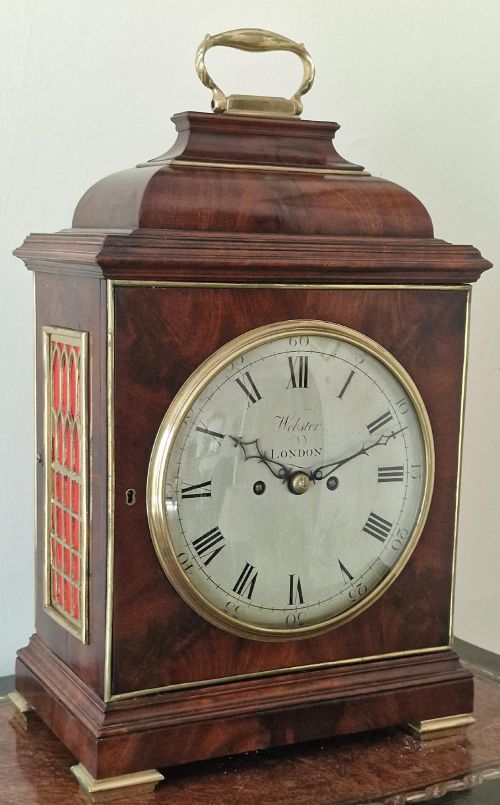


Eight Day Spring Clock
An eight day spring clock is a portable timekeeper driven by a mainspring and built to run for over a week, combining precision engineering with cabinet-maker joinery.
Eight Day Spring Clock
An eight day spring clock offers dependable timekeeping without requiring daily winding, operating on a tensioned spring rather than falling weights. These portable timepieces sit on tables, brackets or mantelpieces rather than standing on the floor.
The selections available here span several centuries and distinct aesthetic movements. Pieces range from early eighteenth-century examples to later Victorian interpretations.
Cabinet forms vary significantly across the inventory. Common manifestations include bell-top designs, mahogany table clocks and architectural bracket clocks with matching wall supports.
How they were made
Clockmakers housed these movements in sturdy wooden cases constructed from mahogany, rosewood, oak and ebonised wood. Brass components formed the dial plates, bezels and internal wheel trains, while steel provided the resilient springs and escapement parts.
Movements relied upon complex mechanisms such as verge escapements, twin fusee systems and chain automation. Dials frequently featured silvered metal inscribed with Roman numerals and maker signatures.
What varies in quality
The refinement of the internal movement dictates the overall standard of the piece. Master clockmakers utilised sophisticated double fusee mechanisms to equalise the force of the mainspring as it unwound.
Cabinetwork quality separates standard production from exceptional craftsmanship. The choice of timber grain, the precision of the bell-top shaping and the retention of original components determine the standing of each clock.
Richard Rooker·Thomas Moss·Somersall London·John McGregor·Winterhalder And Hofmeier
The Eight Day Spring Clock Glossary
- Fusee
- A conical pulley used in spring clocks to maintain equal power as the mainspring unwinds. This clever device ensures the clock keeps accurate time throughout its eight-day run.
- Verge escapement
- An early type of escapement mechanism that controls the release of the wheel train. It typically works alongside a short pendulum or balance spring.
- Bell-top
- A distinct architectural shape for a clock case where the wooden top curves inward towards a central handle, resembling a bell in profile. This form is particularly common on eighteenth-century mahogany examples.
- Twin chain
- A dual-train arrangement utilising fine metal chains rather than gut cords to connect the fusee to the mainspring barrel. This provided greater durability and reliability in high-end movements.
Eight Day Spring Clock: Frequently Asked Questions
How often should an eight day spring clock be wound?
These clocks are designed to run for approximately eight days on a single wind. Winding them once a week maintains consistent tension on the mainspring.
Regular winding at roughly the same time each week helps preserve the mechanical rhythm of the movement.
Where should a bracket clock be placed?
Bracket clocks need a stable, level surface to ensure the escapement beats evenly. Historically they sat on dedicated wall brackets or sturdy tables.
Avoid placing them in areas subject to heavy vibrations or wide temperature fluctuations, which can affect the wood and metal components.
What is the difference between a table clock and a bracket clock?
In historical terms, the two descriptors often overlap. Many bracket clocks were designed to sit directly on a table or mantelpiece without their matching wall bracket.
The inclusion of a carrying handle on top of the case indicates portability, allowing the clock to be moved between rooms.
How can I identify an eighteenth-century clock?
Eighteenth-century pieces typically display specific construction traits like brass dial plates, engraved maker details, and dense timbers such as mahogany or ebonised wood.
Stylistic cues like bell-top cases and verge escapements further point toward this earlier Georgian period of clockmaking.