







Edwardian Spirit Tantalus
An Edwardian spirit tantalus secures your best whiskey and gin behind a clever locking bar so the household staff cannot help themselves to a quiet sip.
Edwardian Spirit Tantalus
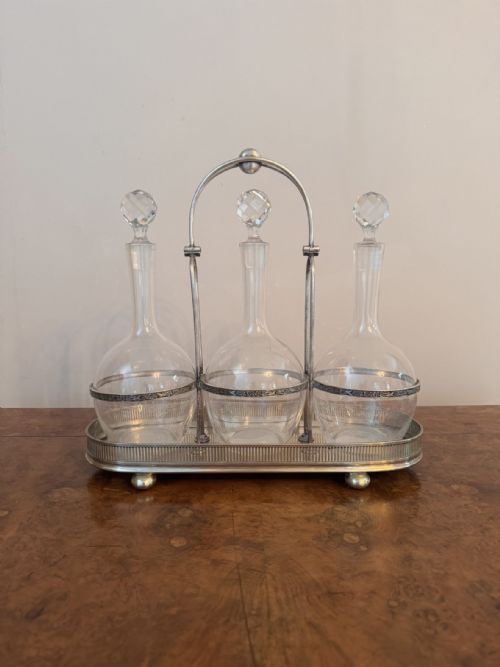
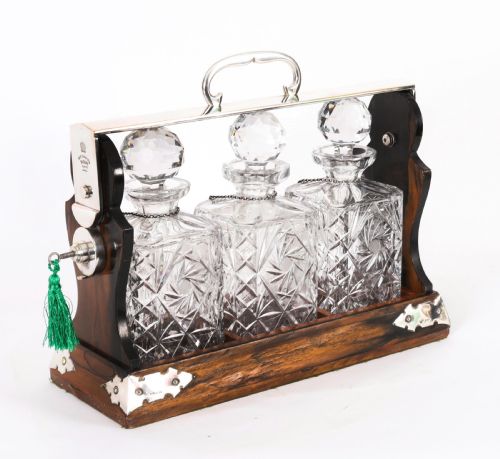
The edwardian spirit tantalus brings together heavy timber frames, locking mechanisms and matching cut crystal decanters to display and protect potable spirits in a dining room or study. You will frequently find oak stands holding three square decanters, fitted with brass or silver plated mounts designed to lift when the lock opens.
While many examples date from the Edwardian era itself, the listings also include late Victorian precursors and later variations running through the 1920s and 1930s. Alongside traditional three bottle frames, you encounter combined games compendiums housing cards and counters beneath the bottle stand.
The form exists to frustrate the thirsty while showing off brilliant glass and polished wood to dinner guests. Most versions on this page rely on sturdy oak or walnut foundations fitted with secure metal locking bars.
Materials and construction
Carpenters built these frames using solid oak, walnut, coromandel, and satinwood, often embellishing the timber with marquetry stringing, brass mounts, and mirrored back panels. The locking system requires precise metalwork in brass or silver plate, engaging with the stoppers so the decanters cannot be pulled free until the key turns.
Edwardian Spirit Tantalus Retail Price Guide 2026
Typical asking prices for edwardian spirit tantalus among the pieces listed under this phrase on Sellingantiques today, from the lower quarter to the upper quarter. They describe what is for sale here now, not the wider market.
Hosts kept the key firmly in a waistcoat pocket, ensuring guests admired the whiskey without sampling a drop unsupervised.
Distinctions in quality
Quality rests upon the weight of the timber, the complexity of the internal mechanism, and whether the set includes integrated games drawers or original matched crystal. Simpler two bottle stands in plain oak sit at one end, while coromandel or marquetry inlaid compendiums with working locks and original keys represent the height of the maker's art.
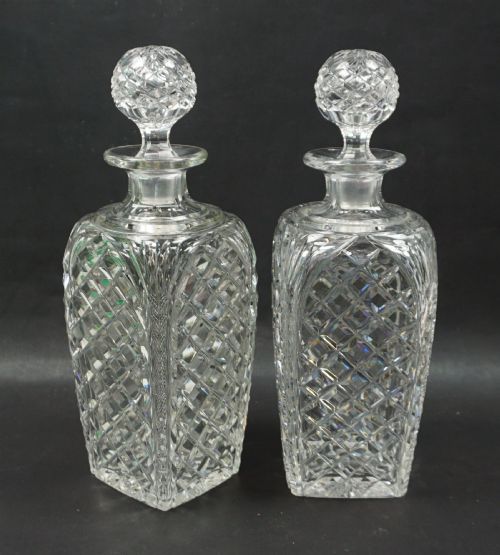
The glass quality distinguishes everyday items from superior pieces, marked by deep hand cut crystal facets and matching stoppers rather than plain moulded glass. Robust silver plating and smoothly operating spring loaded locking bars indicate careful workshop production.
Betjemann and Sons·Hukin and Heath
The Edwardian Spirit Tantalus Glossary
- Tantalus
- A locking drink cabinet named after the mythological figure Tantalus, who was kept just out of reach of food and water. The wooden bar locks over the decanter stoppers so the bottles remain visible yet impossible to remove without the key.
- Compendium
- A multi-purpose box housing games equipment alongside a spirit service. These luxury items often combine card decks, cribbage boards and dice with a standard three bottle tantalus.
- Marquetry
- Decorative woodwork formed by fitted veneers creating patterns on the cabinet surface. Craftsmen used contrasting timbers like satinwood on an oak or walnut base.
- Silver plate
- A layer of silver fused to a base metal foundation used for handles, lock plates and mounts. It provided the brilliance of solid silver at a lower cost for domestic dining furniture.
- Square section
- A bottle shape with straight vertical sides forming a square base, designed to pack tightly into a fitted wooden frame without shifting during transport.
Edwardian Spirit Tantalus: Frequently Asked Questions
How do you open a tantalus without a key?
Most antique locking bars require the original key to release the spring mechanism, though a skilled locksmith can sometimes pick or replace the small lever lock.
Failing that, turning the frame upside down occasionally reveals clearance if the timber has warped over the decades, but forcing the mechanism damages the antique brasswork.
Are all the decanters original to the stand?
Finding a set with all original matching cut crystal decanters and matching stoppers is uncommon because individual bottles frequently broke during daily use.
Inspect the cut patterns and glass tint closely to determine if a replacement bottle was added later in the life of the piece.
What is the difference between a tantalus and a decanter box?
A decanter box fully encloses the bottles inside a hinged wooden case with doors or a lifting lid, lacking the exterior locking bar found on an open tantalus.
Both serve the same purpose of securing household spirits, but the open tantalus displays the cut crystal while keeping the contents physically restrained.
How should I clean the wood and metal?
Dust the timber with a dry cloth and apply a traditional beeswax to nourish dry oak or walnut surfaces without stripping the original polish.
Clean silver plated mounts gently with a non abrasive cloth to avoid rubbing through the thin metal layer down to the brass or copper base.