

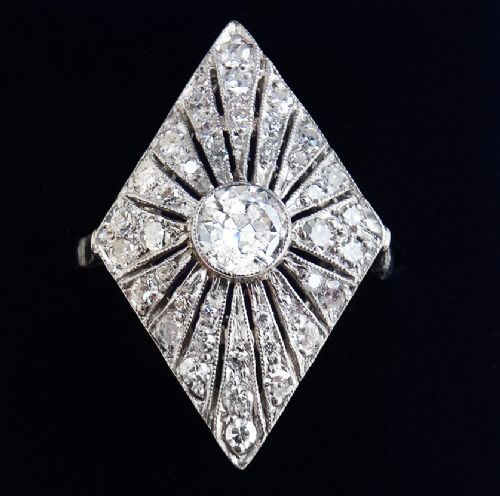


Edwardian Pave Ring
An edwardian pave ring brings together close-set diamonds and fine metals to create a flat, glittering surface of exceptional brilliance.
Edwardian Pave Ring
An edwardian pave ring is defined by stones set closely together so the metal surface almost disappears beneath a field of diamonds. You will most frequently encounter Edwardian and Art Deco examples on this page, alongside occasional Victorian and mid-century pieces.
The forms span cluster rings, target settings, and marquise shapes, often combining diamonds with sapphires, chalcedony, or blue topaz. Platinum and 18ct yellow or white gold provide the structural foundation for these intricate geometric and floral designs.
Materials and technique
The metalwork relies on platinum fused to 18ct gold, a combination that provided the necessary strength for delicate claw and pave settings while maintaining a bright white surface for the stones. Jewellers utilised old cut, rose cut, and old mine diamonds, shaping them to fit tightly across the flat or domed tablet of the ring.
Stones are held by tiny, hand-formed beads of metal raised from the surface itself, securing each diamond in a continuous mosaic. Coloured gemstones such as sapphires, chalcedony, and blue topaz are integrated into the pave layout to contrast with the surrounding white diamonds.
Edwardian Pave Ring Retail Price Guide 2026
Typical asking prices for edwardian pave ring among the pieces listed under this phrase on Sellingantiques today, from the lower quarter to the upper quarter. They describe what is for sale here now, not the wider market.
Among the geometric layouts and diamond clusters, a clover-shaped sapphire ring waits to bring a touch of botanical luck to the finger.
Factors of quality
Quality rests on the precision of the stone setting and the uniformity of the pave surface. The finest pieces display stones matched closely for size, colour, and cut, with minimal visible metal between them.
Structural integrity also separates examples, as the tiny metal beads holding the stones must remain secure and even. Finer rings maintain crisp, sharp edges in their platinum work, whereas lesser pieces show softer contours and uneven stone heights.
The Edwardian Pave Ring Glossary
- Pave
- A setting style where stones are placed closely together and held by small beads of metal, creating a paved surface of gems. This technique maximises surface sparkle by concealing most of the underlying band.
- Old cut diamond
- A hand-faceted diamond shape popular before modern brilliant cutting standards were established in the twentieth century. These stones typically feature smaller tables and larger culets, producing a softer, candlelit glow.
- Target set
- A concentric arrangement of gemstones, usually featuring a central stone surrounded by one or more rings of contrasting colours. This layout was favoured during the Edwardian and Art Deco periods for its bold geometric impact.
- Marquise ring
- A boat-shaped ring design featuring pointed ends and an elongated centre that flatters the hand. The silhouette accommodates cluster and pave arrangements across a slender profile.
- Rose cut diamond
- A historic diamond cut with a flat base and a domed crown of triangular facets arranged in a star pattern. These stones offer a transparent, subtle lustre rather than intense modern brilliance.
Edwardian Pave Ring: Frequently Asked Questions
How do I care for an edwardian pave ring?
Clean these delicate pieces gently with warm soapy water and a soft brush, avoiding harsh ultrasonic cleaners that can loosen tiny settings. Regular checks by a jeweller ensure the small metal beads holding the stones remain secure.
Store the ring in a separate compartment or soft pouch to prevent the platinum and diamonds from scratching other jewellery in your collection.
Can an edwardian pave ring be resized?
Resizing depends on the band material and the extent of the pave work around the hoop. Many platinum and 18ct gold rings can be adjusted by a skilled bench jeweller who understands antique construction.
Take the piece to a specialist workshop rather than a standard high street shop, as the intricate shoulders and stone settings require careful handling to avoid distortion.
What is the difference between Edwardian and Art Deco styles?
Edwardian designs tend to feature lace-like platinum work, floral motifs, and softer garland aesthetics. The emphasis is on delicate craftsmanship and flowing curves.
Art Deco pieces shift towards rigid geometry, sharp angles, and strong colour contrasts using sapphires or chalcedony alongside diamonds. Both styles frequently utilise the same pave technique but express distinct artistic movements.
Are these rings suitable for daily wear?
While platinum and gold provide a durable foundation, antique pave settings require mindfulness during active tasks. Removing the ring during heavy lifting or gardening protects the tiny metal beads securing the stones.
With sensible care and periodic inspection of the settings, many people wear these antique pieces as everyday engagement or dress rings.