



Edwardian Inlaid Library Furniture
Edwardian inlaid library furniture brings sophisticated woodwork and marquetry into domestic studies, offering practical book storage and writing surfaces.
Edwardian Inlaid Library Furniture
Edwardian inlaid library furniture encompasses functional wooden pieces designed for reading rooms, studies and drawing rooms. When searching for Edwardian inlaid library furniture, a buyer encounters practical items such as revolving bookcases, reading tables, writing desks and open bookshelves.
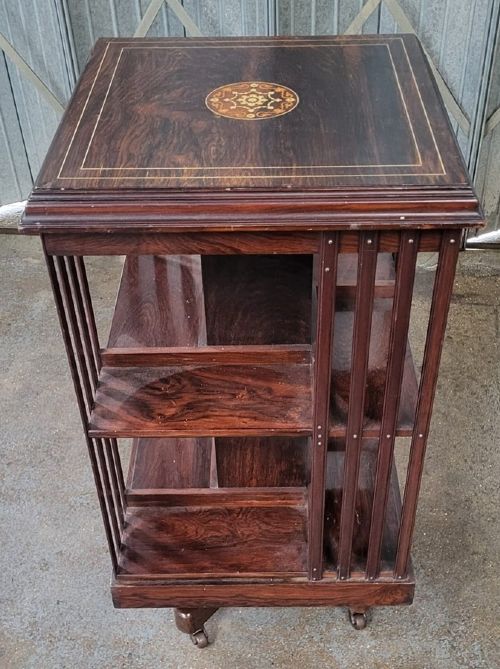
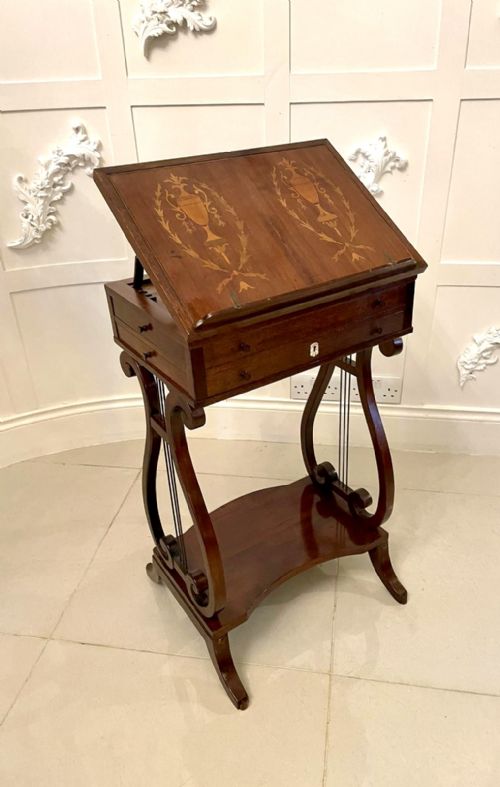
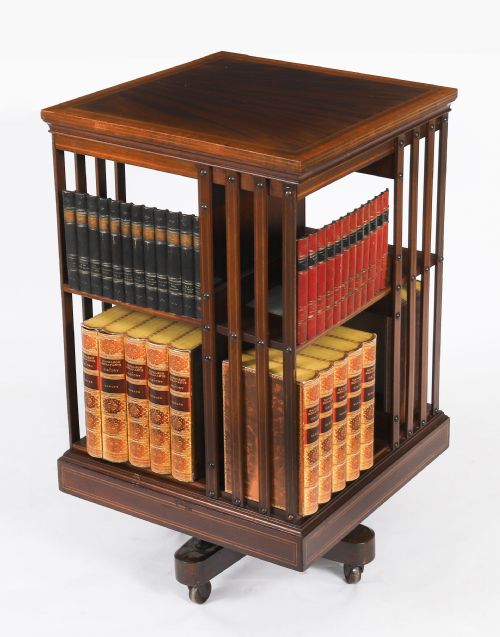
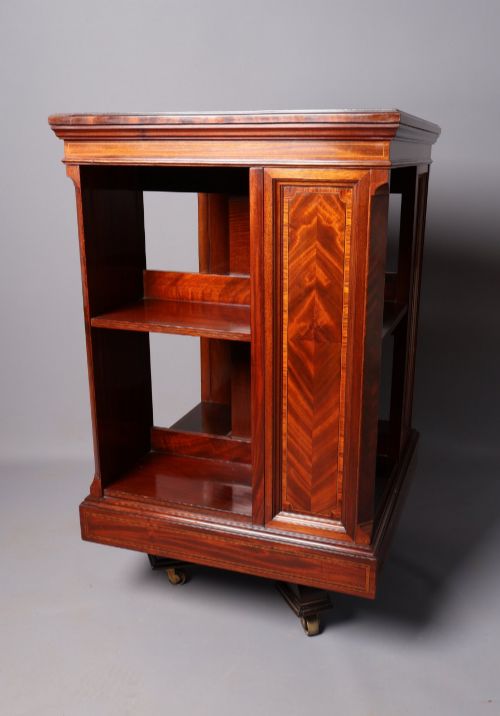
The pieces appearing on this page lean heavily towards revolving bookcases and reading tables constructed during the Edwardian period and around 1900. These items reflect the domestic interior requirements of the era, prioritising accessible book storage alongside refined decorative surfaces.
Makers and workshops of the time drew inspiration from earlier aesthetics, producing items in Sheraton Revival, French Louis XVI style, and Art Nouveau designs. Mahogany serves as the primary structural timber across most examples, often paired with contrasting lighter woods for decorative effect.
Materials and Construction
Construction relies primarily on mahogany, flame mahogany, rosewood, walnut, and kingwood as foundational cabinet timbers. These dense hardwoods provided the structural stability necessary for large bookcases and weight-bearing reading tables.
Decorative detailing is achieved through intricate marquetry and contrasting timber inlays utilising satinwood, fruitwood, and brass mounts. Ormolu highlights and cast iron mechanisms appear on specific items, such as revolving bookstands and centre tables, adding mechanical functionality and visual contrast.
Edwardian Inlaid Library Furniture Retail Price Guide 2026
Typical asking prices for edwardian inlaid library furniture among the pieces listed under this phrase on Sellingantiques today, from the lower quarter to the upper quarter. They describe what is for sale here now, not the wider market.
Listings feature mahogany, rosewood, walnut, and kingwood alongside satinwood and fruitwood inlays.
Judging Quality
Quality in these pieces is dictated by the precision of the timber selection and the execution of the inlay work. Finer examples display carefully matched flame mahogany veneers and crisp, sharply defined satinwood or fruitwood inlays rather than simple painted decoration.
The standard of the underlying cabinetmaking and the smoothness of mechanical parts, such as the turning action on revolving bookcases, separate standard production items from superior works. Furthermore, the inclusion of secondary timbers and branded maker signatures elevates the standing of a piece.
Lamb and Co·Maple and Co
The Edwardian Inlaid Library Furniture Glossary
- Inlay
- A decorative technique where pieces of contrasting timber are inserted into recessed cavities of a wood surface to form a flat pattern.
- Marquetry
- Elaborate veneer work arranged in pictorial or geometric patterns across the entire surface of a piece of furniture.
- Flame Mahogany
- A figured timber veneer exhibiting a distinctive flame-like pattern caused by the diverging growth of the wood grain.
- Ormolu
- Gilded bronze or brass applied as decorative mounts and highlights on furniture frames and corners.
- Sheraton Revival
- A late nineteenth and early twentieth century design movement that reinterpreted the classical, balanced forms of eighteenth-century designer Thomas Sheraton.
Edwardian Inlaid Library Furniture: Frequently Asked Questions
What is a revolving bookcase?
A revolving bookcase is a compact, multi-tiered shelving unit mounted on a concealed rotating base. This design allows users to access a large collection of books from a single seated position.
These pieces were popular in studies and libraries where floor space was limited. The rotating mechanism relies on internal ball bearings or wooden pivots hidden beneath the base.
How do I identify Edwardian library furniture?
Edwardian library furniture is typically characterised by lighter mahogany or satinwood timbers compared to the heavier, darker oak and walnut favored in earlier Victorian rooms. The styling often looks back to eighteenth-century classical revival motifs.
Look for refined proportions, delicate stringing lines, and neoclassical influences such as urns, bellflowers, and ribbon swags executed in contrasting wood veneers.
Where should I place a reading table?
Reading tables suit studies, living rooms, and large hallways where they can function as central display surfaces or auxiliary desks. Their finished backs and detailed tabletops make them suitable for freestanding placement away from walls.
Ensure the table is positioned away from direct heat sources and strong sunlight to protect delicate wood veneers and prevent the timber from drying out.
What is the difference between inlay and marquetry?
Inlay involves cutting specific shapes into a solid wood base and inserting contrasting materials flush into those recesses. It is typically used for geometric lines, borders, and simple floral motifs.
Marquetry covers a broader surface with assembled sheets of veneer to create complex pictures or symmetrical patterns. Both techniques are common across Edwardian decorative cabinetry.