




Edwardian French Centre Table
These edwardian french centre table pieces bring freestanding elegance and rich marquetry into a room, offering surface space with decorative presence from every angle.
Edwardian French Centre Table
An edwardian french centre table is a freestanding piece designed to sit in the middle of a room rather than against a wall, finished carefully on all sides. These tables draw heavily on continental design traditions, often adopting revivalist aesthetics from earlier French reigns.
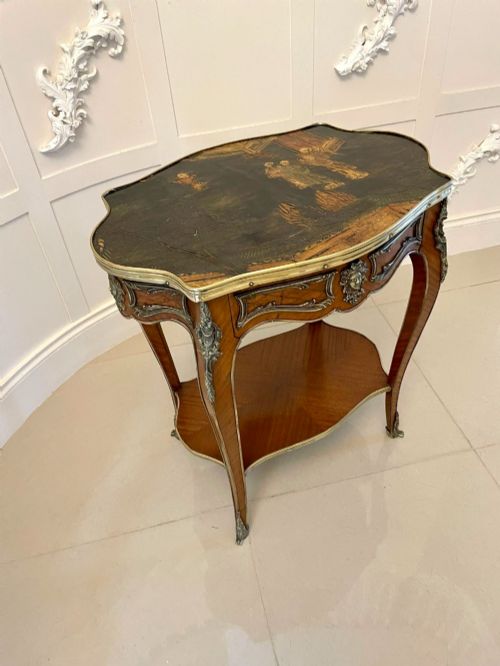
You will encounter various interpretations on this page, ranging from Edwardian pieces to earlier Victorian and nineteenth-century examples. Forms span occasional tables, coffee tables, and grander centre tables executed in fine timbers.
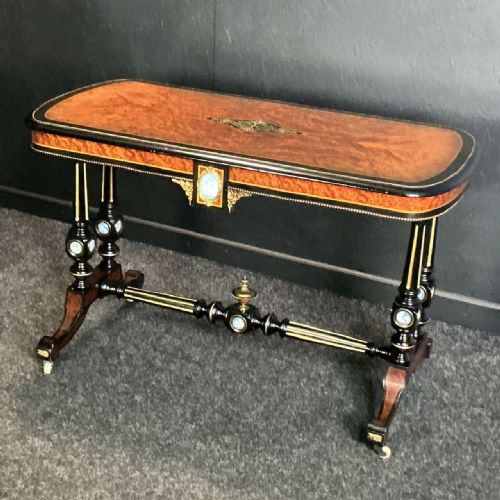
The materials dictate much of the visual weight, with kingwood, amboyna, walnut, and mahogany forming the primary surfaces. Metal mounts in ormolu or gilt bronze frequently accent the edges, corners, and legs.
Construction and materials
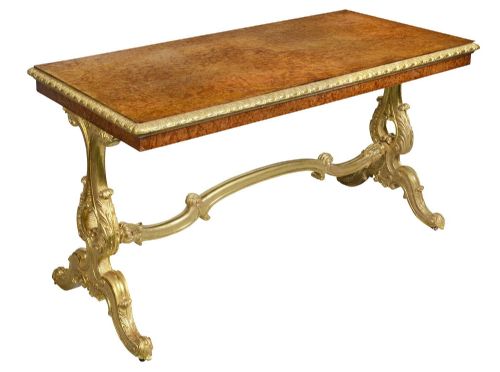
Cabinetmakers utilised dense hardwoods like kingwood and amboyna as primary carcasses or for decorative veneer work. Marquetry inlay patterns demand precise cutting of contrasting woods to create intricate geometric or floral motifs across the top surface.
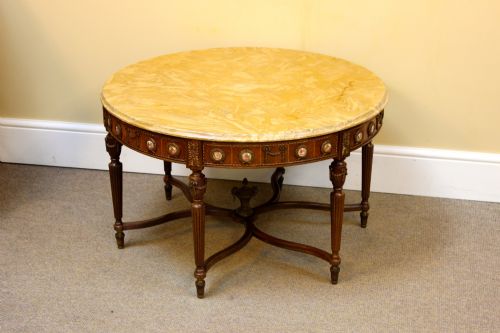
Cast metal mounts in ormolu and brass provide structural reinforcement and decorative flourish, fixed securely to the corners and legs. Marble tops also appear, offering a cool, durable surface set within a timber or gilt frame.
One piece even includes a secret single drawer beneath a chequer top, perfect for hiding stray biscuits.
Assessing quality and execution
The refinement of the marquetry inlay and the crispness of the cast ormolu mounts distinguish the finer examples from simpler work. Hand-chased bronze details show a sharper definition that elevates the overall decorative scheme of the piece.
Timber selection and grain matching across the top surface reveal the maker's intent and skill. Superior construction employs stable core woods beneath carefully chosen veneers to ensure longevity and resilience in a freestanding position.
Edward’s And Robert’s·François Linke·Holland + Son·Ince & Mayhew
The Edwardian French Centre Table Glossary
- Ormolu
- Gilt bronze mounted or applied to furniture for decorative effect. This technique was widely utilised during revival periods to mimic solid gold enrichments.
- Kingwood
- A dense, richly grained Brazilian timber prized for its contrasting dark and golden brown stripes. It frequently forms the primary veneer on high-status cabinet work.
- Marquetry
- The art of applying small pieces of veneer to a structure to form decorative patterns or pictures. Craftsmen select various woods to achieve natural tonal contrasts.
- Freestanding
- Finished on all sides so the piece looks complete from any angle in a room. Centre tables are designed specifically with this all-around finish in mind.
- Amboyna
- A highly prized exotic burl wood showing intricate swirling patterns and a warm reddish-brown hue. It appears frequently on nineteenth-century occasional furniture.
Edwardian French Centre Table: Frequently Asked Questions
Where should I place a centre table?
These pieces are designed to stand away from walls, making them suitable for the middle of a reception room or a large hallway. Because they are finished on all sides, they act as focal points from any viewing angle.
Ensure there is adequate walking space around the perimeter so the table can function properly without obstructing movement through the room.
How do I care for wood and ormolu?
Dust the timber surfaces regularly with a soft, dry cloth to prevent buildup in the marquetry crevices. Avoid using harsh chemical polishes that can degrade older finishes and patinas.
Keep ormolu mounts clean by gently wiping them with a dry brush. Moisture should be kept away from both metal and wood to protect the integrity of the joins.
Can these tables be used for daily dining?
Most of these pieces function as occasional tables, coffee tables, or decorative centre tables rather than heavy-use dining furniture. Their delicate marquetry and polished veneer surfaces require protection from excessive heat and moisture.
Using coasters and placemats helps preserve the polished timber top during everyday use.
How do I distinguish Edwardian from Victorian pieces?
Edwardian examples often lean towards lighter proportions and refined Louis XVI revival styles. Victorian pieces frequently display heavier Victorian Rococo revival details or dense amboyna and walnut veneers.
Examining the construction methods and secondary woods underneath can also offer clues regarding the approximate decade of manufacture.