

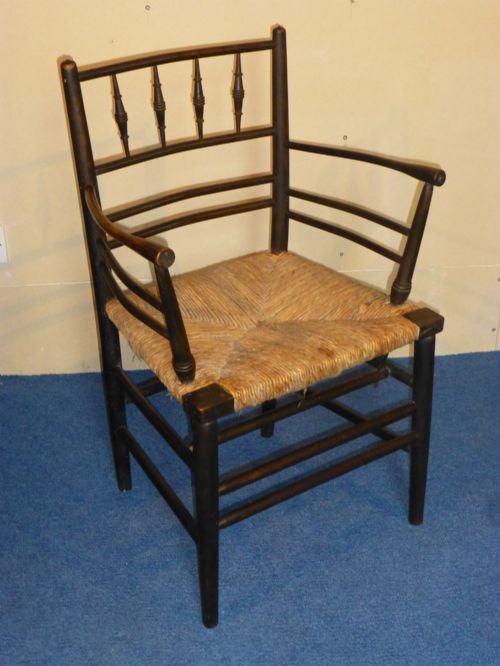
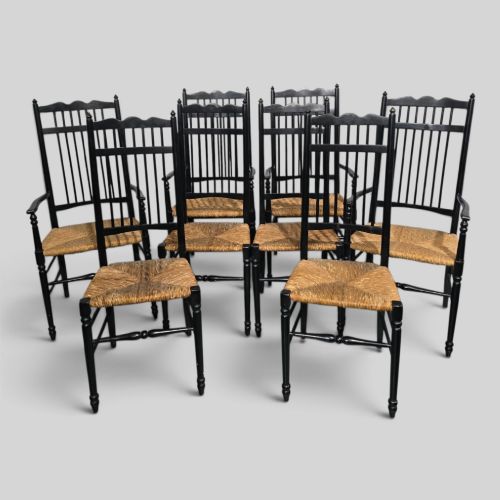
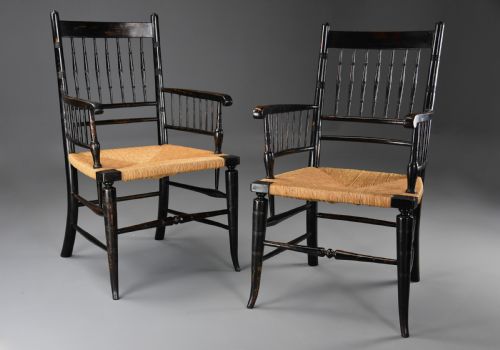


Ebonised Spindle Back Chair
An ebonised spindle back chair brings dark-finished elegance and turned woodwork to a room, drawing on Victorian and Arts and Crafts traditions.
Ebonised Spindle Back Chair
When you search for an ebonised spindle back chair, you encounter seating united by a blackened wood finish and slender turned vertical members. These pieces emerge chiefly from the Victorian and 19th-century periods, spanning forms from simple dining seats to expansive armchairs.
The selection on this page demonstrates considerable variety in function and regional style, including Morris and Co Sussex chairs, nursing chairs, child chairs, and salon chairs. Makers and designers such as Philip Webb and Ford Madox Brown shaped these variations alongside anonymous vernacular craftspeople.
Originating in domestic, aesthetic, and commercial contexts, the type ranges from Swedish neo-classical seating to Welsh vernacular designs and English Arts and Crafts productions. Buyers most frequently meet Victorian and late 19th-century examples that pair ebonised wood with rush or upholstered seats.
Methods of construction
Makers utilised ebonised wood to achieve a dense, dark surface that imitated costly ebony, applying paint or stain to fruitwood, beech, or other timbers. This finish often works alongside turned spindles shaped on a lathe to create repeating geometric patterns along the backrests and supports.
Seating areas commonly incorporate woven natural rush or padded surfaces finished in fabric, velvet, or paint. Structural joinery relies on traditional turned and pegged joints, occasionally accented with brass fittings or ceramic elements depending on the workshop and period.
Ebonised Spindle Back Chair Retail Price Guide 2026
Typical asking prices for ebonised spindle back chair among the pieces listed under this phrase on Sellingantiques today, from the lower quarter to the upper quarter. They describe what is for sale here now, not the wider market.
Listings feature periods spanning the eighteenth century through to the late Victorian era, utilising ebonised wood alongside rush, fabric, velvet, and brass.
Distinctions in quality
The refinement of the turning work and the crispness of the ebonisation distinguish finer examples from standard production. Superior pieces exhibit balanced proportions, tight joinery, and well-preserved surface finishes that retain their deep dark tone without excessive flaking.
Attribution to notable firms or documented designers elevates certain chairs above standard commercial output, as seen in pieces associated with Morris and Co or Liberty of London. The integrity of original seating materials, whether intact natural rush or period upholstery, also influences the standing of an individual chair.
Morris and Co·Philip Webb·Liberty of London·Ford Madox Brown
The Ebonised Spindle Back Chair Glossary
- Ebonised
- Wood finished to resemble ebony through staining, painting, or polishing. This treatment gained widespread popularity during the Victorian and Aesthetic periods.
- Spindle back
- A chair back constructed from a series of slender, turned wooden rods or spindles. These elements provide lightweight structural support and decorative rhythm.
- Rush
- Natural fibrous material woven into a strong, flexible seat. It appears frequently on traditional and Arts and Crafts seating.
- Sussex chair
- A nineteenth-century vernacular chair design popularised by Morris and Co, featuring turned wooden uprights and a rush seat. It drew inspiration from traditional Sussex cottage seating.
Ebonised Spindle Back Chair: Frequently Asked Questions
What is an ebonised spindle back chair?
An ebonised spindle back chair is a piece of seating featuring a dark, ebony-mimicking finish and turned wooden spindles along the backrest. These chairs date primarily from the nineteenth century and encompass various forms from simple dining seats to armchairs.
They reflect design movements such as the Arts and Crafts and Aesthetic periods, combining traditional turning techniques with a sophisticated dark surface aesthetic.
How do I care for rush seats?
Rush seats require gentle maintenance, keeping them away from excessive moisture and direct heat sources that can make the natural fibres brittle. Regular dusting with a soft brush helps prevent dirt accumulation within the woven strands.
Avoid heavy liquid cleaners on natural rush, as moisture can weaken the organic material over time.
How do I date these chairs?
Dating relies on examining construction methods, turning profiles, timber types, and stylistic indicators associated with periods like the Victorian era or Arts and Crafts movement. Comparative analysis with documented designs from makers like Philip Webb helps narrow down the timeframe.
Wear patterns and the composition of the ebonised finish also offer clues to the age and history of the piece.
Where were these chairs used?
These chairs served diverse interior roles, from formal dining rooms and drawing rooms to bedrooms and informal cottage settings. Smaller variants, including child chairs and nursing chairs, were tailored for specific domestic spaces and activities.
Their aesthetic versatility allowed them to fit into both avant-garde artistic interiors and traditional domestic homes during the nineteenth century.