



Early 20th Century Art Set
These early 20th century art set pieces encompass diverse decorative groupings and media from the 1910 and 1920 periods.
Early 20th Century Art Set
An early 20th century art set gathers coordinated items spanning utilitarian dining furniture, framed illustrations, bookends, and painting materials from the 1910 and 1920 periods. Buyers encounter varied formats including oak dining chair sets, framed neoclassical illustrations, and cased silver enamel spoons.
The selection ranges from Arts and Crafts furnishings and Scandinavian caviar servers to gilt bronze bookends and gouache landscape paintings. Edwardian traditional and Neoclassical stylistic influences appear frequently alongside distinct Art Nouveau and Scandinavian Modern sensibilities.
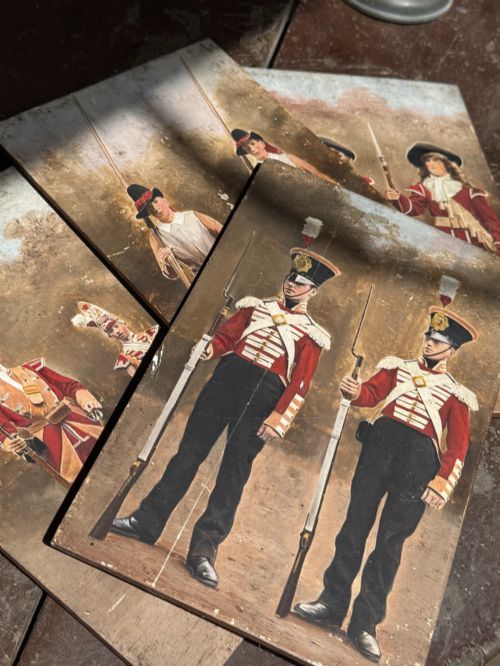
Grouping quantities vary widely from pairs of heavy bookends and three Homeric illustrations up to sets of four panels, caricatures, and eight farmhouse chairs. Wall art and framed prints sit alongside functional serveware, rings, and artist supplies.
Materials and construction methods
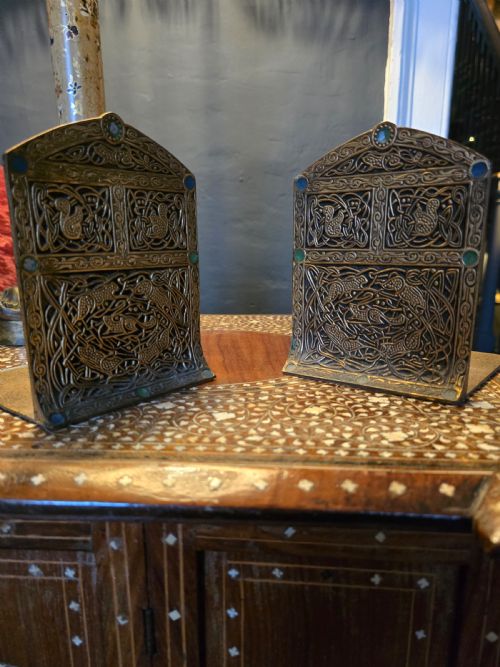
Wood construction relies primarily on solid oak and mahogany, frequently shaped into sturdy farmhouse dining chairs or inlaid quartetto nesting tables. Metalwork incorporates copper, gilt bronze, and silver enamel applied to decorative wall lights, bookends, and Norwegian spoons.
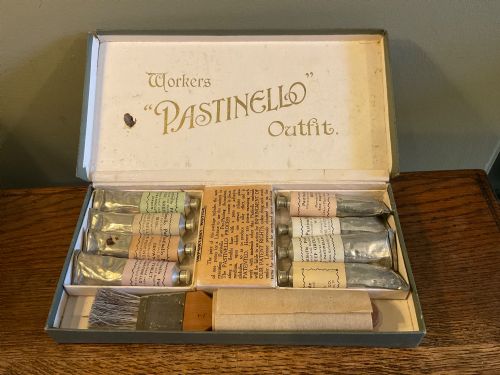
Paper and card support painted surfaces, including oil, heavy opaque gouache, and pastinello media on panels or within framed illustration sets. Glass and jadeite appear in specific serving vessels and carved jewellery items.
Surface finishes display painted soldier panels, gilt bronze patination, and detailed carved elements on rings and decorative wall pieces.
Current listings incorporate items from 1910 and 1920, utilising glass, wood, paper, metal, gilt bronze, paint, cardboard, and bristle.
Evaluating craftsmanship and condition
Superior execution relies on the integrity of the primary material, whether carved jadeite, heavy cast gilt bronze, or solid quarter-sawn oak joined with traditional framing methods. Sets demonstrating uniform preservation across every component retain greater cohesion than mixed assemblies.
Fine detail work distinguishes higher tiers, seen in the precision of enamel application on silver spoons, the hand-painted execution of landscape gouaches, and the crisp casting of classical bronze bookends. Original surfaces and patination elevate the standing of wooden chairs and metal serveware alike.
Completeness dictates utility and collectability, particularly for dining chairs, nesting tables, and multi-part illustrative suites where retaining the full original tally matters significantly.
Tiffany Studios New York·John Flaxman·Harrods London·David Andersen
The Early 20th Century Art Set Glossary
- Arts and Crafts
- A design movement prioritising traditional craftsmanship, natural materials, and simple utility over mass production. This aesthetic appears across oak dining chairs, copper wall lights, and serving sets.
- Gilt bronze
- Metal alloy cast with a fine layer of gold applied to the surface for rich decorative sheen. Tiffany Studios utilised this technique for heavy bookends.
- Quartetto
- A nested set of four graduating occasional tables designed to slide neatly beneath one another. Mahogany examples provide practical surface space.
- Gouache
- An opaque water-based paint medium producing flat areas of dense colour. Landscape paintings from this era frequently employ heavy opaque gouache.
- Enamel
- Vitrified glass powder fused to metal through high-temperature firing to create vibrant surface decoration. David Andersen utilised this method on Norwegian silver spoons.
Early 20th Century Art Set: Frequently Asked Questions
What defines an early 20th century art set?
These assemblies comprise curated groupings of decorative objects, furniture, or artistic works produced primarily during the 1910 and 1920 periods. They capture transitional aesthetics bridging traditional Edwardian tastes and emerging modern styles.
Items range from coordinated dining chairs and nesting tables to multi-part illustrations and boxed silver spoon sets. Each piece reflects the material preferences and manufacturing standards of the early decades of the twentieth century.
How were Arts and Crafts dining chairs constructed?
Makers utilised solid timbers such as oak, employing robust joinery suited to daily domestic use in farmhouses and suburban homes. Construction prioritized straightforward structural honesty and utility over excessive ornamentation.
These chairs often appeared in sets of four or eight, reflecting the dining customs of the period. Their surfaces displayed natural wood grain or painted finishes appropriate to the interior design schemes of the time.
How do I care for silver enamel spoons?
Enamelled silver items require gentle handling to protect the delicate glass fused surfaces from scratching or impact. Cleaning should involve soft cloths without abrasive metal polishes that might damage the vitreous layer.
Storing cased sets in dry environments prevents tarnishing of the silver framework. Proper maintenance preserves the vibrant colour and structural integrity of Norwegian and domestic tableware.
How do I distinguish Edwardian from Scandinavian Modern pieces?
Edwardian traditional items tend to lean towards formal revival styles, heavier woods like mahogany, and ornate decorative details. Scandinavian Modern works introduce cleaner lines, simplified forms, and functional minimalism suited to utilitarian serving.
Comparing the decorative motifs and timber selection helps establish the design lineage of individual items. Both styles share high standards of material execution despite their distinct visual philosophies.