
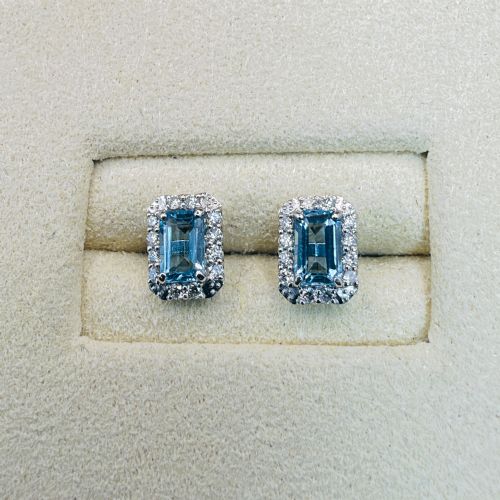
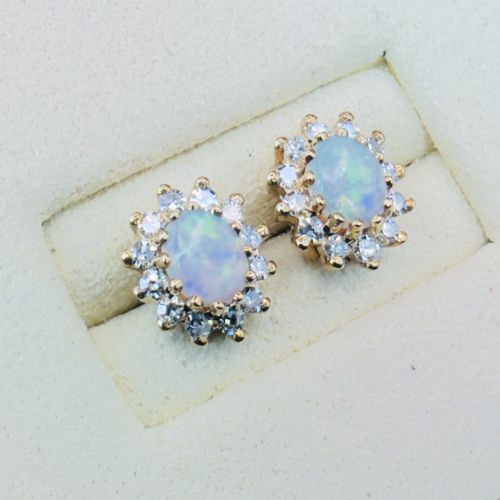


Diamond Halo Cluster Studs
Diamond halo cluster studs offer a brilliant centre stone framed by smaller diamonds, delivering a classic sparkle that sits close to the lobe.
Diamond Halo Cluster Studs
Diamond halo cluster studs combine a central gemstone with a surrounding border of smaller diamonds, creating a pronounced focal point for the ear. These earrings appear across several twentieth-century periods, including Edwardian, Art Deco, Mid-Century, and Retro designs.
The central stones vary widely beyond diamonds alone, frequently featuring emeralds, sapphires, aquamarines, opals, pearls, and amethysts. Mountings range from traditional yellow gold and white gold to platinum, reflecting the prevailing metal choices of each respective era.
How they were made
Goldsmiths utilise precious metals such as platinum, 18ct white gold, 14ct gold, and 9ct yellow gold to construct the supportive framework for the cluster. Central gemstones are secured with claws or bezels, whilst surrounding melee diamonds are closely set to maximise the reflected light around the perimeter.
Earring configurations incorporate standard post and butterfly fittings alongside specialised screw backs for heavier pairs, ensuring secure wear on the earlobe across different decades of production.
Some mid-century pairs come equipped with screw backs designed to survive an energetic tango without tumbling off the lobe.
What varies in quality
The refinement of a pair depends upon the symmetry of the surrounding diamond halo and the matching proportions of the central gem. Superior examples demonstrate careful stone selection where the colour and brilliance of the outer melee complement the primary stone without interruption.
Construction standards reveal themselves in the weight and thickness of the gold or platinum galleries, as well as the precision of the setting work holding each tiny diamond in place.
The Diamond Halo Cluster Studs Glossary
- Halo
- A circular or geometric arrangement of smaller gemstones enclosing a larger central stone. This setting style amplifies the apparent size and brilliance of the primary gem.
- Cluster
- A design grouping multiple stones together into a single cohesive decorative motif. In these earrings, a central coloured stone or diamond is encircled by complementary gems.
- Melee
- Small, cut diamonds used in secondary settings such as the outer border of a cluster. Their uniform size and sparkle create the continuous frame characteristic of halo designs.
- Cabochon
- A gemstone shaped and polished with a smooth, convex dome rather than faceted surfaces. This cut is frequently utilised for softer stones like opals and certain sapphires.
- Basaltic sapphire
- A sapphire originating from basalt-related geological deposits, often displaying deep, saturated blue tones. These stones appear in antique cluster configurations from the early twentieth century.
Diamond Halo Cluster Studs: Frequently Asked Questions
How do I wear cluster studs daily?
These earrings sit snugly against the earlobe, making them practical for everyday wear when secured with reliable backings. Their compact profile prevents them from catching easily on clothing or hair.
For longevity, remove them during vigorous physical activity or swimming to protect delicate claw settings and softer central gems like opals or pearls.
Are these earrings from the Edwardian era?
Edwardian examples feature delicate platinum or yellow gold work, often incorporating rose-cut diamonds and fine millegrain detailing around the cluster edges. These pieces reflect the lighter, garland-style aesthetics popular in the early twentieth century.
Later mid-century iterations tend to present bolder geometric lines and heavier gold or white gold mounts that distinguish them from earlier antiques.
What is an emerald cut?
An emerald cut is a rectangular gemstone shape featuring cropped corners and step-cut facets that create a hall-of-mirrors optical effect. This geometry emphasises the clarity and depth of coloured stones like aquamarines or emeralds.
When paired with a diamond halo, the linear angles of the centre stone contrast sharply against the surrounding sparkle.
How do screw back studs work?
Screw back studs utilise a threaded post paired with a matching threaded backing that twists securely into place. This mechanism prevents loss by locking the earring firmly onto the lobe.
They appear frequently on mid-century heavier cluster designs where extra security is required to support the weight of the piece.