
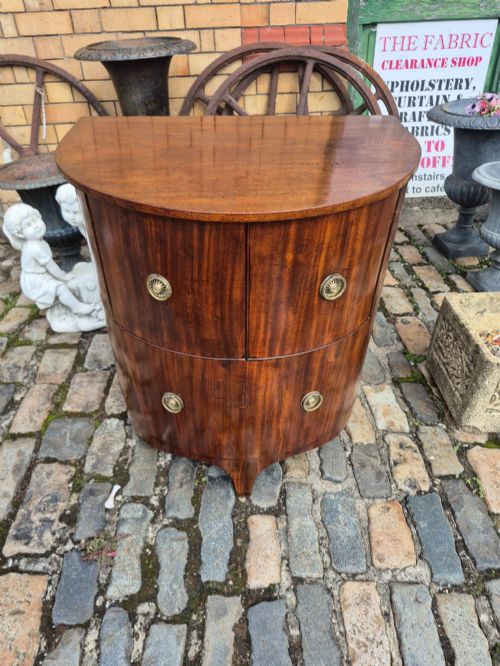
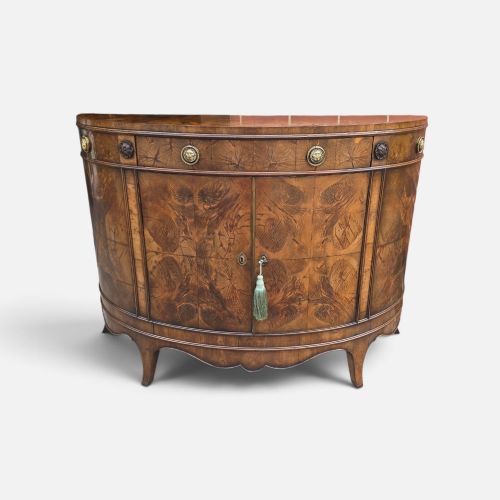
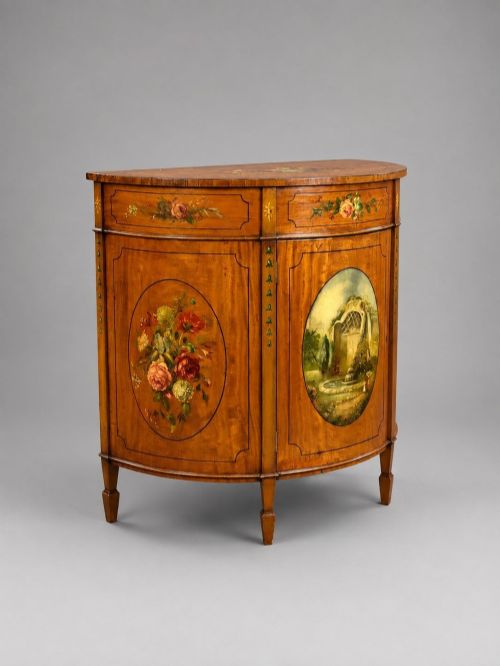


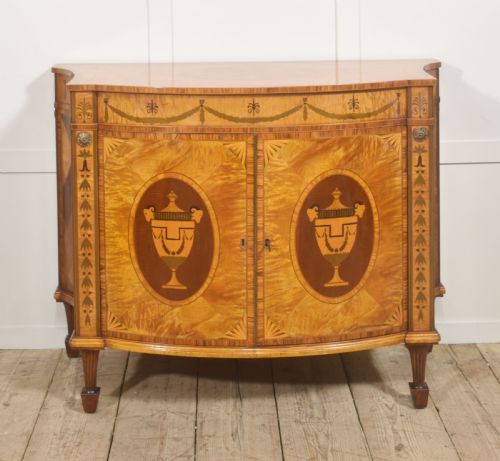


Demi Lune Side Cupboard
A demi lune side cupboard brings graceful semicircular curves to a hallway or drawing room, offering discreet storage without heavy angles.
Demi Lune Side Cupboard
A demi lune side cupboard is a semicircular piece designed to sit flush against a wall, combining the surface utility of a console with enclosed cabinet space. These items appear most frequently in satinwood, mahogany, and walnut, spanning periods from the eighteenth century through the Edwardian era and the nineteen-twenties.
The visual vocabulary draws heavily on Sheraton Revival and Neoclassical styles, frequently incorporating painted panels and delicate marquetry. Buyers encounter formats ranging from eighteenth-century George III commodes to early twentieth-century French marquetry consoles and Edwardian bedside tables.
Materials and Construction
Cabinetmakers constructed the curved carcase using timber such as mahogany, walnut, and satinwood, often embellishing surfaces with intricate marquetry and boxwood stringing. Selected pieces incorporate burr elm, burr yew, and marble tops.
Detailing often includes hand-painted classical panels, tambour fronts, and brass feet. French and Italian examples utilise marquetry veneers to create complex pictorial motifs across the curved doors.
Several pieces feature tambour doors, offering a satisfying roll that hides the clutter of modern life behind a curve of timber.
Assessing Quality
Quality rests in the precision of the curved joinery and the fineness of the surface decoration, whether painted or inlaid. Superior examples display crisp marquetry work and well-figured timber grains across the semicircular top.
The distinction between standard production and exhibition pieces shows in the depth of the classical panels and the integration of materials like marble and brass hardware.
Pietro Ferrario
The Demi Lune Side Cupboard Glossary
- Demi-lune
- A half-moon shape characteristic of these cabinets and commodes designed to stand flat against a wall. This profile saves floor space while providing a decorative surface.
- Marquetry
- The art of applying pieces of veneer to a structure to form decorative patterns and pictures. Craftsmen use various coloured woods to achieve tonal depth.
- Sheraton Revival
- A late nineteenth and early twentieth-century style inspired by the furniture designs of eighteenth-century designer Thomas Sheraton. It favours satinwood, painted details, and classical motifs.
- Tambour
- A flexible sliding door made of narrow vertical strips of wood glued to canvas. This mechanism allows access to curved compartments where hinged doors are impractical.
- Commode
- A decorative low cabinet or chest of drawers originating in France. In British usage, the term often describes fine living room cabinets with doors rather than drawers.
Demi Lune Side Cupboard: Frequently Asked Questions
Where should I place a demi lune side cupboard?
These cabinets suit narrow hallways, landings, and reception rooms where a deep rectangular piece would block the walkway. Their flat back allows them to sit securely against the wall.
They also function effectively in dining rooms as sideboards or in bedrooms as compact bedside tables, depending on the scale of the specific piece.
How do I distinguish eighteenth-century pieces from later revivals?
Eighteenth-century examples, such as George III commodes, typically show period timber construction methods, hand-cut dovetails, and genuine age in the patina of the mahogany or burr yew.
Twentieth-century Sheraton Revival and Edwardian pieces often utilise lighter satinwood bases with machine-assisted veneer work and distinct twentieth-century finishing techniques.
What is the difference between a commode and a side cabinet?
Historically, a commode refers to a low, ornate cabinet with doors or drawers developed in France. In many British and revival contexts, the terms overlap.
Side cabinets generally emphasise internal shelving behind doors, whereas commodes traditionally offered drawer storage, though both share the semicircular footprint.
How do I care for satinwood and marquetry surfaces?
Keep these pieces away from direct sunlight and heat sources to prevent the delicate satinwood veneers and painted panels from fading or cracking. Gentle dusting with a dry cloth preserves the finish.
Avoid liquid polishes and use professional wax sparingly only when the timber appears dry, taking care to protect any inlaid boxwood and stringing.