


Deep Red Garnet Jewellery
Deep red garnet jewellery brings rich, dark crimson stones into rings, earrings, bracelets and suites spanning the Georgian era to the mid-twentieth century.
Deep Red Garnet Jewellery
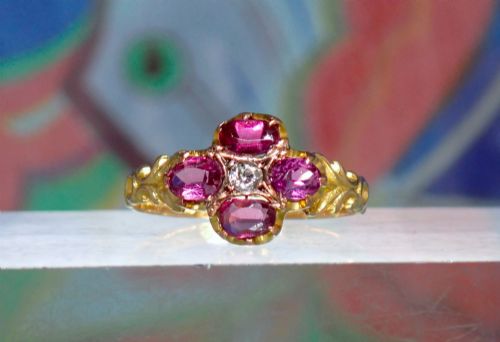
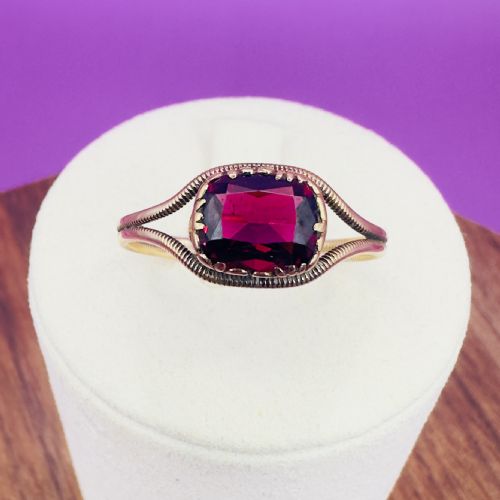
Deep red garnet jewellery encompasses rings, earrings, bracelets and suites fashioned across several distinct periods from the eighteenth century to the mid-twentieth century. Pieces range from early Georgian solitaire rings and Austro-Hungarian halo earrings to late Victorian cluster designs and mid-century studs.
The version most frequently encountered on this page is the Victorian creation, often taking the form of Bohemian garnet cluster earrings, ivy leaf drops or substantial rings. These items showcase deep crimson stones set alongside diamonds, pearls and gold or silver gilt.
Collectors also find Edwardian cluster studs, vintage drop earrings, and larger jewellery suites featuring considerable carat weights. The range extends from nineteenth-century almandine garnet and diamond settings to later mid-century gold interpretations.
How they were made
Garnets are set in varying grades of gold, including nine-carat, fifteen-carat and eighteen-carat varieties, alongside silver gilt and fourteen-carat options. Metalwork techniques adapt across the periods, supporting intricate stone configurations in rings and articulated bracelets.
Gemstone combinations frequently pair deep red garnets with old mine cut diamonds, rose cut diamonds or seed pearls. These contrasting stones enhance the dark crimson hue of the primary gems within halo, cluster and solitaire arrangements.
Listings span seven distinct periods, ranging from eighteenth-century Georgian work through Victorian and Edwardian eras to mid-twentieth-century examples.
What varies in quality
Quality diverges in the depth of colour and the precision of the stone cutting, distinguishing standard commercial output from finer workshop production. Almandine garnets and Bohemian stones display differing saturation levels and brilliance depending on their natural composition and facet placement.
The integration of supporting materials such as diamonds and pearls influences the overall character of a piece. Finer examples balance substantial garnet weight with balanced precious metal settings, while simpler designs rely entirely on the presence of the central red stones.
The Deep Red Garnet Jewellery Glossary
- Almandine Garnet
- A variety of garnet known for its deep red to violet-red coloration. This specific stone appears frequently in nineteenth-century rings and cluster settings.
- Old Mine Cut
- An early form of diamond cutting featuring a cushion-shaped outline with a high crown and small table. It is typically found in Georgian and Victorian jewellery alongside deep red garnets.
- Rose Cut
- A diamond or gemstone cut characterised by a flat base and a domed crown covered in triangular facets. This traditional technique provides a soft lustre rather than intense modern brilliance.
- Silver Gilt
- Silver that has been coated with a thin layer of gold. This material often appears in Austro-Hungarian and period pieces to provide a rich metallic backdrop for dark gemstones.
- Jewellery Suite
- A matching set of jewellery pieces, such as earrings, rings and bracelets designed to be worn together. Complete suites incorporating garnets and diamonds represent more substantial historical ensembles.
Deep Red Garnet Jewellery: Frequently Asked Questions
How do I date deep red garnet jewellery?
Dating relies on observing the metal purity marks, the style of the stone cutting, and the overall construction of the setting. Georgian pieces often feature closed-backed foils and old mine cuts, whereas Victorian and Edwardian examples show distinct cluster and halo arrangements.
Changes in gold standards, such as fifteen-carat yellow gold used in the nineteenth century versus later nine-carat or mid-century alloys, also help establish the chronological origin of a piece.
Were garnets popular in Victorian times?
Garnets enjoyed immense popularity throughout the Victorian era, particularly during the late nineteenth century. Bohemian garnet mining provided a steady supply of deep red stones that were fashioned into bracelets, ivy leaf earrings and intricate cluster rings.
These dark stones suited the romantic yet sombre aesthetic of the period, often paired with seed pearls or diamonds to create striking contrast.
How should I care for antique garnet jewellery?
Antique garnet jewellery requires gentle handling due to the age of the settings and the nature of the gemstone. Cleaning should be done with a soft, dry cloth rather than harsh chemical immersion or ultrasonic cleaners, which can damage older claw settings and pearls.
Storage in individual soft pouches prevents friction against other items and protects delicate gold work and silver gilt surfaces.