



Dappled Rocking Horse
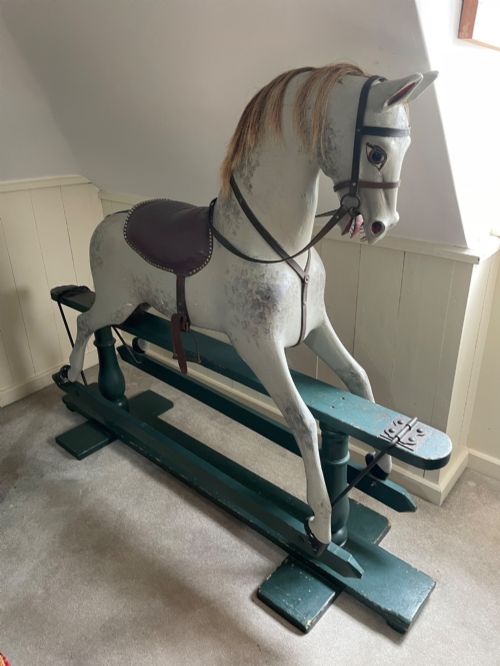
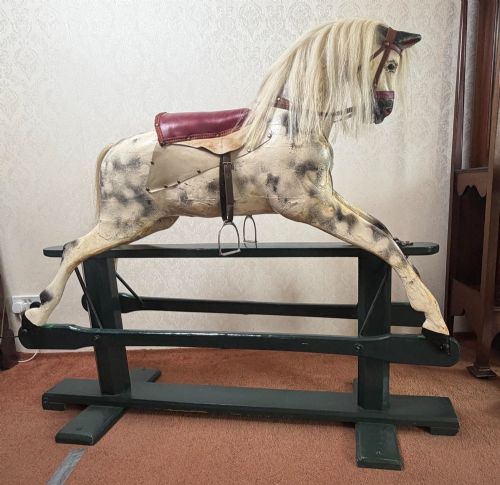
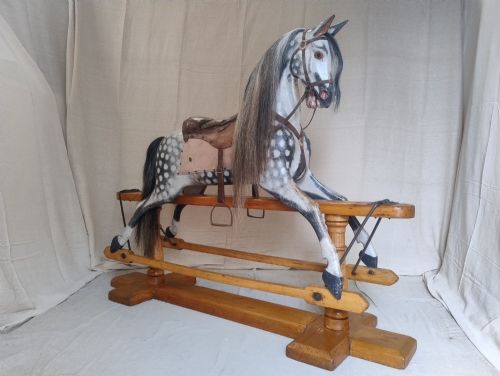
A dappled rocking horse brings traditional nursery charm into a room, fashioned from carved wood and painted to echo a real creature's coat.
Dappled Rocking Horse
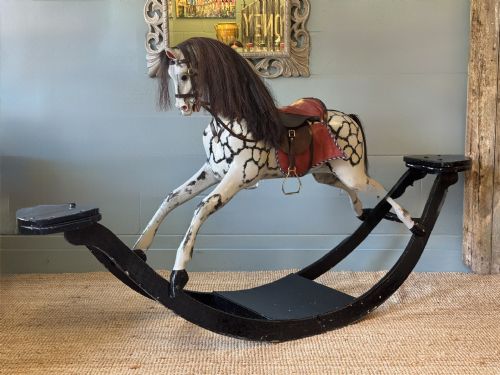
A dappled rocking horse is a substantial wooden toy designed to simulate the motion of riding, most frequently encountered here in forms dating from the Victorian era through the mid twentieth century. These pieces encompass large and extra large examples mounted on safety stands or traditional curved wooden rockers. Makers such as F.H. Ayres and G & J Lines produced robust models that survive in both restored and original finishes.
The selection ranges from nineteenth century folk art interpretations to mass produced twentieth century sports models like the Sportiboy. Buyers encounter carved pine bodies finished with dappled paintwork, often accompanied by leather tack and metal fittings. Each era contributes distinct proportions and structural details, reflecting the changing manufacturing methods of British toy makers.
Materials and construction
Construction relies heavily on carved wood and pine, forming the sturdy core required to withstand the weight of a rider during play. Artisans shaped these wooden components by hand or utilised early machinery before assembling the body onto bow rockers or stable stands.
Surface finish is achieved through layered paint applications to create the characteristic dappled pattern, complemented by natural horsehair manes and tails. Details such as glass eyes, leather harnesses, and iron or steel brackets complete the assembly of these traditional toys.
Dappled Rocking Horse Retail Price Guide 2026
Typical asking prices for dappled rocking horse among the pieces listed under this phrase on Sellingantiques today, from the lower quarter to the upper quarter. They describe what is for sale here now, not the wider market.
Listings feature pieces spanning from the Victorian era through the 1950s, utilising materials including carved pine, leather, and horsehair.
Factors of quality
Quality in a dappled rocking horse rests upon the depth of the hand carving and the proportion of the wooden body. Finer examples display realistic muscle definition in the shoulders and flanks, whereas simpler workshop pieces rely on basic geometric shaping.
The survival of original painted surfaces and traditional tack significantly elevates an example. Pieces retaining their early dappled coats and authentic maker markings hold greater distinction among collectors compared to those with later repainting.
G & J Lines of London·F.H.Ayres·Collinson·Lines Bros
The Dappled Rocking Horse Glossary
- Dappled
- Painted with a pattern of spots or patches over a lighter base colour to simulate a horse coat. This traditional finish defines the classic nursery aesthetic.
- Rocker
- The curved wooden bow underneath the horse that allows it to sway back and forth. Early examples sit directly on these long floor-standing curves.
- Tack
- The harness, saddle, and reins fitted to the horse. Leather and metal components form this equipment.
- Horsehair
- Natural hair utilised for the mane and tail of the figure. It provides a tactile texture distinct from synthetic substitutes.
Dappled Rocking Horse: Frequently Asked Questions
How do I date a rocking horse?
Dating relies on observing construction methods, the shape of the carved wooden body, and the style of the paintwork. Victorian examples often feature deep hand carving, while later twentieth century pieces show standardised manufacturing.
Maker stamps on the wooden stand or bracket fixings also provide precise attribution and production years.
What is the difference between rockers and safety stands?
Traditional curved wooden rockers allow the entire horse to glide across the floor during movement. Safety stands keep the base stationary while the horse swings within a suspended wooden frame.
Curved rockers appear more frequently on nineteenth century models, whereas safety stands became popular later in the period.
How should I clean a painted wooden surface?
Dust the carved wooden body gently with a dry microfiber cloth to remove everyday accumulation. Avoid harsh chemical cleaners or excess water that might lift the historic dappled paint layer.
Consult a specialist conservator if the painted surface requires deeper cleaning or stabilization.