

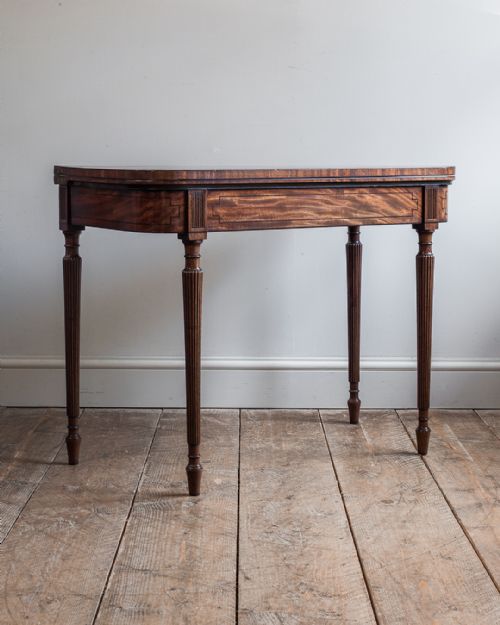
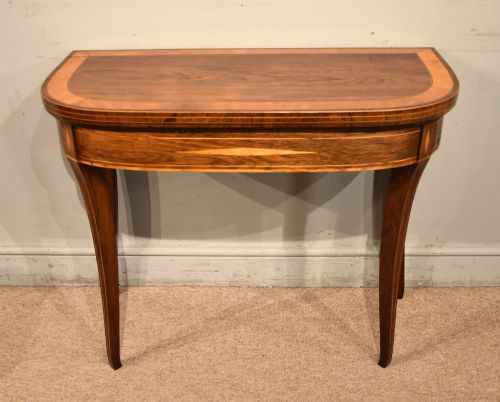


D Shaped Fold Over Table
A d shaped fold over table brings Georgian and Victorian ingenuity straight into a modern room, offering a neat console that opens to double its surface.
D Shaped Fold Over Table
When you search for a d shaped fold over table, you encounter versatile furniture pieces designed primarily as card tables, tea tables, and games tables. These objects date across the 18th century, 19th century, Georgian, and Victorian periods, reflecting shifting domestic habits.
The most common formats on this page include mahogany and burr walnut examples featuring demi-lune, serpentine, or butterfly shapes. They function as slim wall consoles when closed, pivoting or folding open to reveal baize-lined or polished timber surfaces.
How they were made
Cabinetmakers utilised rich timber veneers such as mahogany, rosewood, burr walnut, and satinwood, often enhanced with contrasting stringing of boxwood and brass details. These materials were expertly applied to solid secondary woods to create stable, curved tops.
Construction relied on precise pivot hinges, rotating leaves, and clever frame mechanisms that swing out to support the extended top when unfolded. Pedestal bases or tapering legs provide steady balance to the pivoting structure.
D Shaped Fold Over Table Retail Price Guide 2026
Typical asking prices for d shaped fold over table among the pieces listed under this phrase on Sellingantiques today, from the lower quarter to the upper quarter. They describe what is for sale here now, not the wider market.
Listings feature mahogany, burr walnut, and rosewood across Georgian, Regency, and Victorian periods.
What varies in quality
The distinction between tiers rests upon the choice of timber figures, such as highly figured burr walnut or rich flame mahogany, matched symmetrically across the fold-over leaves. Finer examples display meticulous grain continuity even when the top is fully opened.
Execution of complex serpentine curves and precise inlay work separates standard production from superior cabinetmaking. The smoothness of the pivoting mechanism and the integrity of the structural joints further define the grade of the piece.
William Trotter
The D Shaped Fold Over Table Glossary
- Demi-lune
- Half-moon shaped, describing tables with a flat back edge designed to sit flush against a wall. This profile defines the classic look of many card and tea tables.
- Serpentine
- A gently undulating curved outline featuring a convex centre flanked by concave sides. Cabinetmakers employed this shape to add visual movement to table edges.
- Stringing
- Thin inlaid lines of contrasting wood, such as boxwood, used to edge panels and borders. It highlights the geometric forms of Regency and Georgian furniture.
- Baize
- A coarse woollen fabric traditionally used to line the playing surfaces of card and games tables. It provides a soft, protective mat for playing cards.
D Shaped Fold Over Table: Frequently Asked Questions
What is a d shaped fold over table?
A d shaped fold over table is a dual-purpose piece of furniture featuring a flat back that stands against a wall and a curved front. When closed, it serves as a narrow console or side table.
By lifting and rotating or folding the top leaf over, the table reveals a larger surface intended for tea drinking, playing cards, or general games.
How were these tables used historically?
In Georgian and Victorian parlours, these tables conserved precious floor space during the day while accommodating social activities in the evening. Households used them for serving tea or hosting card games.
The clever folding mechanism allowed hosts to quickly transform a decorative hallway or parlour console into a functional activity table when guests arrived.
How do I place one in a modern home?
These tables fit naturally into hallways, living rooms, or dining spaces where floor space is limited. Placed against a wall with a lamp or mirror above, they function as slim display surfaces.
When entertaining, you can pull the table into the room and unfold the top to create extra serving space or an impromptu game area.
How do I tell the periods apart?
Georgian and 18th-century examples often feature straight tapering legs and restrained mahogany surfaces, emphasising classic architectural proportions. Regency pieces frequently incorporate rosewood, brass inlay, and bolder geometric lines.
Victorian iterations lean towards rich burr walnut, serpentine contours, and robust pedestal bases or more ornate carved details.