

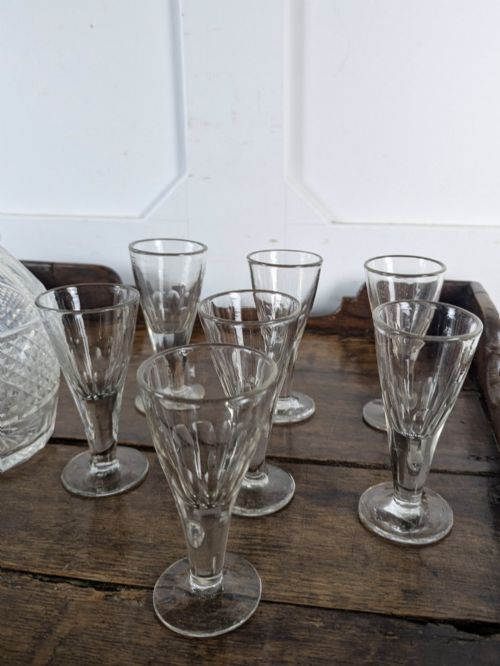



Cut Glass Sherry Glasses
These cut glass sherry glasses bring genuine weight and sparkle to the table, offering a tactile connection to historical dining habits.
Cut Glass Sherry Glasses
When you search for cut glass sherry glasses, you are looking at small stemmed vessels designed for fortified wines, spanning Georgian, Victorian and Edwardian eras. The selection often includes matching sets alongside pairs, featuring faceted bowls intended to catch the light during evening gatherings.
You are most likely to meet Victorian and Georgian examples on this page, frequently rendered in clear glass or lead crystal. These pieces range from simple thumb-cut flutes to elaborate sets with engraved botanical motifs or silver-plated pairings.
How they were made
Maker workshops utilised lead crystal and clear glass, shaping molten material into stems and bowls before applying wheel-cut facets. Artisans achieved the characteristic brilliance by polishing the deeply incised geometric patterns.
Certain vessels incorporate etched details or 24ct gold leaf accents, combining mechanical cutting with delicate surface engraving to create texture. These techniques required steady hands to ensure uniform depth across multi-piece sets.
Cut Glass Sherry Glasses Retail Price Guide 2026
Typical asking prices for cut glass sherry glasses among the pieces listed under this phrase on Sellingantiques today, from the lower quarter to the upper quarter. They describe what is for sale here now, not the wider market.
Listings span Georgian, Victorian, Edwardian and early twentieth-century periods, showcasing lead crystal, uranium glass and 24ct gold leaf.
What varies in quality
The distinction between standard vessels and finer examples rests on the crispness of the cutting and the weight of the metal. Sharp, clean facets reflect light distinctly, whereas softer edges indicate worn wheels or hurried finishing.
Consistency across a set dictates desirability, as hand-cut pieces naturally display subtle variations in height and panel width. Matching sets with uniform clarity command greater attention from collectors.
Saint-Louis·Webb
The Cut Glass Sherry Glasses Glossary
- Lead crystal
- Glass containing lead oxide, which increases weight, brilliance and the refractive index. This material allows for deeper, sharper cuts.
- Facet cut
- A decorative technique involving flat, polished planes ground into the exterior of the glass. It creates multiple reflective surfaces.
- Stemware
- Drinking vessels raised on a stem above a footed base. This form keeps the hand from warming the contents.
- Intaglio cut
- A style where the design is carved directly into the surface rather than leaving raised facets. It produces a sunken, frosted appearance.
Cut Glass Sherry Glasses: Frequently Asked Questions
Can I use them for modern drinks?
These small vessels suit modern dessert wines, cordials or spirits just as well as traditional sherry. Their compact capacity concentrates aromas effectively.
Handle them with care during gatherings, remembering that historical lead crystal has thinner rims than contemporary glassware.
How do I date a set of glasses?
Examine the weight, pontil mark on the base and the style of the cutting to determine the period. Georgian pieces often show heavier, hand-blown characteristics with irregular bases.
Victorian and Edwardian examples typically display more mechanical precision in their facet cuts and may feature distinct engraving styles associated with specific decades.
Are mismatched sets acceptable?
Assembled pairs and varied sets reflect how historic glassware accumulated over generations in family dining rooms. Many collectors happily mix individual pieces that share similar period characteristics.
While matching sets of eight or ten carry distinct appeal for formal settings, smaller groups offer an accessible entry point into collecting period crystal.