




Cut Crystal Candleholder
These cut crystal candleholder examples bring real weight and sparkle to a room, catching the light in a way modern glass simply cannot match.
Cut Crystal Candleholder
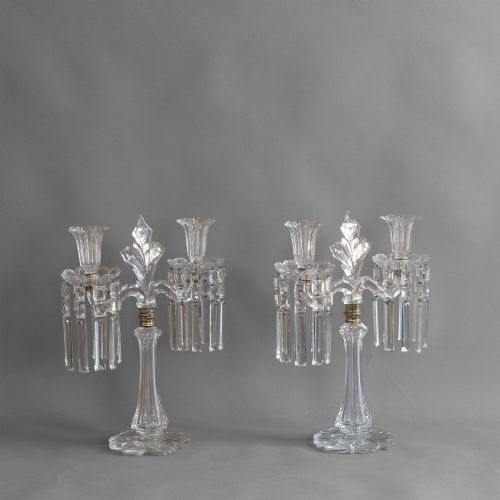
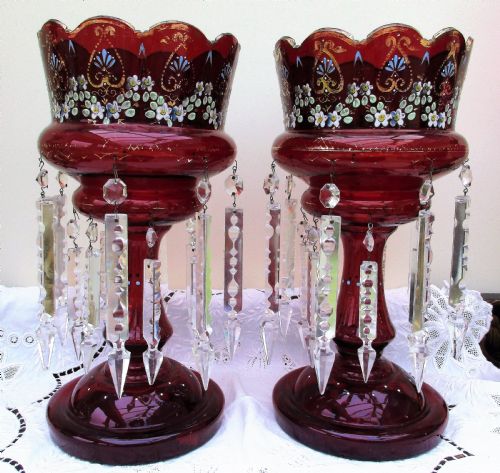
Buyers will most frequently encounter pairs of mantel lustres and table lustres dating from the Victorian era. These decorative glass vessels feature hanging crystal prisms that catch and refract candlelight across the room.
The inventory also includes multi-armed brass and glass candelabras influenced by the Louis XVI style. Coloured glass variants in ruby red, green, and cranberry appear frequently alongside clear lead crystal.
Materials and construction methods
The primary material is heavy lead crystal or cut glass, shaped by hand and wheel-cut to create sharp geometric facets. Many Victorian examples utilise flash glass techniques, where a thin layer of coloured glass is fused over clear glass before being cut away.
Metal components such as brass provide structural support for larger multi-armed candelabras. Additional decorative elements include enamel work and gold leaf detailing applied to the glass surface.
Hanging glass prisms are attached to the body using metal pins or wire loops, allowing the pendants to sway and chime gently in the draft.
Cut Crystal Candleholder Retail Price Guide 2026
Typical asking prices for cut crystal candleholder among the pieces listed under this phrase on Sellingantiques today, from the lower quarter to the upper quarter. They describe what is for sale here now, not the wider market.
Victorian mantel lustres were designed to chime softly whenever someone walked past the fireplace.
Judging quality and craftsmanship
Quality rests upon the crispness of the cutting and the weight of the glass itself. Superior pieces show deep, sharp facets that scatter light cleanly, whereas lesser examples feature shallow, rounded polishing.
The completeness and matching nature of the hanging prisms dictate the overall integrity of a lustre. Original matched sets of crystal drops command greater regard than replacements gathered at a later date.
Colour saturation and the evenness of flash glass layering distinguish finer Continental and English production from standard utilitarian wares.
The Cut Crystal Candleholder Glossary
- Lustre
- A decorative tabletop vase or urn fitted with a circle of hanging crystal pendants designed to catch the light. They were particularly popular on Victorian mantelpieces.
- Flash glass
- A technique of coating a core of clear glass with a very thin layer of coloured glass before cutting through the outer layer to reveal the clear glass beneath. This method creates striking contrast in ruby and cranberry pieces.
- Candelabra
- A branched candlestick holding multiple tapers on separate arms. Finer antique versions combine cast brass frames with cut glass bobeches and pendants.
- Lead crystal
- Glass containing a high percentage of lead oxide, which increases the weight, refractive index, and clarity of the material. It allows for deeper and sharper wheel-cutting.
- Bobeche
- A small glass drip pan fitted below the candle nozzle to catch melting wax. They often feature scalloped rims and matching cut crystal detailing.
Cut Crystal Candleholder: Frequently Asked Questions
Can I actually burn candles in them?
Most antique candlesticks and candelabras are fully functional for standard tapers. Ensure the candle fits securely in the nozzle to prevent any dripping onto the glass or surrounding surfaces.
Lustres are primarily decorative mantel ornaments rather than active candleholders, though some feature central sockets for a single taper alongside their surrounding crystal drops.
How do I date a Victorian glass piece?
Examine the base of the piece for pontil marks where the glassblower's rod was snapped off and roughly ground down. Smooth, polished pontils generally indicate later Victorian or Edwardian manufacture.
Consider the colour palette as well, noting that vibrant cranberry and ruby flash glass variations are strongly characteristic of mid to late nineteenth-century production.
Why do some lustres have missing crystal drops?
Hanging prisms are exceptionally vulnerable to accidental knocks and chips over the course of a century or more. Replacements can be sourced, though finding exact matches in age, glass tint, and cut pattern requires patience.