

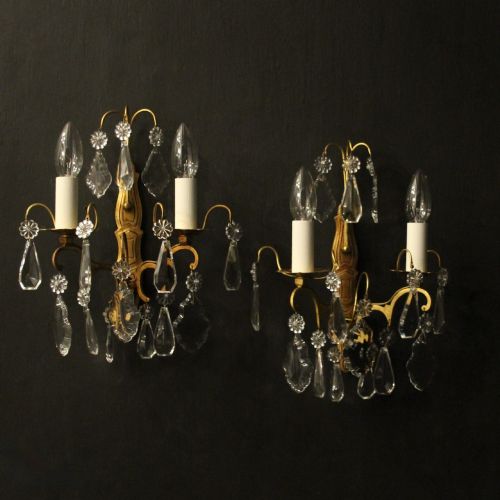
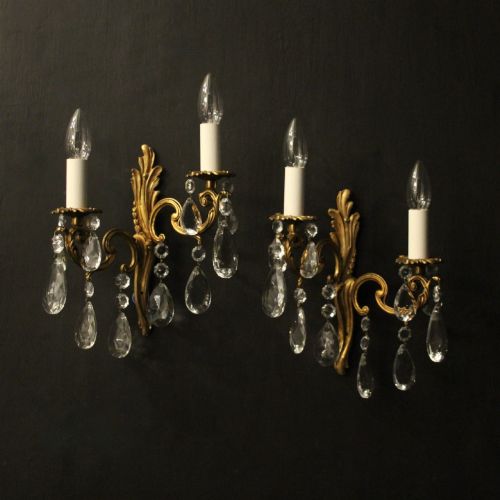


Crystal Twin Arm Sconces
Crystal twin arm sconces bring brilliant reflection and dual candle power to a wall, offering the classic illumination that collectors seek for period interiors.
Crystal Twin Arm Sconces
Crystal twin arm sconces are wall mounted light fittings designed to carry two branches of illumination, appearing frequently in French Rococo, Edwardian, and Regency styles. When searching for crystal twin arm sconces, buyers encounter wall lights and girandoles formed from brass, gilt bronze, giltwood, and cut glass.
The pieces listed on this page span from the mid nineteenth century through to the nineteen thirties, encompassing English and Florentine workshops alongside French makers. Most examples date from the early twentieth century, particularly the nineteen twenties, reflecting the popularity of French gilded and crystal designs during that decade.
How they were made
Metalwork forms the structural backbone of these wall lights, utilising cast brass, gilt bronze, and giltwood shaped into leaf motifs and scrolling arms. Metal components are frequently gilded or silver gilt to enhance the reflective quality of the frame.
Cut glass and crystal elements are suspended from or mounted directly onto the metal armature to refract the light. These glass components range from simple drops to intricate moulded plates that catch and multiply the illumination from the twin branches.
Crystal Twin Arm Sconces Retail Price Guide 2026
Typical asking prices for crystal twin arm sconces among the pieces listed under this phrase on Sellingantiques today, from the lower quarter to the upper quarter. They describe what is for sale here now, not the wider market.
Every crystal drop has spent a century whispering to the wall.
What varies in quality
The calibre of a piece rests upon the depth of the metal casting and the precision of the hand cutting on the crystal drops. Heavier brass and bronze frames with crisp, well defined leaf and scroll work stand apart from simpler commercial alternatives.
The integration of the materials also dictates the standard of the piece, particularly how cleanly the glass pendants match the metal finish. Finer examples display a cohesive design where the giltwood, brass, or silver gilt frame harmonises fully with the cut glass elements.
Baccarat·F. and C. Osler
The Crystal Twin Arm Sconces Glossary
- Girandole
- A branched wall light fitted with mirrors or extensive crystal drops designed to reflect and amplify light. These fixtures often feature elaborate frames carved from giltwood or cast in bronze.
- Gilt bronze
- A bronze substrate treated with a fine layer of gold leaf or mercury gilding to produce a durable, luminous finish. This material resists tarnishing and provides a rich ground for crystal drops.
- Cut glass
- Glass shaped and patterned by abrasive wheels to create faceted surfaces that refract light. It differs from mould pressed glass through the sharp edges of its cuts.
- Twin arm
- A configuration featuring two distinct branching arms extending from a central wall plate to hold light sources. This balanced layout provides symmetry on either side of a mirror or architectural feature.
Crystal Twin Arm Sconces: Frequently Asked Questions
Where should I place twin arm sconces?
These wall lights suit flanking positions beside a fireplace, doorway, or large mirror in a reception room. Their dual branches provide balanced illumination across a wall surface.
Ensure they are hung at eye level to make the best use of the hanging crystal drops and to cast light effectively throughout the space.
How do I identify a French sconce?
French pieces often display Rococo or Louis XV revival characteristics, utilising scrolling gilt bronze, leaf carved giltwood, and abundant crystal drops. The metalwork tends to be ornate and fluid in form.
English or Florentine alternatives frequently show different stylistic restraint or distinct regional carving traits, such as Florentine leaf motifs.
Can these sconces take modern bulbs?
Most antique wall lights have been adapted over time to accept standard electrical wiring rather than candles. A qualified electrician can check the existing fittings for modern safety standards.
Low wattage candle style LED bulbs work well to replicate the soft glow of historic lighting without generating excessive heat.
What periods do these wall lights cover?
The pieces available range from mid Victorian cut glass designs of the eighteen sixties up to nineteen thirties Art Deco interpretations. Edwardian examples also feature prominently alongside nineteen twenties productions.
Stylistic cues such as heavy silver gilt work or lighter giltwood frames help distinguish between the mid nineteenth century items and later twentieth century revivals.