



Crystal Prism Ceiling Lamp
These crystal prism ceiling lamp pieces catch the daylight and throw it across a room in a way modern light fittings simply cannot manage.
Crystal Prism Ceiling Lamp
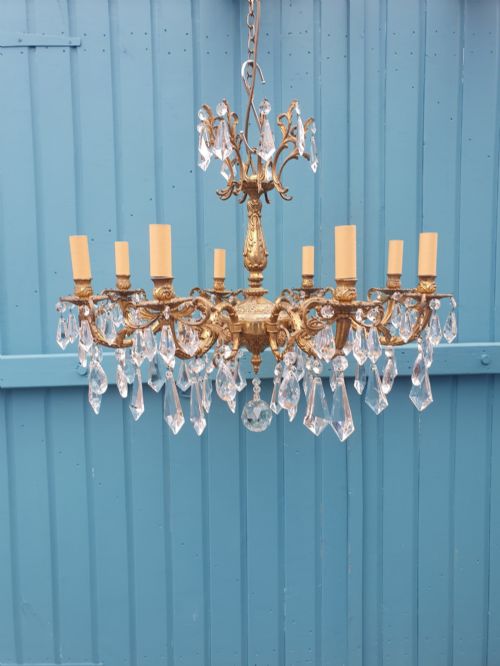
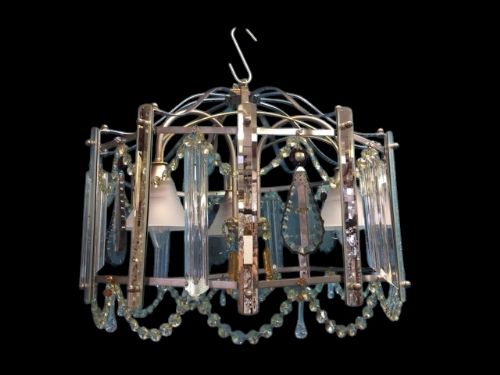
A crystal prism ceiling lamp brings together cut glass drops and metal framing to light a room with refracted brilliance. When you search for a crystal prism ceiling lamp, you encounter Edwardian designs alongside French Empire and Art Deco iterations.
The selections span chandeliers, ceiling lights, and pendant lights in sizes ranging from small drop fixtures to large eight-arm brass fixtures. Most pieces date from the early twentieth century, taking the form of basket chandeliers, tent and waterfall arrangements, and spike designs.
French Chateau and French Classical styles appear frequently alongside English basket work. You will meet smaller bead chandeliers featuring blue prisms alongside substantial gilt metal frames.
How they were made
Maker construction relies heavily on brass and gilt metal to form the structural skeletons that support the glass elements. These metal frames hold multiple arms, bands, and hoops designed to bear the weight of numerous hanging drops.
The hanging components utilise glass, crystal, lead crystal, and cut glass fashioned into lustres, beads, and prisms. Artisans wired these elements together so that the glass hangs freely, allowing each drop to move and scatter light.
Crystal Prism Ceiling Lamp Retail Price Guide 2026
Typical asking prices for crystal prism ceiling lamp among the pieces listed under this phrase on Sellingantiques today, from the lower quarter to the upper quarter. They describe what is for sale here now, not the wider market.
Listings for this phrase include pieces dated from nineteen hundred through to nineteen thirty, spanning Edwardian and Art Deco periods.
What varies in quality
The standard of a crystal prism ceiling lamp depends on the weight and clarity of the glass used in the prisms and drops. Lead crystal and deep cut glass refract light with sharper dispersion than plain pressed glass.
Metalwork construction also separates the output, with heavy cast brass and gilt frames offering greater structural integrity than lighter pressed metal alternatives. The complexity of the drop configuration, such as tent and waterfall assemblies, indicates the ambition of the original maker.
The Crystal Prism Ceiling Lamp Glossary
- Prism
- A cut glass pendant designed to refract light into spectral colours. These hang from the frame to catch and scatter illumination.
- Lustre
- A glass drop or pendant suspended from a chandelier. Larger versions form prominent focal points beneath the metal arms.
- Tent and waterfall
- A style of chandelier where strings of beads form an upper tent shape that flows down into a waterfall of cascading drops. This arrangement maximises the surface area of glass.
- Basket chandelier
- A light fitting where the lower section forms a bowl or basket shape woven from glass drops. These sit flush or semi-flush to the ceiling.
- Gilt brass
- Brass coated with a thin layer of gold or gilt finish. This treatment provides a bright, reflective surface that complements the crystal drops.
Crystal Prism Ceiling Lamp: Frequently Asked Questions
How do I clean a crystal prism ceiling lamp?
Cleaning requires removing dust with a soft brush and wiping each glass drop individually with a mild soapy solution. Rinsing thoroughly and drying with a lint-free cloth restores the sparkle.
Leaving the glass on the frame while cleaning prevents the wire hooks from bending or breaking. Take care to support heavy brass arms during the process.
Where should I hang a prism chandelier?
These lights suit dining rooms, entrance halls, and high-ceilinged living spaces where the hanging drops have room to catch natural light. Positioning them centrally allows the refracted light to travel across the walls.
Ensure the ceiling height accommodates the drop length of the specific fitting. Smaller spike or bead chandeliers fit lower ceilings better than large multi-arm arrangements.
How do I date an early twentieth-century ceiling light?
Dating relies on stylistic markers such as geometric Art Deco frames or ornate Edwardian brasswork. Wiring types and metal patination also offer clues to the age of manufacture.
Comparing the cut of the glass drops against period styles helps narrow down the decade of production between nineteen hundred and nineteen thirty.
Are these lamps difficult to wire for modern homes?
Most antique fittings require professional rewiring to meet current electrical safety standards. Electricians can adapt the internal channels to take modern bulb fittings while retaining the original exterior.
Checking the weight capacity of the ceiling joists is essential before hanging heavier brass and crystal structures.