
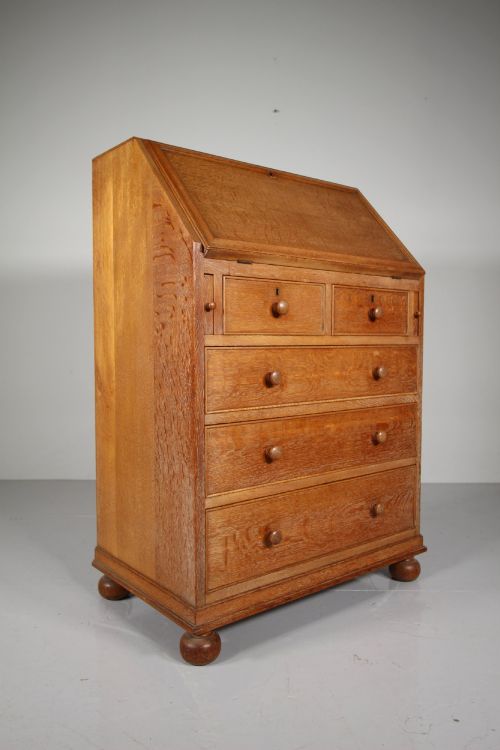
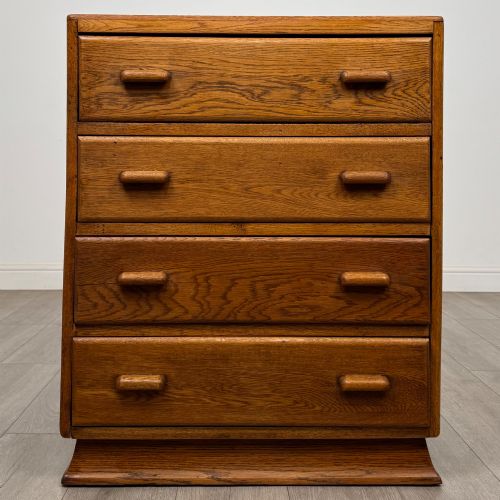
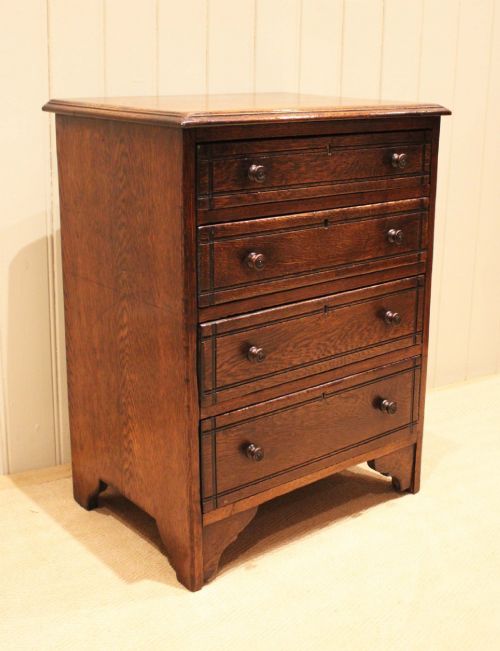
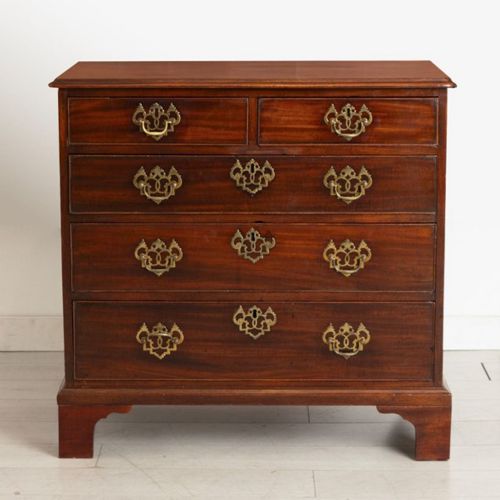


Compact Oak Chest Drawers
These compact oak chest drawers offer smaller proportions and rich timber, built for tight spaces without losing storage.
Compact Oak Chest Drawers
A compact oak chest drawers brings together modest footprints and sturdy timber, designed to fit tighter rooms while keeping daily storage practical. These items appear across several distinct eras, spanning 18th Century pieces, Georgian designs, Victorian examples, and Edwardian items.
How they were made
Cabinet makers relied predominantly on solid oak and mahogany to build these scaled-down chests, pairing the timber with brass handles, escutcheons, and drawer pulls. Construction techniques focused on durability, utilising thick planks for drawer carcases and solid backs.
Joinery methods such as dovetailing secured the drawer boxes, while bracket feet or plinth bases provided stable footing for tallboys and smaller drawer sets.
Victorian makers once built specialised sporran chests to keep Scottish highland accessories neatly organised between wearings.
What varies in quality
The distinction between standard examples and finer items rests in the selection of timber grain, the crispness of the joinery, and the presence of original brass hardware. Pieces featuring untouched drawer linings and consistent oak figuring command greater interest from collectors.
Proportion also defines the tier of a piece, with smaller scaled Georgian or George I examples demonstrating more refined cabinet work than later mass-produced variations.
The Compact Oak Chest Drawers Glossary
- Bracket foot
- A foot forming a simple architectural bracket at the corner of a chest. It often takes an ogee or simple curved profile.
- Tallboy
- A tall chest of drawers made in two sections, one stacked atop the other. This form maximises storage whilst maintaining a narrow floor footprint.
- Bachelors chest
- A small chest of drawers featuring a fold-over top or slide used for writing. These pieces date chiefly from the Georgian period.
- Linen press
- A tall cupboard enclosing sliding trays or shelves, positioned above a set of drawers. They were traditionally built to store household linens.
Compact Oak Chest Drawers: Frequently Asked Questions
What periods do these chests come from?
The available selection spans from the early 18th Century through the Georgian, Victorian, and Edwardian eras. Pieces often reflect specific regional cabinet-making traditions.
Dates range from George I examples up to early 20th century compactum designs, showing evolving styles in domestic furniture.
How were smaller chests used historically?
These compact pieces served multiple functions in bedrooms, dressing rooms, and halls where floor space was restricted. Some incorporated writing surfaces or specialised compartments for gentlemanly accessories.
Their smaller dimensions made them suitable for smaller chambers while retaining the storage capacity of larger furniture.
Are original handles common?
Original brass handles and escutcheons appear on several pieces, particularly those from the 18th and early 19th centuries. Replacements also occur due to centuries of domestic use.
Examining the backplates and fixing holes helps determine whether the hardware dates to the original construction period.
What is a compactum chest?
A compactum combines traditional drawer storage with cupboards, hanging space, or sliding trays in a single unified piece. These multi-functional designs became popular for maximising room utility.
They appear in both Georgian linen press forms and later 20th century wardrobe combinations.