



Classical Mahogany Chairs
These classical mahogany chairs bring distinct architectural lines and rich timber tones into a room, offering both sturdy everyday seating and strong historical presence.
Classical Mahogany Chairs
When you search for classical mahogany chairs, you encounter seating built across several centuries, drawing heavily on Regency, Edwardian, and Neoclassical design vocabularies. The forms range widely from practical hall chairs and dining sets to library armchairs, fauteuils, and settees.
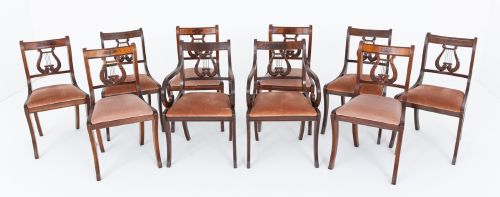
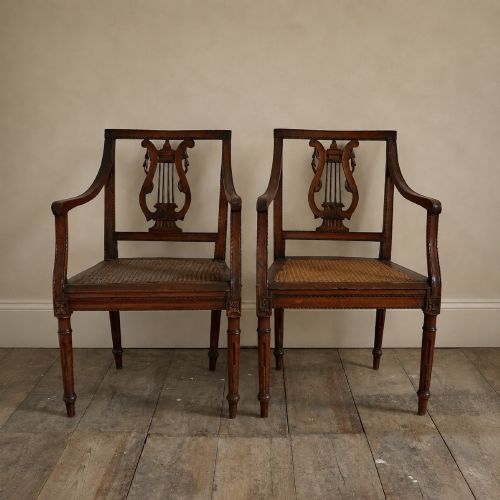
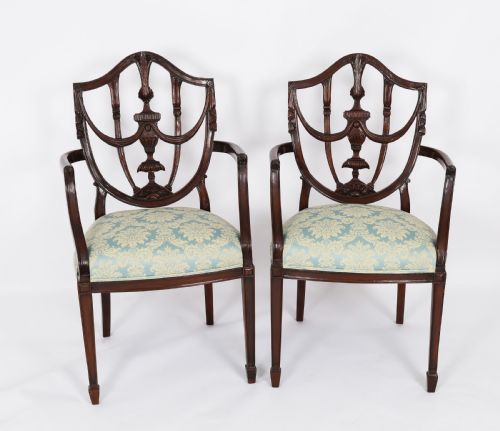
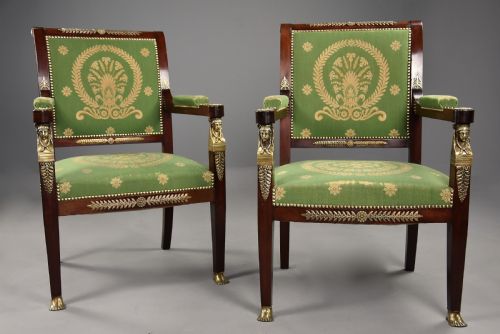
You are most likely to meet pieces originating from the nineteenth and early twentieth centuries, including Federal Revival and French Empire interpretations. These items reflect enduring classical motifs such as lyre backs, shield backs, and X-frames.
How they were made
The primary timber across these pieces is solid mahogany, frequently enhanced with contrasting satinwood inlay and delicate stringing. Workshops employed skilled carving alongside timber selection to create structured frames.
Many examples incorporate secondary materials such as cane seats, brass details, giltwood highlights, and fabric upholstery. Bronzed wood and parcel gilt treatments also appear on select library and parlour seating.
Classical Mahogany Chairs Retail Price Guide 2026
Typical asking prices for classical mahogany chairs among the pieces listed under this phrase on Sellingantiques today, from the lower quarter to the upper quarter. They describe what is for sale here now, not the wider market.
The site listings feature mahogany seating spanning the nineteenth century, the Edwardian era, and the early twentieth century.
What varies in quality
The standard of carving and the precision of inlaid details dictate the visual sharpness of each piece. Crisp execution in architectural motifs distinguishes finer examples from simpler vernacular production.
The choice of secondary materials, such as the fineness of the cane work or the execution of gilt and bronze finishes, influences the overall character and refinement of the seating.
George Smith
The Classical Mahogany Chairs Glossary
- Mahogany
- A durable tropical hardwood prized for its deep reddish-brown colour and stable grain, serving as the foundational material for these chairs.
- Regency
- A style period spanning the early nineteenth century defined by a strong revival of classical Greek, Roman, and Egyptian forms.
- Neoclassical
- An artistic movement drawing inspiration from the classical art and culture of ancient Greece and Rome, prominent in furniture design.
- Fauteuil
- An open-armed upholstered armchair with exposed wooden arms, originating in French interior tradition.
- Satinwood inlay
- A decorative technique inserting contrasting pale yellowish timber into the mahogany surface to create geometric or floral patterns.
Classical Mahogany Chairs: Frequently Asked Questions
How do I identify a Regency period armchair?
Regency armchairs often display strict classical proportions influenced by ancient Greek or Roman models. Look for architectural elements such as reeded legs, sabre legs, or distinctive backrest shapes.
They frequently incorporate brass mounts or bronzed wood finishes that typify the early nineteenth-century aesthetic.
Are these chairs suitable for daily dining use?
Many dining chairs and hall chairs within this selection were constructed for robust everyday function. Solid mahogany frames provide the necessary structural integrity for regular seating.
Upholstered versions may require careful attention to fabric wear depending on the age of the materials.
What is an X-frame armchair?
An X-frame armchair utilises intersecting diagonal wooden members beneath the armrests to form the primary structural support. This ancient form gained renewed popularity during the Edwardian era.
The resulting silhouette offers both geometric visual interest and sturdy load-bearing capacity.
How do Edwardian pieces differ from nineteenth-century ones?
Edwardian interpretations frequently feature delicate inlaid decoration using satinwood and lighter overall framing. They lean into refined revival styles rather than the heavier monumental presence of earlier decades.
This period also produced numerous matching salon suites and tub chairs suited for domestic reception rooms.