


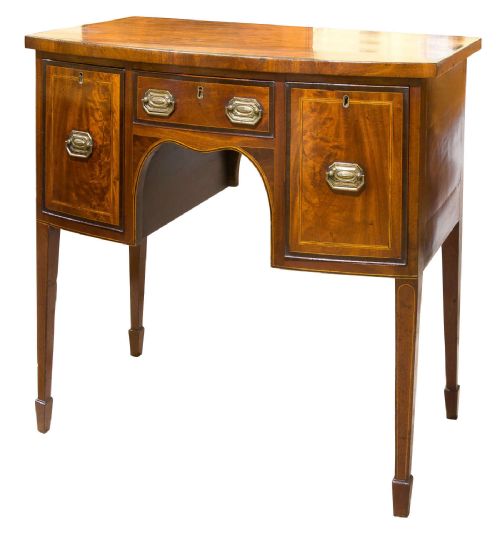


Classic Dining Sideboard
A classic dining sideboard anchors the room with gravitas, offering deep storage and a generous top for service during grand meals.
Classic Dining Sideboard
A classic dining sideboard provides heavy timber storage and a wide top surface designed specifically for dining rooms. You will frequently encounter mahogany pieces spanning the eighteenth century, the Victorian era, and the early twentieth century.
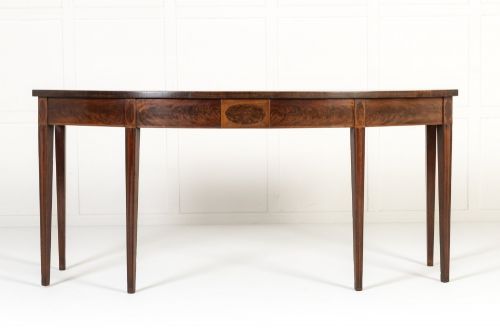
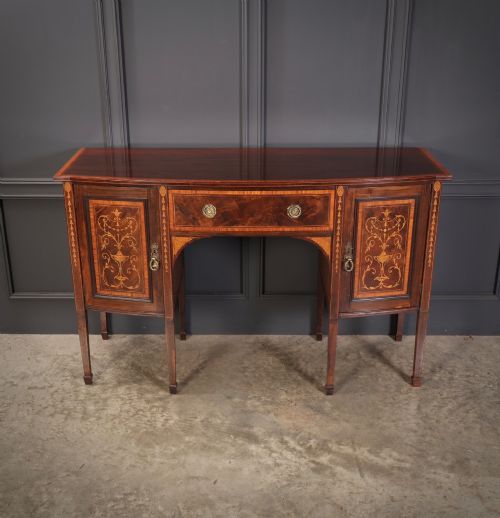
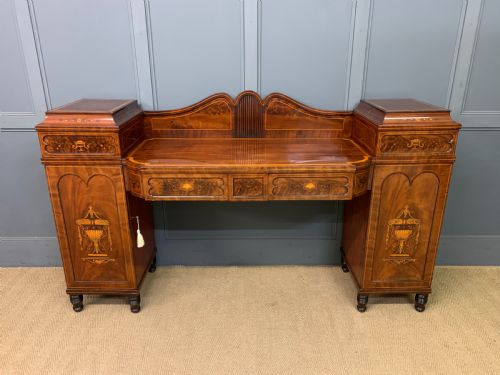
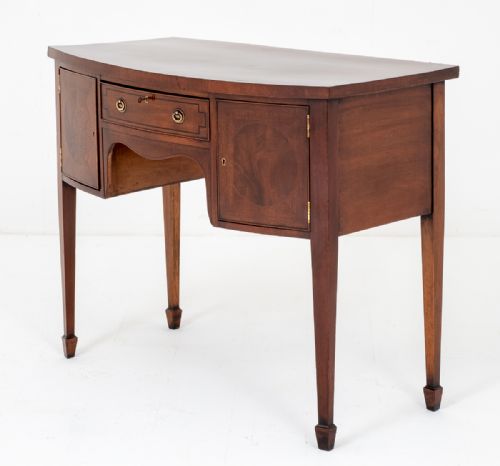
The selection ranges from George III serving tables to bow front sideboards and twin pedestal designs. Many examples incorporate satinwood and boxwood inlay alongside straightforward mahogany construction.
Makers adapted these forms across different periods, shifting from straight serving tables to serpentine and bow front configurations. Oak also appears among the Victorian pieces.
Buyers look for these items to anchor a formal dining space with period presence and functional surface area. The pieces on this page reflect this variety of Georgian and later revival styles.
How they were made
Cabinet makers relied primarily on solid mahogany and mahogany veneers, often enhanced with boxwood and satinwood inlay. These woods provided the structural integrity and rich surface grain expected in a dining room.
Brass fittings, such as handles and rails, were integrated to complement the dark timber. Joinery methods varied from eighteenth-century framing to later Victorian and Edwardian manufacturing techniques.
Inlaid decoration required precise hand-cutting of contrasting timbers to create delicate border lines and classical motifs.
Classic Dining Sideboard Retail Price Guide 2026
Typical asking prices for classic dining sideboard among the pieces listed under this phrase on Sellingantiques today, from the lower quarter to the upper quarter. They describe what is for sale here now, not the wider market.
Six-legged Georgian sideboards offered extra stability for carving heavy joints of meat without the table swaying.
What varies in quality
The refinement of the timber figure and the crispness of the inlay separate the better examples from standard production. Cabinet makers who selected highly figured mahogany and executed precise boxwood lines achieved a superior visual depth.
Proportion and structural balance dictate the success of the piece, particularly in bow front and serpentine formats where curve geometry is vital. Original brass hardware and clean internal timber also elevate the status of a sideboard.
Revival pieces from later periods display differing standards of hand-carving and veneer selection compared to their Georgian prototypes.
The Classic Dining Sideboard Glossary
- Bow front
- A convex curved cabinet front that projects outward in the centre. This shape softens the room's angles and gained widespread popularity during the Georgian period.
- Serpentine front
- A furniture front characterised by a convex centre flanked by concave curves. It requires advanced carpentry skill to execute properly.
- Pedestal sideboard
- A form featuring two distinct pedestals connected to a central tabletop or serving surface. These are often associated with George III designs.
- Inlay
- A technique where contrasting pieces of wood, such as boxwood or satinwood, are inserted into recesses in the primary wood surface to form decorative patterns.
- Serving table
- An open-frame table used for holding dishes before service, preceding the fully enclosed cabinet sideboard.
Classic Dining Sideboard: Frequently Asked Questions
What is a classic dining sideboard?
A classic dining sideboard is a large wooden cabinet or serving table built to store crockery and hold food during meals.
These pieces emerged in various forms across the eighteenth and nineteenth centuries, using timbers like mahogany and oak.
Were these used in every home?
These pieces were traditionally commissioned by affluent households to assist with formal dining and large-scale entertaining.
Over time, cabinet makers adapted the forms for wider domestic use, resulting in various sizes and revival styles.
How do I care for mahogany?
Mahogany requires stable room humidity and protection from direct sunlight to preserve its deep colour and polish.
Regular dusting with a dry cloth keeps the surface clean without stripping the historic finish.
What is the difference between a serving table and a sideboard?
A serving table is an open-frame table without built-in cupboards, whereas a sideboard incorporates enclosed storage space.
Sideboards evolved from serving tables as dining habits demanded more concealed storage for silver and linen.