

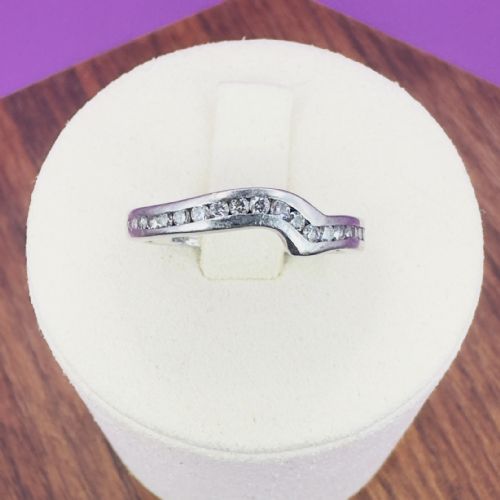


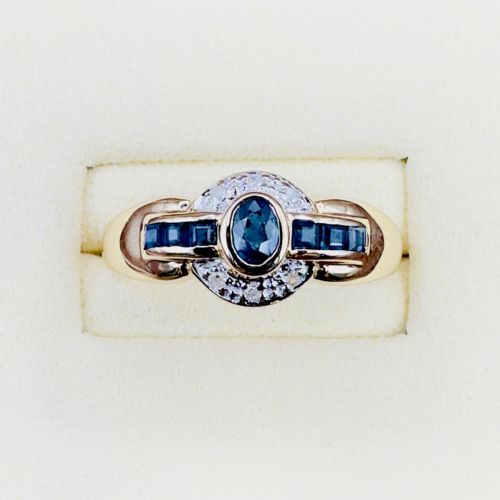


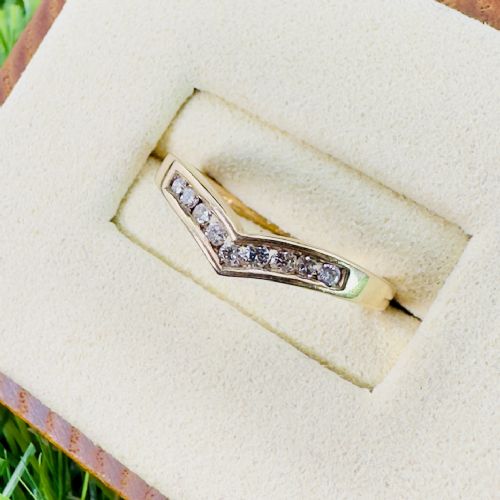


Channelled Diamond Ring
A channelled diamond ring brings together clean geometric lines and secure stone setting, offering a refined profile that catches the light from every angle.
Channelled Diamond Ring
A channelled diamond ring positions stones securely between parallel walls of metal without individual claws, creating a sleek and uninterrupted band of brilliance. When searching for a channelled diamond ring, buyers encounter pieces spanning the 1920s to the 1960s, with a strong representation of mid-century examples alongside earlier Art Deco items.
The configurations on offer range from half eternity and full eternity bands to sapphire, emerald and ruby cluster designs, as well as wishbone and crossover forms. Materials vary from platinum and 18ct white gold to yellow gold in 9ct, 14ct and 18ct purities, reflecting the changing preferences of twentieth-century jewellery design.
Art Deco and Art Deco revival styles sit alongside modern classic and contemporary pieces, giving buyers a broad spectrum of historical design languages to consider. These rings function equally well as standalone dress pieces or as wedding and eternity bands designed to sit snugly against other rings.
Materials and construction
Makers set diamonds and coloured gemstones such as sapphires, emeralds and synthetic rubies directly into metal channels or clusters using platinum and various purities of gold. Platinum provided the strength needed for delicate Edwardian and Art Deco settings, while white gold and yellow gold became prominent choices for mid-century production.
The technique relies on precise metalworking, where parallel grooves are cut into the band to hold the girdle of each stone firmly in place without the obstruction of claws. This method protects the edges of the stones while presenting a smooth outer surface that resists catching on clothing.
Channelled Diamond Ring Retail Price Guide 2026
Typical asking prices for channelled diamond ring among the pieces listed under this phrase on Sellingantiques today, from the lower quarter to the upper quarter. They describe what is for sale here now, not the wider market.
Quality and execution
The distinction between standard commercial pieces and finer examples rests on the precision of the channel walls and the uniformity of the set stones. Tightly fitted stones with consistent colour and minimal gaps demonstrate superior bench work and careful selection of materials by the jeweller.
The choice of precious metal also defines the grade of a piece, with platinum and high-purity gold settings offering greater longevity and structural integrity than lower-carat alternatives. Heavier gauge metal used in the shank prevents distortion over decades of daily wear, distinguishing robust traditional manufacture from lighter modern production.
The Channelled Diamond Ring Glossary
- Half eternity ring
- A band set with gemstones across the upper half of the hoop, leaving the lower shank plain for resizing and comfort. This design provides the visual impact of a full stone setting while remaining practical for everyday wear.
- Eternity ring
- A continuous circle of gemstones symbolising unending love, set entirely around the circumference of the band. These rings require precise stone calibration to maintain an unbroken line.
- Cluster ring
- An arrangement where a central gemstone is surrounded by a border of smaller stones, frequently diamonds framing a sapphire, emerald or ruby. This layout maximises the overall visual presence on the finger.
- Wishbone ring
- A curved or chevron-shaped band designed to nestle against a solitaire engagement ring. The distinct V-shape allows multiple rings to sit flush together.
- Crossover ring
- A style where the shank sweeps across the finger in an overlapping motif, often highlighting two central stones or contrasting metal colours. This form gained popularity during the mid-century period.
- Princess cut
- A square or rectangular gemstone cut with numerous facets that produce high brilliance. It appears frequently in twentieth-century cluster and multi-stone configurations.
Channelled Diamond Ring: Frequently Asked Questions
Can a channelled diamond ring be resized?
Resizing depends largely on the specific design and whether the channel extends halfway around the band or completely encircles the finger. Half eternity and wishbone rings generally offer more flexibility for a jeweller to adjust the shank.
Full eternity rings present a greater challenge because altering the metal circumference disrupts the continuous channel of set stones. Buyers should consult a specialist workshop before purchasing an eternity ring if the current size does not match their exact requirements.
What is the difference between white gold and platinum?
Platinum is a naturally white, dense and durable precious metal that retains its colour and weight over generations of wear. It provides exceptional security for stone settings without requiring plating.
White gold is an alloy created by mixing yellow gold with white metals such as palladium or silver, often finished with a rhodium plating to enhance brightness. While white gold offers a similar aesthetic at a different weight, the plating may require occasional maintenance over time.
How do I care for an antique eternity ring?
Regular gentle cleaning in warm soapy water helps remove oils and debris that accumulate beneath the channel walls. A soft brush allows safe access around the stones without loosening the metal.
Periodic inspection by a jeweller ensures that the channel walls remain secure and that no stones have developed movement within their tracks. Avoiding harsh chemical cleaners preserves the integrity of both the gold or platinum and the gemstones.
What periods do these rings come from?
The available pieces span several decades of twentieth-century design, starting from the geometric precision of the 1920s Art Deco era. Subsequent decades are represented by 1930s platinum bands, 1950s cocktail and crossover styles, and 1960s cluster and wishbone rings.
This timeline illustrates how jewellers adapted stone-setting techniques from heavy platinum work into more accessible gold configurations as manufacturing methods evolved.