

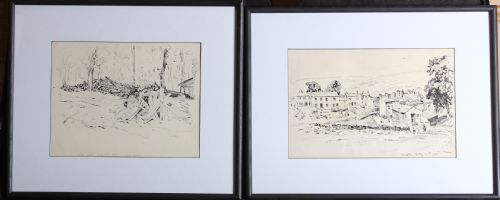


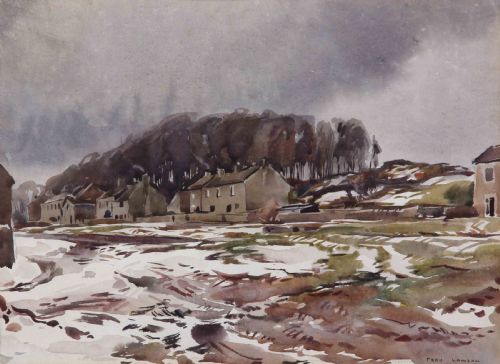
Castle Bolton Watercolour
These castle bolton watercolour works capture Wensleydale landscapes through the twentieth century, offering collectors historic depictions of the historic fortress.
Castle Bolton Watercolour
When you search for a castle bolton watercolour, you are looking at original twentieth century British paintings and drawings depicting the famous Wensleydale fortress and its surrounding landscape. The pieces on this page span several decades from the Edwardian era through the mid twentieth century, recording the changing face of the Yorkshire dales.
You will most frequently encounter works by listed British artists working in watercolour and ink on paper, often framed behind glass in wood. These range from quiet winter scenes of the castle to detailed landscape drawings and companion pairs showing specific local houses and farms.
Materials and technique
Artists created these works using watercolour paint and pigment applied to paper support, frequently combining fluid washes with precise pen and ink line work. This traditional method allowed painters to capture both broad atmospheric effects of the Wensleydale weather and architectural details of the castle masonry.
The surviving pieces are typically mounted on paper and housed in wooden frames behind protective glass. Works from this period rely on high quality watercolours and stable drawing inks that preserve the subtle tones of the Yorkshire landscape over decades.
Castle Bolton Watercolour Retail Price Guide 2026
Typical asking prices for castle bolton watercolour among the pieces listed under this phrase on Sellingantiques today, from the lower quarter to the upper quarter. They describe what is for sale here now, not the wider market.
The selection includes individual sheets, artist book drawings, and companion pairs depicting Wensleydale subjects.
Distinctions in quality
Quality in these watercolours depends upon the sureness of the draftsmanship and the strength of the composition, particularly how effectively the artist balances the bulk of the castle against the surrounding landscape. Stronger examples demonstrate confident handling of ink and pigment that captures the specific light and topography of Wensleydale.
Condition also plays a part, distinguishing works that retain their original pigment intensity from those affected by fading or paper discoloration. Pieces that show a clear provenance, such as those originating from dated artist sketchbooks, carry additional documentary interest.
Fred Lawson·George Graham·Sonia Lawson R.A.
The Castle Bolton Watercolour Glossary
- Watercolour
- A painting method in which the paints are made of pigments suspended in a water-based solution. These works are typically executed on paper.
- Pen and ink
- A drawing technique using fine lines applied with a nib and dark ink, frequently combined with watercolour washes to define architectural elements.
- British Impressionism
- A twentieth century painting style focusing on light, colour and everyday subjects rather than strict academic finish. Works in this manner often favour loose brushwork.
- Edwardian
- Pertaining to the period from nineteen hundred to nineteen ten, characterised in British art by a distinct pastoral realism.
- Modern British
- A broad term for twentieth century art that absorbed European modernist movements while retaining a connection to traditional British landscape subjects.
Castle Bolton Watercolour: Frequently Asked Questions
What is a castle bolton watercolour?
It is an original painting or drawing on paper depicting Castle Bolton and the surrounding Wensleydale countryside. These works were produced by British artists during the twentieth century.
They record local topography, historic architecture and rural Yorkshire scenes through various seasons and changing weather conditions.
How old are these watercolours?
The works available here date from the early to mid twentieth century, specifically spanning the decades between nineteen ten and nineteen sixty. This encompasses Edwardian and mid century modern periods.
Most pieces are explicitly dated by the artists within the titles or inscriptions on the paper.
How were these artworks framed?
These watercolours are typically preserved behind glass within wooden frames to protect the paper support and delicate pigments from environmental damage. Original framing materials often complement the age of the drawing.
Proper glazing helps prevent fading caused by light exposure over time.
Where can I hang a watercolour?
Watercolours require careful placement away from direct sunlight to prevent the pigments from fading and the paper from yellowing. Interior walls with indirect or filtered light are best for long term preservation.
Keeping them away from damp environments like kitchens or bathrooms protects both the paper and the wooden frame.