

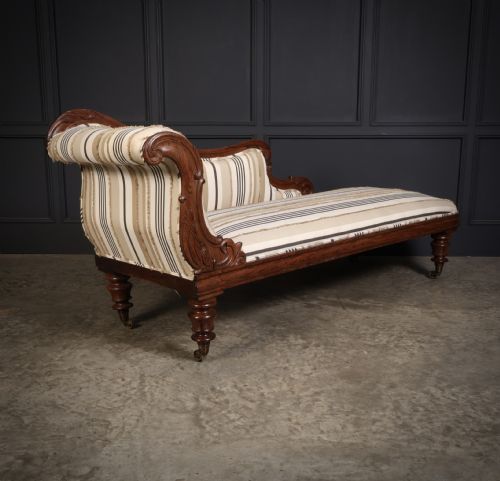
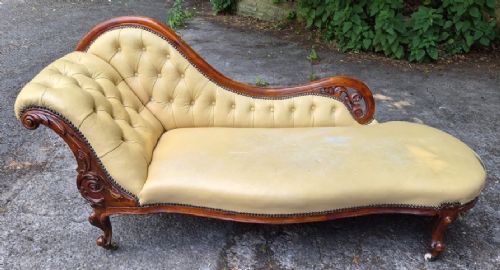


Carved Wood Fainting Couch
A carved wood fainting couch offers a reclining seat designed for Victorian repose, blending classical revival styles with rich timber frames and plush upholstery.
Carved Wood Fainting Couch
A carved wood fainting couch primarily appears on this page under descriptions of Victorian, Edwardian, and Regency periods, alongside specific forms like chaise longues and daybeds. These long seats allow a person to recline in a semi-recumbent posture, often featuring a raised headrest at one end.
The materials and styles span centuries and influences, taking shape in solid oak, mahogany, rosewood, and walnut frames. Some pieces arrive as bare timber frames waiting for restoration, whilst others retain their historic fabric and velvet upholstery.
Miniature furniture also surfaces in this selection, demonstrating that makers produced small-scale examples alongside full-sized daybeds. Most full-sized examples trace their lineage back through William IV, Louis XVI revival, and late nineteenth-century workshops.
How they were made
Makers constructed the structural frames of a carved wood fainting couch using dense hardwoods such as mahogany, rosewood, walnut, and oak. These timbers provided the necessary strength to support carved show-frames and scrolling headboards.
Craftsmen applied decorative techniques ranging from intricate timber carving to gilt decoration and ebonising. Brass elements occasionally appeared in the construction and detailing of these frames.
Upholstery completed the piece, utilising fabrics like velvet stretched over internal padding to create a comfortable surface for reclining. Frames were sometimes left exposed to display the carved wooden grain.
Carved Wood Fainting Couch Retail Price Guide 2026
Typical asking prices for carved wood fainting couch among the pieces listed under this phrase on Sellingantiques today, from the lower quarter to the upper quarter. They describe what is for sale here now, not the wider market.
Listings span the Regency, Victorian, and Edwardian eras, incorporating mahogany, rosewood, walnut, oak, and iron.
What varies in quality
The choice of timber dictates much of the character, moving from standard structural timber to richly figured rosewood and mahogany. Dense hardwoods allow for sharper, deeper carving along the show-frame.
The ambition of the design separates simpler daily furniture from revival pieces influenced by Louis XVI styles or ornate Victorian tastes. Gilding, ebonising, and complex framing elevate the visual weight of the daybed.
The Carved Wood Fainting Couch Glossary
- Chaise longue
- A long reclining chair or daybed designed for one person to stretch out. This form dominates the seating arrangements found in nineteenth-century interiors.
- Show-frame
- The exposed wooden portion of a seated piece of furniture that displays the carving and polish. On these couches, it outlines the upholstered body.
- Ebonised
- Timber treated to resemble ebony through staining or painting. This dark finish appears on selected miniature and full-sized frames.
- Gilt decorated
- Surface ornamentation using gold leaf or gold paint applied to wood. It brings a bright metallic contrast to the carved frame.
- Recumbent
- Reclining or resting in a horizontal position. The physical shape of these seats is specifically engineered for this posture.
Carved Wood Fainting Couch: Frequently Asked Questions
What is a fainting couch?
A fainting couch is a nineteenth-century daybed or chaise longue featuring an asymmetric raised backrest. It was historically used for resting in a semi-reclined position without retiring to a bedroom.
Today, these pieces function as statement daybeds in living spaces or large hallways, offering a blend of classical timber framing and upholstered comfort.
How do I date a chaise longue?
Dating relies on identifying the underlying timber, the framing style, and period markers such as Regency curves or heavy Victorian carving. Lighter oak frames often point towards the Edwardian era.
Comparing the decorative vocabulary against documented nineteenth-century cabinet-making trends helps narrow down the decade of production.
Can I use these daybeds daily?
Many antique daybeds remain structurally sound for regular sitting and reclining, provided the internal frame and joints are stable. Solid hardwood frames handle everyday use well.
Historic upholstery or fragile silk velvets may require professional restoration or replacement to withstand frequent daily lounging.
Why are some frames sold bare?
Some listings offer bare wooden frames from the mid-nineteenth century that lack upholstery and springs. This allows a buyer to finish the piece according to modern interior requirements.
Restoring a bare frame involves traditional webbing, stuffing, and covering with a fabric of choice to match the original silhouette.