

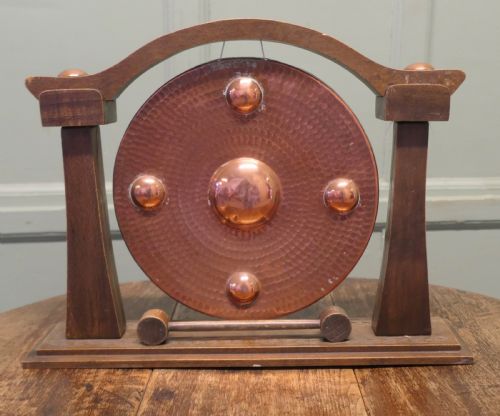


Carved Wood Dinner Gong
These carved wood dinner gong pieces bring resonant brass and bronze bells set in elaborate frames into the home, offering both historic utility and striking decor.
Carved Wood Dinner Gong
A carved wood dinner gong combines a suspended metal bell or disc with a wooden stand, traditionally used to summon households to meals. Buyers searching for a carved wood dinner gong encounter forms ranging from simple domestic frames to highly ornate regional expressions.
The pieces appearing on this page span the Victorian and Edwardian eras through to the twentieth century, with styles drawing upon Chinese export work, Black Forest carving, Arts and Crafts design, and 20th century folk art. Mahogany, oak, mango wood, and general hardwood provide the architectural support for metal striking elements.
Regional diversity shapes these objects, including Chinese dragon motifs, Burmese origins, and Scottish country house pieces. Stands vary from straightforward rectangular framing to intricate figural sculpture involving monkeys or serpentine dragons.
Materials and construction
Makers constructed the structural frames from dense timbers such as mahogany, oak, and mango wood, allowing deep chisel work and substantial joinery to support heavy hanging bells. These woods were hand-carved with motifs ranging from naturalistic foliage to mythological creatures.
The sound-producing elements utilise cast brass, copper, and bronze, suspended within the wooden frames using sturdy cord or metal linkages. Artisans combined metal casting with woodworking to balance acoustic resonance and structural stability.
Carved Wood Dinner Gong Retail Price Guide 2026
Typical asking prices for carved wood dinner gong among the pieces listed under this phrase on Sellingantiques today, from the lower quarter to the upper quarter. They describe what is for sale here now, not the wider market.
Listings feature items spanning the nineteenth and twentieth centuries, incorporating materials such as brass, copper, cord, hardwood, mahogany, glass, and bronze.
Judging quality and execution
Quality rests upon the depth and precision of the wood carving, where finely rendered details on figures or foliage distinguish superior workshop output from simpler production. The integration between the carved wooden stand and the hanging apparatus reveals the maker's structural intent.
The purity and sustain of the metal bell or gong plate dictate its acoustic success, pairing with the robustness of the frame to determine the overall integrity of the piece.
The Carved Wood Dinner Gong Glossary
- Arts and Crafts
- A design movement prioritising handcraftsmanship and simple materials over industrial mass production. Pieces from this tradition often emphasise honest joinery and utility.
- Black Forest
- A style of wood carving originating in Central Europe, known for highly realistic depictions of animals and natural forms. Monkeys and forest fauna frequently appear in these compositions.
- Chinese Export
- Decorative items produced in China specifically for Western markets, blending traditional Eastern motifs with European furniture forms. Dragons and elaborate structural stands are typical of this category.
- Chinoiserie
- European artistic interpretations of Chinese and East Asian artistic traditions. This style manifests in decorative framing and ornamental woodwork.
- Dinner Gong
- A household percussion instrument used historically to announce meals. It consists of a metal disc or bell suspended in a dedicated frame.
Carved Wood Dinner Gong: Frequently Asked Questions
What is a dinner gong?
A dinner gong is a percussion instrument featuring a suspended metal bell or disc held within a frame, traditionally used in large houses to summon residents to dining rooms.
Over time, these objects transitioned from functional household signals into decorative interior furnishings that showcase period woodworking and metal casting.
How do I date a wooden gong?
Dating relies upon examining the timber species, carving style, and construction methods used in the frame. Victorian and Edwardian examples often exhibit distinct regional motifs and hardware characteristics.
Comparing the stylistic markers, such as Arts and Crafts simplicity or Black Forest naturalism, helps narrow down the period of manufacture.
Were these gongs actually used?
Yes, households utilised them regularly before modern electric bells and intercom systems became standard in domestic architecture. The deep resonance carried across multiple rooms and large hallways.
Servants or family members struck the metal disc with a mallet to signal the start of meals or gatherings.
What woods were used for frames?
Makers selected dense hardwoods such as mahogany and oak for their structural strength and ability to hold crisp carved details. Mango wood and general hardwoods also appear in later or regional pieces.
The choice of timber frequently reflects the stylistic origin and period of the workshop.