





Carved Wood Butler Tray
A carved wood butler tray brings practical folding service and rich period timber into everyday rooms.
Carved Wood Butler Tray
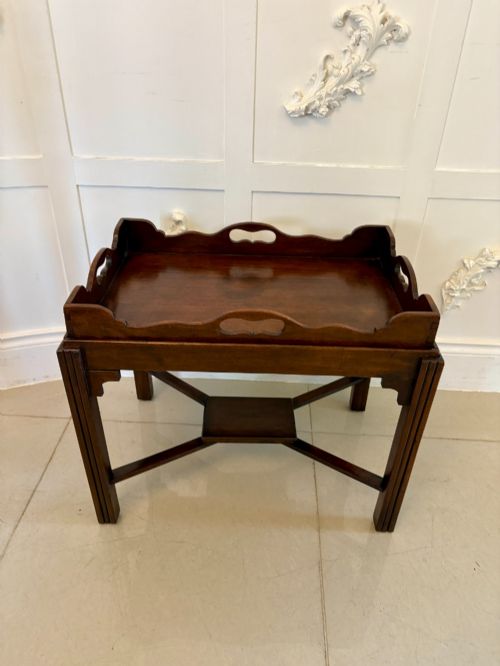
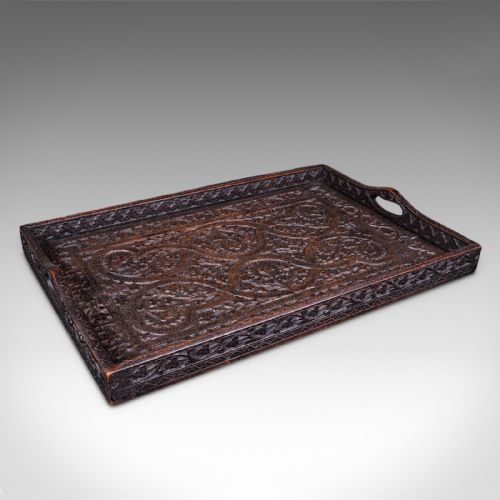
A carved wood butler tray represents a portable serving surface designed to lift off its folding stand for domestic use. Buyers pursuing a carved wood butler tray encounter forms ranging from nineteenth-century mahogany folding tables to Edwardian serving platters.
The selection on this page centres on mahogany and hardwood examples, spanning Victorian, Georgian, and Edwardian periods. Many pieces combine traditional British cabinet-making with regional decorative motifs from Anglo-Indian and Japanese traditions.
Most items function as occasional tables or coffee tables when paired with their original or later stands. Oval galleried trays and scalloped edge variants dominate the offerings, providing raised rims to secure glassware and china.
Materials and construction
Makers relied primarily on dense hardwoods such as mahogany, teak, and oak to withstand regular lifting and transport. Joinery techniques included dovetailed galleries and hinged folding frames designed for compact storage.
Carving was executed by hand directly into the solid timber margins, frequently supplemented by brass hinges, handles, and cotton webbing on supporting stands.
Carved Wood Butler Tray Retail Price Guide 2026
Typical asking prices for carved wood butler tray among the pieces listed under this phrase on Sellingantiques today, from the lower quarter to the upper quarter. They describe what is for sale here now, not the wider market.
The listings on this page span several decades, featuring mahogany and oak alongside brass hardware and cotton webbing across various occasional table forms.
Assessing quality in period trays
Quality rests upon the crispness of the hand carving and the selection of figured timber for the tray base. Superior examples display tight grain patterns, harmonious patination, and robust structural joinery in both the tray and its folding stand.
Later Georgian Revival pieces or standard trade items often reveal simpler execution and less substantial timber thickness compared to earlier nineteenth-century originals.
The Carved Wood Butler Tray Glossary
- Gallery
- A raised wooden border fitted around the edge of a tray to prevent items from sliding off during service. This rim is frequently shaped with scalloped edges or pierced handholds.
- Folding stand
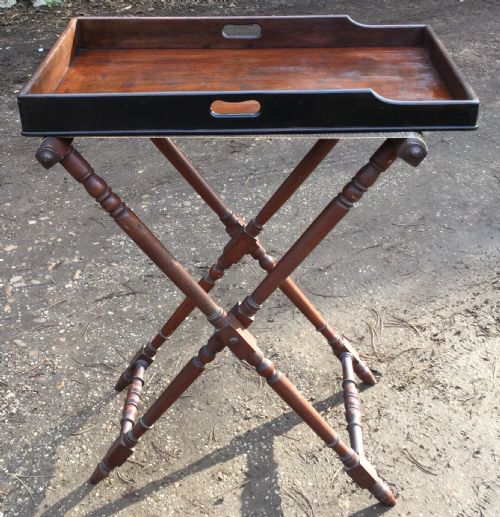
- A collapsible wooden support designed to hold a removable tray at table height. These stands often incorporate X-frame designs for stability.
- Hongmu
- A traditional Chinese term for dense hardwoods, typically translated as red wood. Trays in this material exhibit deep colour and heavy weight.
- Galleried tray
- A serving surface featuring an enclosed rim. It provides both security for glassware and a finished decorative profile.
Carved Wood Butler Tray: Frequently Asked Questions
How were butler trays originally used?
Servants used these portable trays to carry food and drinks from the kitchens to the dining rooms or drawing rooms in large houses. Once delivered, the tray was often placed onto a folding wooden stand to serve as an impromptu side table.
After use, the tray was lifted off the stand and the entire assembly folded flat for compact storage in pantries or hallways. This versatility allowed households to deploy extra surface space wherever it was required.
Can these trays be used as coffee tables?
Many people repurpose these folding trays and stands today as low coffee tables in sitting rooms. The height of the traditional folding stand suits modern seating arrangements well.
To protect the antique timber surface from daily wear, many owners place a clear glass top over the tray. This preserves the original carved wood and raised gallery while offering a stable place for cups and books.
How do I distinguish a Georgian tray from later revival pieces?
Authentic Georgian pieces display the timber selection, hand-cut joinery, and natural patination characteristic of the eighteenth and early nineteenth centuries. The weight, tool marks, and construction of the gallery sides offer reliable clues to the age of the wood.
Revival pieces, such as those made around nineteen hundred, often utilise machine-sawn components and standardised fittings. Examining the underside and the joints reveals the manufacturing methods of the period.
What is the difference between a serving tray and a tray table?
A serving tray is constructed solely as a portable platter with integrated handholds or a gallery for carrying items. It relies on being lifted and moved by hand.
A tray table pairs that same removable tray with a dedicated folding or fixed stand to create a piece of furniture. On this page, many listings include both the tray and its matching stand.