


Carved Timber Kitchen Table
A carved timber kitchen table brings honest domestic utility and centuries of tactile grain into modern daily life.
Carved Timber Kitchen Table
A carved timber kitchen table serves as the heavy working heart of a home, built for daily culinary prep and family gathering. When you search for this phrase, you encounter solid domestic surfaces shaped by regional European and English workshops over successive centuries.
The pieces appearing on this page span several distinct eras, stretching from late eighteenth-century Spanish chestnut designs to Edwardian oak forms and twentieth-century French butcher blocks. You are most likely to meet sturdy oak farmhouses tables and heavy beech or elm chopping blocks fitted with drawers or trestle ends.
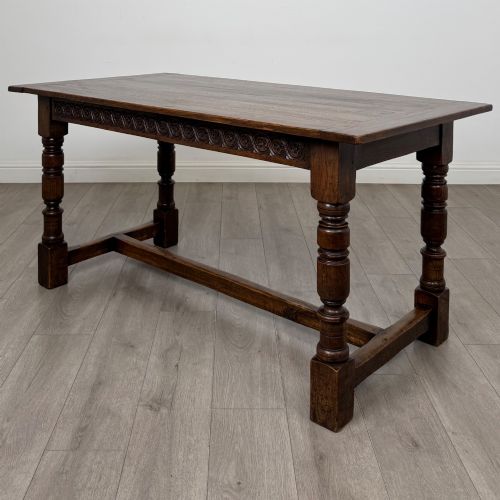
Makers such as Trussant and Cie and Hennes France demonstrate the commercial and utilitarian origins of these domestic mainstays, which range from English country house prep tables to French provincial centre tables. Each object balances utilitarian strength with carved detailing upon skirts, legs, and trestle supports.
Materials and construction methods
These tables rely on durable domestic hardwoods, predominantly oak, beech, elm, and chestnut, selected for their resistance to heavy daily labour. Workshops joined heavy timber planks using traditional joinery, often mounting thick chopping slabs and prep tops upon stable trestle frames or four-legged undercarvings.
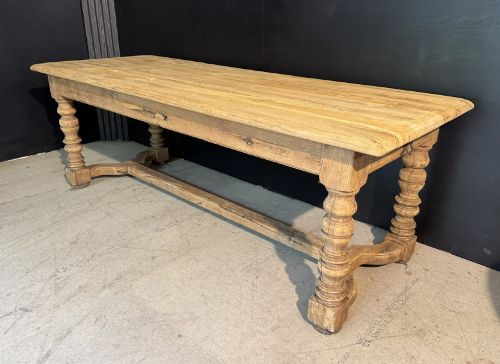
Metal components appear where structural reinforcement is required, incorporating iron and brass brackets, handles, and occasionally bronzed mounts to secure heavy working timber. Certain examples exhibit deliberate surface treatments, such as bleached oak finishes, while others retain the marks of historic use across French provincial and English country house traditions.
Several heavy butchers blocks retain embedded metal hooks once used for hanging cleavers within arm's reach of the chef.
Distinguishing quality across periods
Quality in a carved timber kitchen table rests in the integrity of the primary timber and the honesty of its construction rather than superficial decorative flourish. Superior examples display dense, well-seasoned oak, elm, or chestnut with thick working tops that have endured generations of preparation without losing their structural stability.
The refinement of the carving upon the skirts and trestle ends distinguishes standard utilitarian pieces from finer regional works, such as Jacobean revival dining tables or late eighteenth-century Spanish farmhouse forms. Well-executed hardware, integrated drawers, and maker stamps from firms like Trussant and Cie elevate an ordinary kitchen surface into a notable piece of vernacular furniture.
Trussant and Cie·Hennes France
The Carved Timber Kitchen Table Glossary
- Butchers Block
- A heavy, thick-topped wooden table designed for meat preparation and kitchen utility. These blocks typically feature dense end-grain or planked beech and elm construction.
- Trestle Table
- A table consisting of two or more support frames connected by a horizontal beam or stretcher. This design provides maximum legroom and structural stability for long dining boards.
- Bleached Oak
- Oak timber treated to lighten its natural tone, a finish seen on English country house prep tables. This process highlights the prominent grain patterns of the wood.
- French Provincial
- A style reflecting regional French domestic cabinet-making traditions, characterised by modest proportions and subtle carved details. These pieces combine rustic charm with functional utility.
Carved Timber Kitchen Table: Frequently Asked Questions
How do I care for a historic timber table top?
Maintain the surface by applying natural oils periodically to nourish the dry wood without sealing it permanently. Avoid harsh chemical cleaners that strip the historic patina accumulated through decades of domestic use.
Keep the table away from direct heat sources and sudden humidity shifts to prevent the heavy planks from splitting or warping. Simple wipe-downs with a damp cloth suffice for daily maintenance.
Were these tables used only in kitchens?
While many served as dedicated food preparation surfaces and chopping blocks in sculleries, larger examples functioned as main dining boards in farmhouses and country houses. Their robust construction made them suitable for any heavy domestic labour.
Over time, prep tables and centre tables transitioned between working kitchens and living spaces as domestic layouts evolved. Today, their versatile proportions allow them to bridge the gap between workspace and dining table.
How can I distinguish an Edwardian table from an eighteenth-century one?
Examine the tooling marks, timber density, and assembly methods visible beneath the top and along the frame. Eighteenth-century pieces often display hand-sawn board widths and pegged joinery characteristic of earlier provincial workshops.
Edwardian interpretations frequently incorporate revival styles, machine-assisted finishing, and standardised hardware while maintaining heavy oak construction. Comparing the wear patterns on the working surface also provides clues regarding the age of the timber.
What is the difference between a prep table and a dining table?
Prep tables generally feature thicker working tops, integrated drawers for utensils, and occasionally specialised lower shelves or butcher block inserts. Their proportions prioritize height and stability for standing tasks.
Dining tables focus on comfortable knee clearance, balanced trestle or four-leg placements, and expansive surface areas for seating guests. Hybrid forms often blur these lines, reflecting the multifunctional nature of historic kitchens.