



Carved Mahogany Music Rack
These carved mahogany music rack pieces bring traditional order to sheets and volumes, offering sturdy timber and divided storage for the discerning collector.
Carved Mahogany Music Rack
When you search for a carved mahogany music rack, you are looking at practical timber furnishings designed to hold folios, sheets, and periodicals in domestic spaces. These pieces appear primarily as canterburys, music stands, and magazine racks spanning the Georgian, Regency, William IV, and Victorian periods.
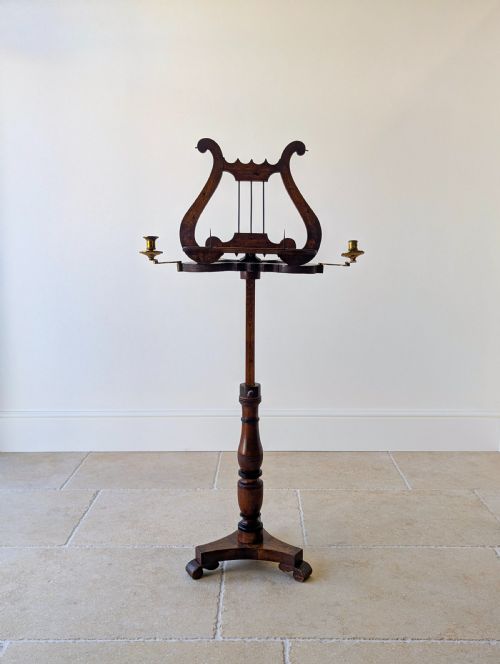
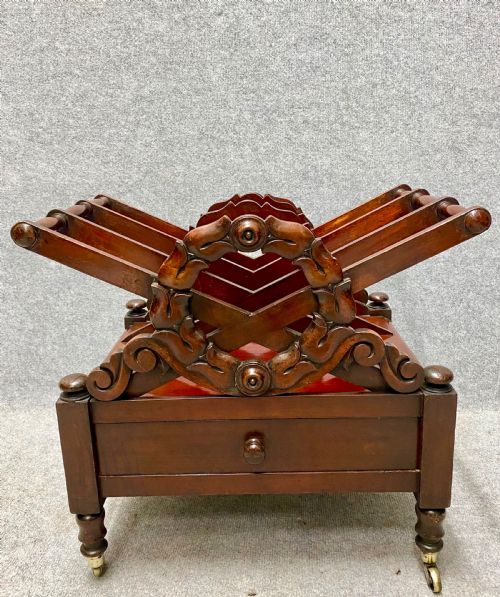
You are most likely to meet Canterbury designs featuring divided sections for holding scores alongside supportive uprights and lower storage drawers. The forms range from simple three-division scroll compartments to elaborate lyre-form music stands in rich mahogany and Cuban mahogany timbers.
How they were made
Cabinet makers utilised dense timbers such as standard mahogany, Cuban mahogany, and occasionally rosewood to build these stands. The structural components rely upon solid wood joined with traditional carpentry methods to support the weight of heavy paper collections.
Decoration is achieved through specialist techniques including carved wreath motifs, pierced scroll divisions, and shaped supports. Brass accents and castors appear frequently to assist mobility across household floors.
The listings show pieces constructed from standard mahogany and Cuban mahogany, augmented occasionally by rosewood and brass fittings.
What varies in quality
The standard of timber selection and carving execution dictates the grade of each piece, distinguishing utilitarian items from finer examples. Rich grain figures in the mahogany and crisply defined scrollwork denote superior workshop production.
Structural integrity of the vertical divisions and the smoothness of any integrated drawer movement mark the difference between standard items and those built for prominent country houses.
Gillows of Lancaster·J.C.Loudon
The Carved Mahogany Music Rack Glossary
- Canterbury
- A low stand with vertical divisions used for holding sheet music, folios, and periodicals. It frequently incorporates a small drawer beneath the divisions and rests upon short legs with castors.
- Lyre-form
- A decorative framework shaped in the outline of a classical lyre instrument. This silhouette appears often in the upright supports of music stands.
- Cuban mahogany
- A dense, heavy timber sourced from the Caribbean noted for its deep colour and rich grain patterns. Cabinet makers prized this material for high-status furniture during the Georgian and Regency eras.
- Scroll divisions
- Partitions shaped into sweeping curves that separate the storage sections of a rack. These openwork partitions lighten the visual weight of the timber.
Carved Mahogany Music Rack: Frequently Asked Questions
What is a carved mahogany music rack used for?
These pieces serve to organise and display bound volumes, sheet music, and periodicals within domestic reception rooms. The upright divisions keep papers upright and accessible for daily performance or reading.
Historically, they sat near pianos or seating areas to keep reading materials close at hand. Today, owners utilise them to store modern journals and records while retaining traditional room aesthetics.
How do I identify a Regency period piece?
Regency examples display classical proportions, clean architectural lines, and specific decorative motifs such as lyre shapes. The timber often exhibits a warm tone with subtle grain patterning.
Examining the construction methods underneath and inside drawers helps confirm the period. Later reproductions often lack the hand-finished subtleties found in genuine early nineteenth-century work.
Where should I place a music rack at home?
Position these stands beside a piano, writing desk, or within a quiet library corner where their divided compartments remain accessible. Their compact footprint allows them to fit neatly against walls or beside seating.
Keep the timber away from direct sunlight and strong heat sources to prevent the mahogany from drying out. Regular dusting maintains the natural sheen of the polished surface.
How do canterburys differ from standard magazine racks?
Traditional canterburys incorporate specific structural divisions designed originally for heavy musical scores alongside a low drawer base. Standard magazine racks often feature simpler wire or lighter wood frameworks.
Canterburys rely on solid timber construction like mahogany and feature turned legs with castors. This heavier build reflects their origins as substantial pieces of period furniture.