





Carved Hardwood Frame
A carved hardwood frame brings dense, tactile relief and deep grain to interiors, spanning Victorian, Chinese, and Anglo-Indian traditions.
Carved Hardwood Frame
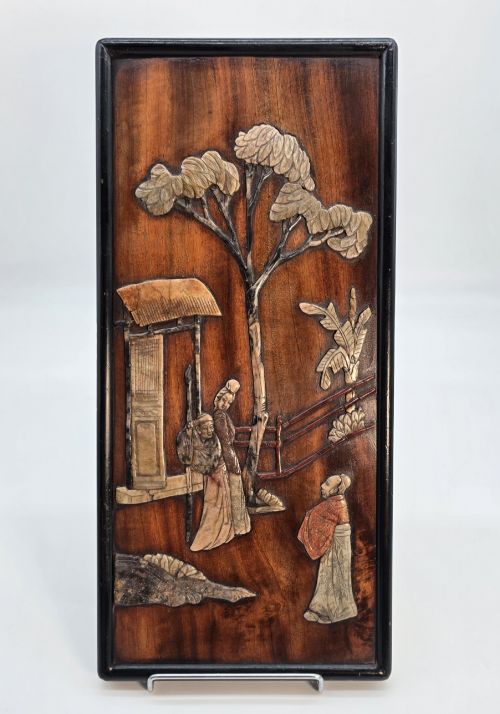
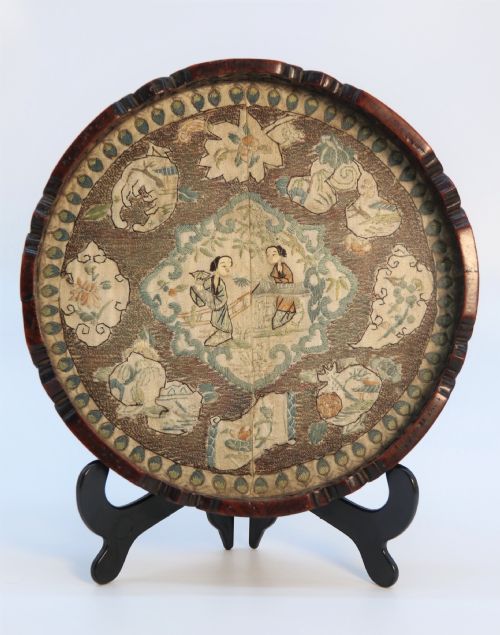
A carved hardwood frame acts as the structural housing for mirrors, wall panels, and embroidered table screens found across these listings. These pieces emerge primarily from 19th-century Chinese workshops and Indian regional centres like Hoshiarpur, often displaying intricate floral or geometric motifs. Buyers encounter both standalone wall art and frames integrated into larger furniture forms such as folding armchairs and four-poster beds.
The aesthetic vocabulary divides distinctly between the deep relief carvings of the Indian Raj period and the refined, often water-plant or figural motifs of Qing Dynasty craftsmanship. Many examples incorporate mixed media, setting the dark timber against brass wire inlay, silk embroidery, or inset soapstone and hardstone panels. Formats range from modest tabletop screen supports to imposing architectural wall panels and monumental bed structures.
Assessing quality in carved woodwork
Quality rests principally on the crispness and depth of the chisel work, distinguishing master carvers from commercial producers. Superior pieces exhibit undercutting and varied planes that create genuine shadow and movement, whereas lesser examples rely on shallow, repetitive surface scoring.
The integrity of the secondary materials, such as the tightness of brass wire inlay and the preservation of original silk or hardstone inserts, marks the difference between a well-preserved survivor and a compromised example. Timber selection also dictates grade, with straight-grained, stable hardwoods commanding greater respect than reactive secondary woods.
Carved Hardwood Frame Retail Price Guide 2026
Typical asking prices for carved hardwood frame among the pieces listed under this phrase on Sellingantiques today, from the lower quarter to the upper quarter. They describe what is for sale here now, not the wider market.
Camels everywhere nod in approval as heavy nineteenth-century saddles moonlight as decorative room sculpture.
The Carved Hardwood Frame Glossary
- Anglo-Indian
- A style describing decorative arts produced in India during the British colonial period, frequently blending British furniture forms with indigenous carving traditions.
- Savonarola style
- A type of folding X-frame chair constructed from intersecting curved wooden slats, often heavily carved or inlaid.
- Hoshiarpur
- A town in Punjab, India, renowned for its distinct woodwork tradition involving intricate brass wire inlay set into dense timber frames.
- Qing Dynasty
- The final imperial dynasty of China, spanning the seventeenth to early twentieth centuries, known for refined hardwood furniture and scholarly objects.
- Table screen
- A decorative tabletop panel supported by a carved stand, designed to display embroidered silk, stone, or carved wood.
Carved Hardwood Frame: Frequently Asked Questions
How do I clean a carved wooden frame?
Dust accumulated in deep relief carvings requires a soft-bristled artist's brush rather than a cloth that might snag on delicate edges. Apply periodic feeds of microcrystalline wax sparingly to nourish the timber without clouding the grain.
Avoid liquid polishes containing silicone, which build up in the recesses and darken the wood unnaturally over time. Gentle, dry maintenance preserves the original patina developed over the nineteenth century.
Are these frames suitable for modern mirrors?
Many frames house their original silvered glass or silk panels, which contribute significantly to the historical integrity of the piece. Replacing glass should be approached cautiously to avoid altering the original rebate and backing construction.
When utilised purely as wall art, the structural strength of these heavy timbers easily supports modern mirror inserts provided appropriate professional wall fixings are employed.
How do I distinguish Chinese from Indian carvings?
Chinese carving from this era typically emphasises asymmetry, water plants, and figures rendered in deep, rounded relief on dense tropical hardwoods. Indian work from centres like Hoshiarpur relies heavily on geometric brass wire inlay and intricate foliage patterns.
Examining the construction joints and secondary support structures also reveals regional workshop practices characteristic of the nineteenth century.
What is a table screen?
A table screen consists of a decorative panel mounted within a stable, freestanding wooden base designed for scholar's desks or interior display. These panels frequently showcase embroidered silk, soapstone inlay, or pierced wood carvings.
The form originated in East Asia as both a functional draft barrier and an object of contemplation for scholars and collectors.