

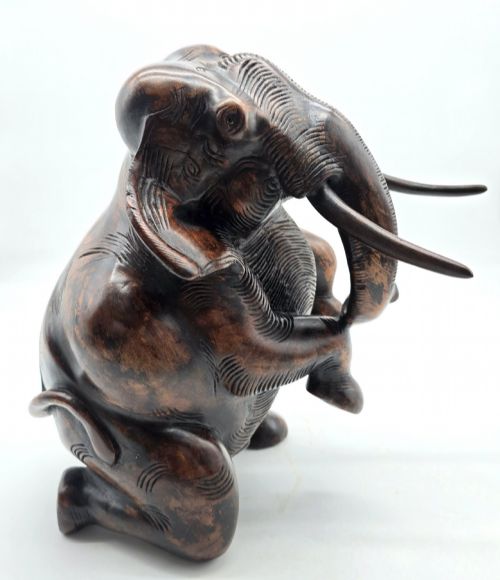


Carved Hardwood Animal Statue
These carved hardwood animal statue examples bring natural forms into rooms through regional traditions spanning the nineteenth and early twentieth centuries.
Carved Hardwood Animal Statue
A carved hardwood animal statue represents diverse regional styles, ranging from Chinese Qing Dynasty pairs of Mandarin ducks and water buffaloes to Indian Raj period elephant studies and African folk art. Buyers encounter forms including sculptures, decorative carvings, bookends, and processional horses created across the nineteenth and early twentieth centuries.
The pieces appearing on this page reflect international carving traditions from the 1880s through the 1930s. Artisans utilised dense timbers to capture subjects as varied as monkeys, panthers, tigers, hippopotamuses, iguanas, and Cape buffaloes in varied postures.
Materials and construction methods
Carvers shaped dense timbers such as ebony and general hardwood, sometimes combining carved hardwood with bone to highlight anatomical details. Surfaces received dark stains to enrich the natural grain and depth of the timber.
Makers employed hand-carving techniques to produce freestanding sculptures, fitted stands, and functional bookends. Regional workshops in China, India, Japan, and Africa applied traditional tool work characteristic of periods including the Meiji period and Art Deco era.
Carved Hardwood Animal Statue Retail Price Guide 2026
Typical asking prices for carved hardwood animal statue among the pieces listed under this phrase on Sellingantiques today, from the lower quarter to the upper quarter. They describe what is for sale here now, not the wider market.
Periods represented span from the nineteenth century through the 1930s, encompassing the 1880, 1890, 1900, 1920, and 1930 dates.
Distinguishing sculptural merit
The success of a carving depends on the precision of the animal's anatomy and the vitality of its posture, whether depicting a stampeding Cape buffalo or a resting monkey. Stronger examples display confident handling of the timber grain to define muscle, texture, and movement.
The Carved Hardwood Animal Statue Glossary
- Hardwood
- Dense timber derived from broad-leaved trees, providing the primary medium for these animal sculptures. This material resists warping and allows for fine detail work.
- Ebony
- A dense black or very dark brown wood prized for its weight and smooth finish. Carvers utilised ebony for studies of elephants and bookends.
- Raj period
- The period of British rule in the Indian subcontinent spanning the nineteenth and twentieth centuries. Works from this era often depict processional or ceremonial elephants.
- Qing Dynasty
- The last imperial dynasty of China, lasting until the early twentieth century. Sculptures from this period include paired Mandarin ducks and water buffaloes.
- Meiji Period
- An era in Japanese history characterised by significant cultural exchange and fine craftsmanship. Wood sculptures from this time demonstrate acute observation of natural subjects.
Carved Hardwood Animal Statue: Frequently Asked Questions
What animals are commonly depicted in these statues?
Carvings portray a wide range of fauna including elephants, water buffaloes, monkeys, panthers, tigers, hippopotamuses, and horses. Many reflect the native wildlife or cultural symbols of their regions of origin.
Selections also feature paired birds such as Mandarin ducks and reptiles like iguanas. Each subject showcases the distinct regional style of periods like the Qing Dynasty or the Raj period.
How should I care for a hardwood animal sculpture?
Keep wooden sculptures away from direct sunlight and sudden temperature changes to prevent the timber from drying out or splitting. Dust gently with a soft, dry cloth.
Avoid using water or liquid polishes unless specifically recommended for the finish. Maintaining stable indoor humidity preserves the integrity of the carved surface.
How do I identify the period of a carved animal?
Dating relies on stylistic markers associated with specific eras such as Art Deco, the Meiji period, or late nineteenth-century craftsmanship. Examining the tools marks and regional convention provides further clues.
Material choices like ebony combined with bone or specific staining techniques also point towards manufacturing traditions of the 1880 to 1930 timeframe.
Were these statues used as functional items?
Many examples function purely as decorative sculptures, figures, or standalone models of animals. Others serve practical purposes, such as pairs of carved ebony elephant bookends.
Processional horses and ceremonial elephants often functioned as display pieces reflecting cultural rituals and domestic decoration of their respective eras.