



Cartography Globe on Stand
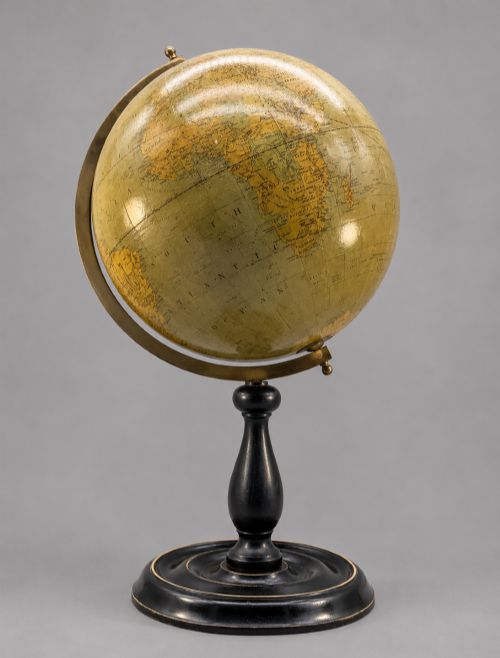
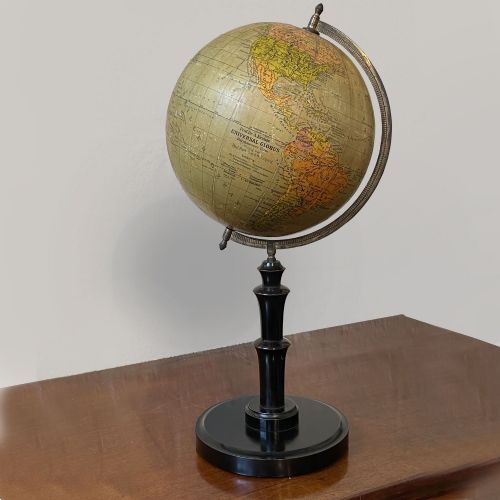
A cartography globe on stand sits as a centrepiece of study, offering a physical map of the world supported on a dedicated wooden or metal frame.
Cartography Globe on Stand
When you search for a cartography globe on stand, you are looking at geographical spheres designed to rest securely upon table bases, floor pedestals, or library mountings. The selections span smaller table-top specimens up to substantial floor-standing pairs created for grand rooms.
The versions most commonly met on this page date from the nineteenth century, including Victorian productions and specific dated examples from eighteen-eighty. Makers such as Malby's feature prominently among the larger library formats.
Object types vary widely from pocket-sized miniature table globes to eighteen-inch library giants and matched pairs of terrestrial and celestial globes. Origins stretch across British workshops and nineteenth-century French makers like Lebegue and Cie.
Construction and materials
Construction relies upon papier-mâché or plaster spheres built over a wooden core, upon which gores of printed paper maps are painstakingly hand-applied. These delicate paper surfaces are then finished with varnish to protect the cartography.
Stands utilise traditional cabinet timbers such as mahogany and ebonised wood, frequently paired with brass meridian rings and cast iron weighted bases for stability. The marriage of turned wood and metal hardware dictates the physical presence of each piece.
Cartography Globe on Stand Retail Price Guide 2026
Typical asking prices for cartography globe on stand among the pieces listed under this phrase on Sellingantiques today, from the lower quarter to the upper quarter. They describe what is for sale here now, not the wider market.
Some nineteenth-century globes retain obsolete country names and forgotten colonial borders that tell the story of a changing world.
Factors determining quality
Quality rests heavily upon the legibility and detail of the cartographic engraving, alongside the crispness of the hand-colouring applied to the paper gores. Finer examples retain their original varnished finish without significant darkening or surface disruption.
The structural integrity of the supporting stand, whether a modest table frame or a complex floor pedestal with brass hardware, distinguishes superior productions from standard utility items.
Lebegue and Cie·Malby's·Thomas Malby
The Cartography Globe on Stand Glossary
- Terrestrial globe
- A spherical representation of the Earth displaying continents, oceans, and political boundaries. These map the physical world as understood at the date of manufacture.
- Celestial globe
- A sphere mapping the constellations and stars relative to the Earth. They are frequently encountered as companion pieces paired with terrestrial globes.
- Gores
- Tapered printed paper strips shaped to fit smoothly over a spherical globe. The alignment of these sections requires considerable skill during assembly.
- Meridian ring
- The graduated brass or metal ring that encircles the globe and holds it within the stand. It allows the sphere to tilt and rotate along specific axes.
Cartography Globe on Stand: Frequently Asked Questions
What is a cartography globe on stand?
It is a geographical sphere mounted upon a dedicated base, designed for display on a desk, table, or directly on the floor.
These pieces combine decorative woodwork with historical cartography to serve as both scientific instruments and interior furnishings.
How were these globes used historically?
They served as practical reference tools for navigation, education, and understanding global trade routes in libraries and studies.
Owners consulted them to follow contemporary explorations and geopolitical shifts of the nineteenth and early twentieth centuries.
How do I care for an antique globe?
Keep the piece away from direct sunlight and fluctuating humidity to prevent the paper gores from fading or cracking.
Dust the surface gently with a dry cloth and avoid using liquid cleaners on the delicate varnished paper map.
Why are some globes found in pairs?
Makers often produced terrestrial and celestial globes together to represent both the Earth and the night sky in a unified display.
Such pairs were standard furnishings for prosperous Victorian and Georgian libraries.