
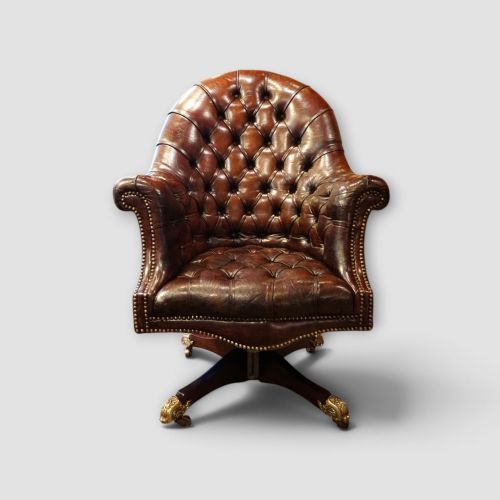
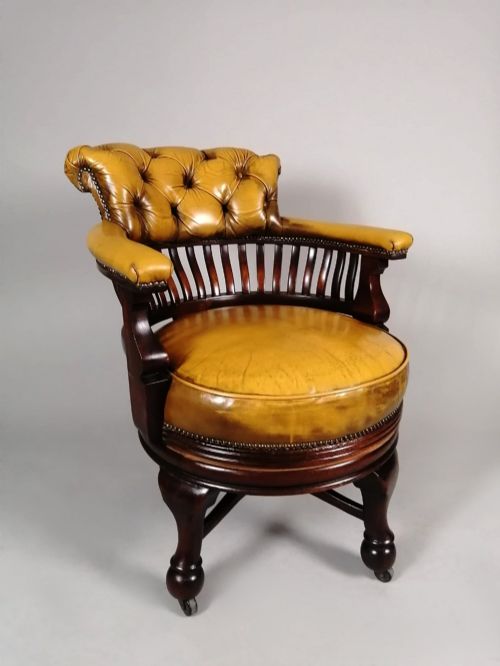


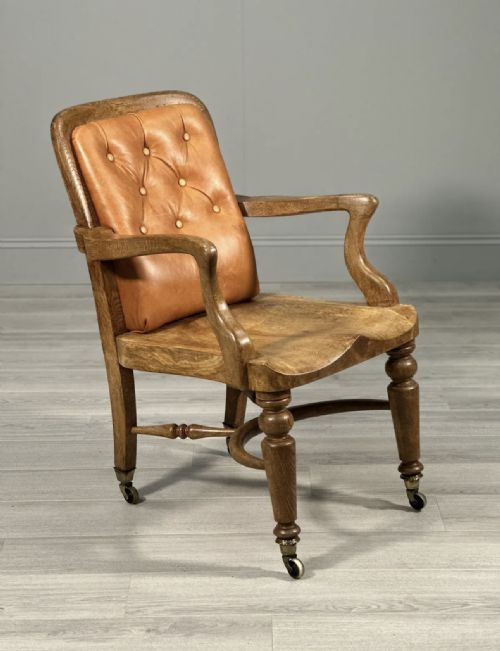
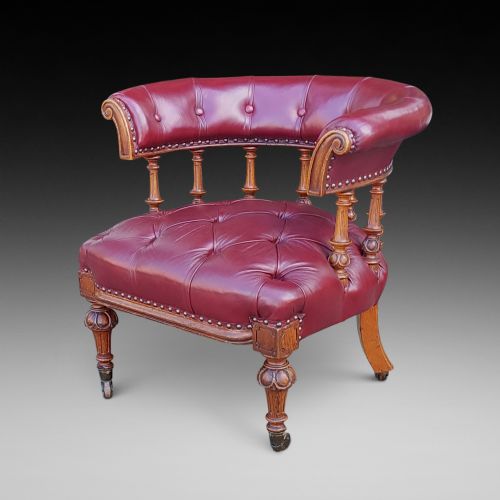
Buttoned Leather Swivel Chair
A buttoned leather swivel chair brings heft and mobility to a study, built from solid timbers and hide.
Buttoned Leather Swivel Chair
A buttoned leather swivel chair is a working seat designed for a desk or study, combining height adjustment and rotational movement with deep upholstery. You will most frequently meet Victorian and Edwardian examples on this page, dating from the late nineteenth century through to the early decades of the twentieth.
The forms range from compact office armchairs to revolving desk chairs and occasional ships chairs, often constructed in mahogany, oak, walnut, or hardwood. These pieces serve primarily as functional seating for a library or office, retaining their mechanical actions and heavy bases.
Makers of the period shaped these chairs for daily use, incorporating brass fittings, cast iron mechanisms, and turned supports. The surviving pieces show a clear lineage of utilitarian design shaped by the demands of nineteenth-century commerce and study.
How they were made
Makers built the frames of these chairs from dense timbers like mahogany, oak, and walnut, selecting hardwoods capable of bearing the strain of a revolving spindle. Joinery relied on solid dowels, mortise and tenon joints, and carved wooden components designed to last through decades of use.
Upholsterers secured leather hides over stuffing, pressing the material into deep tufts held by buttons to create the characteristic grid pattern. Brass studs frequently edge the leather panels, while cast iron and brass mechanisms underneath provide the pivot and height adjustment.
Materials recorded across the archive include brass, cast iron, and leather paired with traditional framing timbers.
What varies in quality
Quality rests in the weight of the timber framing and the original integrity of the swivel mechanism beneath the seat. Heavier gauge cast iron and robust brass spindles separate sturdier workshop output from lighter commercial variants.
The finish of the leather and the depth of the buttoning also distinguish the work, alongside the crispness of any carved wooden details on the arms and backrest. Pieces retaining their original patinated hide sit distinctly apart from later replacements.
The Buttoned Leather Swivel Chair Glossary
- Revolving
- The ability of the seat to turn full circle on a central vertical spindle. This action relies on an iron or brass screw mechanism hidden beneath the wooden base.
- Buttoned
- An upholstery technique where twine pulls the leather tight against the padding at regular intervals, securing the stuffing and forming deep depressions.
- Mahogany
- A dense, reddish-brown tropical hardwood favoured by nineteenth-century cabinet makers for its stability and fine grain. It takes a high polish and resists warping under daily stress.
- Cast iron
- A strong, rigid metal alloy poured into moulds to form the heavy undercarriages and spider legs of swivel chairs. It provides the necessary ballast to prevent tipping during rotation.
- Ships chair
- A compact variant designed for stability in maritime environments, often featuring heavier framing or specific mounting points to counter movement.
Buttoned Leather Swivel Chair: Frequently Asked Questions
How do I adjust the height on these chairs?
Most of these chairs adjust by simply spinning the seat on its central wooden or iron screw thread, raising or lowering the upper frame relative to the base.
Older examples lack modern pneumatic levers, relying entirely on this manual threaded rotation to set the working height.
Are the swivel mechanisms original?
Many retain their original cast iron and brass spindles, which often show maker marks or foundry stamps from the nineteenth century.
Over decades of use, some components required maintenance or replacement, so checking the underside reveals whether the ironwork matches the age of the wooden frame.
How do I care for nineteenth-century leather?
Leather from this era benefits from occasional feeding with appropriate wax or balm to maintain suppleness and prevent cracking across the buttoned folds.
Avoiding direct sunlight and excessive heat preserves the natural patina and keeps the hide from drying out over time.
How do I distinguish Victorian from Edwardian examples?
Victorian pieces tend to feature darker, heavier mahogany or walnut frames with deep carving and robust proportions. Edwardian versions often lean towards lighter oak or satinwood inlay, reflecting a shift toward simpler lines.