
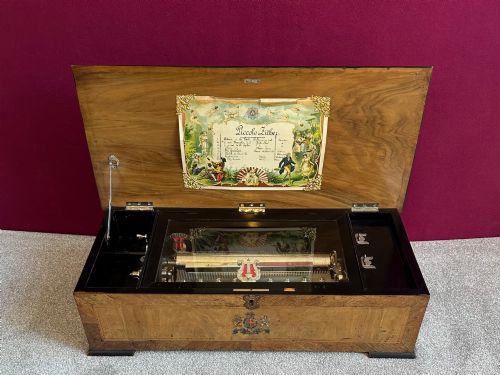


Brown Walnut Music Box
A brown walnut music box brings mechanical melody into the room through brass, steel and rich timber.
Brown Walnut Music Box
When you search for a brown walnut music box, you are looking at Victorian and Edwardian melodic automata and associated furniture pieces designed to play mechanically produced tunes in the home. These objects span simple tabletop cylinder boxes and large table top symphoniums to fitted music cabinets and upholstered piano stools.
The version you are most likely to meet on this page is the Victorian walnut cased cylinder box or cabinet dating from the mid-nineteenth century through to the early twentieth century. Walnut and burr walnut dominate the timber choices, frequently enhanced with inlaid fruitwood, brass mounts and ebonised wood details.
Beyond standard tabletop music boxes, the selections include complex symphonium disc players and specialist furniture housing musical movements, such as Canterbury stools and fall-front piano stools. Origins traverse British cabinet-making traditions alongside Swiss musical mechanism production.
Materials and construction
Cases rely on solid walnut and decorative burr walnut veneers, sometimes contrasted with ebonised wood and inlaid fruitwood details to frame the exterior. Internal components depend entirely upon precision metalwork, pairing tempered steel combs with brass cylinders or metal discs.
Structural elements incorporate glass viewing panels on advanced disc players and brass hinges, handles and locking mechanisms. Furniture pieces such as piano stools and music cabinets integrate upholstered seating elements and internal shelving alongside their mechanical provisions.
Current listings feature Victorian and Edwardian periods utilising walnut, burr walnut, rosewood, ebonised wood, and inlaid fruitwood.
Assessing quality and execution
Quality reveals itself in the complexity of the musical arrangement and the fidelity of the metal comb and pinned cylinder or disc mechanism. Finer examples command attention through substantial scale, robust cabinetry, and sophisticated mechanisms such as mandolin-effect combs or large-format symphonium layouts.
The finish of the walnut casing and the precision of any fruitwood inlay or brass hardware separate standard utility boxes from exceptional salon pieces. Superior execution is further evident in dedicated cabinetry like music cabinets and fitted piano stools that maintain structural integrity alongside functional mechanical compartments.
Lochmanns·B A Bremond
The Brown Walnut Music Box Glossary
- Cylinder box
- A mechanical musical instrument that plays tunes using a rotating brass cylinder set with tiny pins that pluck a steel comb. These pins strike individual tuned teeth to produce the notes.
- Symphonium
- A large table top disc player that uses interchangeable metal discs instead of pinned cylinders to deliver music. This disc system allows a wider repertoire of tunes to be played on a single machine.
- Mandolin
- A special comb arrangement within a cylinder box where notes are repeated rapidly on multiple tuned teeth to mimic the plucked sound of a mandolin. It creates a shimmering tremolo effect.
- Canterbury stool
- A low furniture piece featuring vertical partitions designed originally for holding sheet music, often combined with a seated top. In walnut iterations, it serves as both storage and seating.
- Burr walnut
- A prized timber veneer taken from the knotted growth of a walnut tree, yielding swirling, highly decorative grain patterns. Makers utilised it on the primary exterior surfaces of finer boxes and cabinets.
Brown Walnut Music Box: Frequently Asked Questions
How do cylinder music boxes work?
A brass cylinder rotates while its surface pins strike a tuned steel comb. Each pin aligns with a specific tooth to produce precise notes.
Hand-wound spring motors drive the rotation at a regulated speed governed by a small air brake or governor.
What is a symphonium?
A symphonium is a heavy tabletop disc player that uses perforated metal discs rather than pins on a cylinder. The holes in the rotating disc trigger star-wheels that pluck the steel comb.
This format allows owners to swap flat metal discs easily to change the musical selections.
How do I date a walnut music box?
Dating relies on the casing style, timber treatment, and mechanical format. Victorian pieces often display straightforward walnut cases or rich burr veneers from the mid to late nineteenth century.
Edwardian examples transition into the early twentieth century, occasionally incorporating heavier architectural mouldings or specialised cabinetry.
Where were these music boxes placed?
Tabletop cylinder boxes and large symphoniums sat prominently in drawing rooms and parlors as decorative furniture and entertainment focal points. Larger pieces rested on tabletops or dedicated stands.
Music cabinets and piano stools integrated the hobby directly into the musical life of the Edwardian and Victorian parlor.