



Bronze Statue Clock
A bronze statue clock marries sculptural presence with timekeeping, bringing nineteenth-century French artistry directly onto your mantelpiece.
Bronze Statue Clock
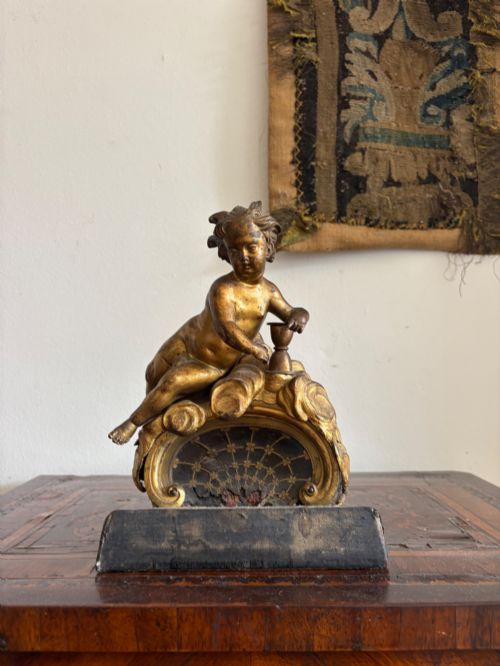
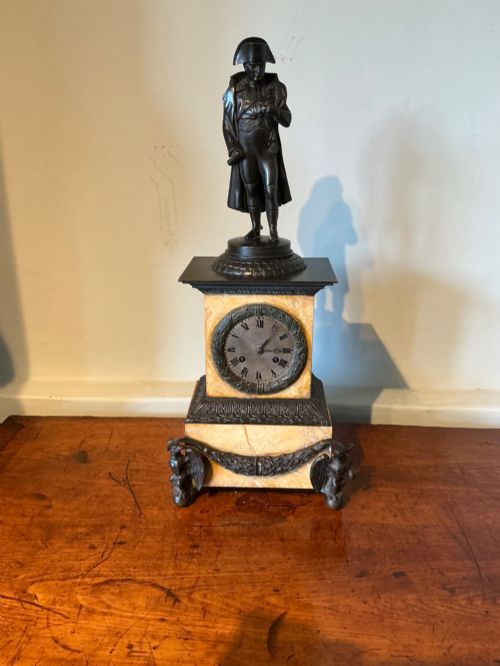
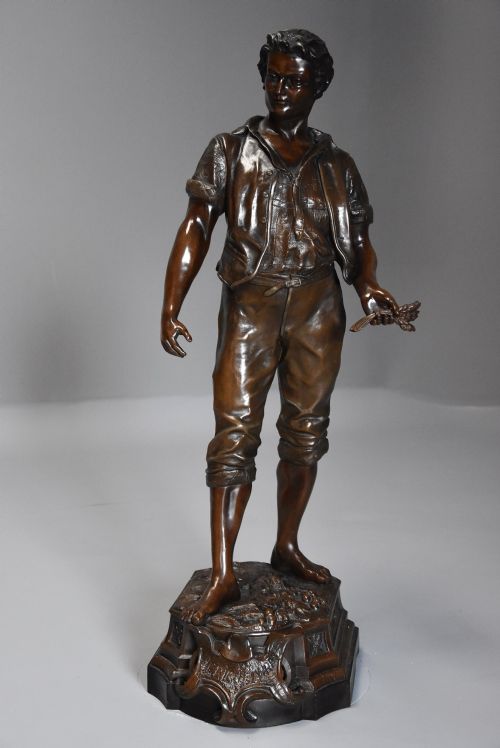
A bronze statue clock unites figurative sculpture and timekeeping within a single decorative object, predominantly originating from nineteenth-century French workshops. Buyers seek these pieces for their commanding presence and the detailed character of the figures, which range from classical emperors to mythological putti and farm labourers.
The versions most commonly met on this page are mantel clocks featuring patinated or gilt bronze figures mounted upon marble or bronze plinths. These works span the Victorian era, the French Empire style, and later nineteenth-century revivals, often incorporating hand-painted enamel dials alongside sculptural narratives.
The integration of the timepiece and the figure varies significantly across forms, with some designs placing a clock face directly within a bronze plinth while others elevate a grand figure beside or above the dial. Certain examples arrive as part of a clock garniture set, accompanied by matching decorative ornaments that complete a symmetrical arrangement.
How they were made
Foundry workers produced these figurative timepieces using traditional casting methods in bronze, ormolu, and occasionally alternative metals such as spelter. Gilt bronze and ormolu finishes involved applying a mercury-gilding technique to achieve a lasting golden sheen, whilst patinated bronze surfaces were chemically treated to create dark, nuanced tones.
Many figures incorporated cold-painted details or fine chasing work finished by hand after the initial cast cooled. Dials were frequently fashioned from white enamel with delicate hand-painted numerals, protected beneath glassbezels set into marble bases or bronze housings.
Bronze Statue Clock Retail Price Guide 2026
Typical asking prices for bronze statue clock among the pieces listed under this phrase on Sellingantiques today, from the lower quarter to the upper quarter. They describe what is for sale here now, not the wider market.
Farm labourers keep watch over the hours alongside imperial generals and winged putti.
What varies in quality
Materials also dictate the tier of the object, with dense sienna marble plinths and heavy fire-gilt ormolu mounts commanding greater presence than lighter spelter alternatives with painted finishes. The integration between the clock mechanism and the surrounding sculpture further separates workshop productions from master bronzier creations.
F. Milliot·Bellenot Paris·Louis Hottoot
The Bronze Statue Clock Glossary
- Ormolu
- Gilt bronze created by applying a mixture of gold and mercury to a bronze base, then firing to leave a rich metallic coating. This technique produced the bright golden highlights seen on nineteenth-century French clock mounts.
- Spelter
- A zinc-based alloy used as an accessible alternative to bronze for figurative castings during the nineteenth century. It was often bronzed or painted to mimic heavier, more costly metal.
- Clock Garniture
- A matching set consisting of a central mantel clock accompanied by flanking ornaments or vases. These sets were designed to create a unified decorative display on a fireplace mantel.
- Putto
- A chubby male child figure, frequently winged, derived from classical art and commonly used as a decorative finial or mounting detail on French clocks. These figures add a playful mythological element to the composition.
Bronze Statue Clock: Frequently Asked Questions
How do I wind my bronze clock?
Most nineteenth-century mechanical movements require a key to tension the spring through winding arbors on the enamel dial.
Care should be taken not to overwind the mechanism to ensure the movement retains its correct tension.
Are these clocks suitable for daily use?
These antique timepieces function well as daily clocks when properly serviced by a professional horologist.
Placing them on a stable mantelpiece away from direct sunlight protects both the marble base and the delicate enamel dial.
What is a clock garniture set?
A garniture set pairs a central mantel clock with two matching side ornaments, such as urns or candelabra.
This arrangement was designed to create a balanced, formal display across a nineteenth-century mantelpiece.
How do I distinguish bronze from spelter?
Bronze is heavier, colder to the touch, and displays a finer grain when viewed closely at unpainted edges.
Spelter is a softer zinc alloy that often shows lighter weight and distinct casting seams under close inspection.