




Bronze Door Hardware
Bronze door hardware brings weight and character to an entrance, offering tactile handles, knockers, and pulls shaped in centuries-old styles.
Bronze Door Hardware
Bronze door hardware comprises functional and decorative fittings for entrances, spanning from heavy architectural knockers to matched pairs of door handles and centre pulls. When exploring bronze door hardware, expect to encounter forms ranging from seventeenth-century continental knockers to Art Deco crystal pulls and Edwardian centre door knobs.
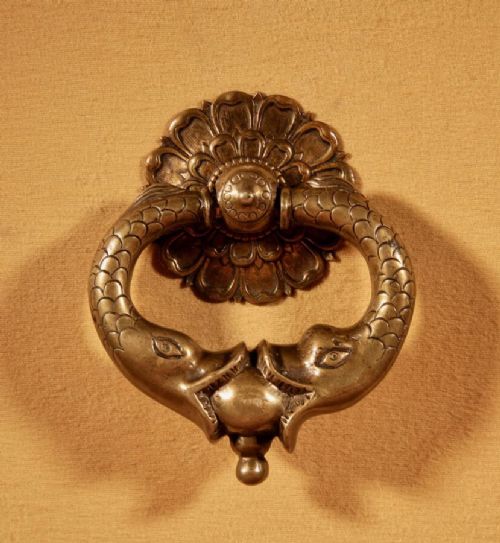
The selection includes specific sculptural shapes such as hand knockers, lion masks, sphinxes, Foo dogs, and ram heads alongside geometric octagonal knobs and push plates. Pieces appear from the seventeenth, eighteenth, nineteenth, and twentieth centuries, reflecting Victorian, Baroque, Art Deco, Neoclassical, and Edwardian design traditions.
How they were made
Items in this category are fashioned primarily from bronze, brass, cast bronze, and cast brass, utilising casting and forging methods suited to heavy architectural metalwork. Some examples incorporate contrasting components such as crystal elements or combine copper alloys with iron and wrought iron elements.
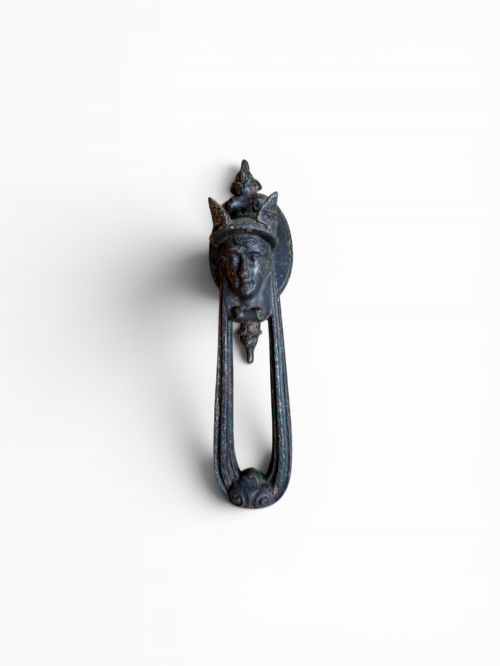
Makers shaped the molten metal into detailed motifs like laurel wreaths, Hermes heads, and stylized Art Nouveau foliage. Subsequent hand-polishing or natural ageing created the varied surface finishes seen on these historical fixtures.
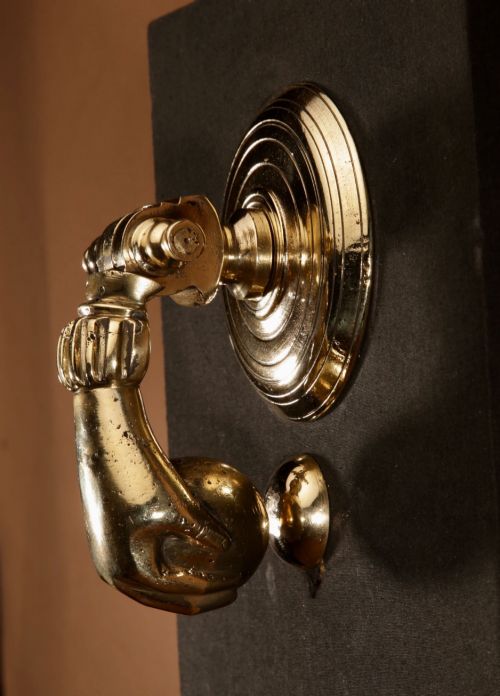
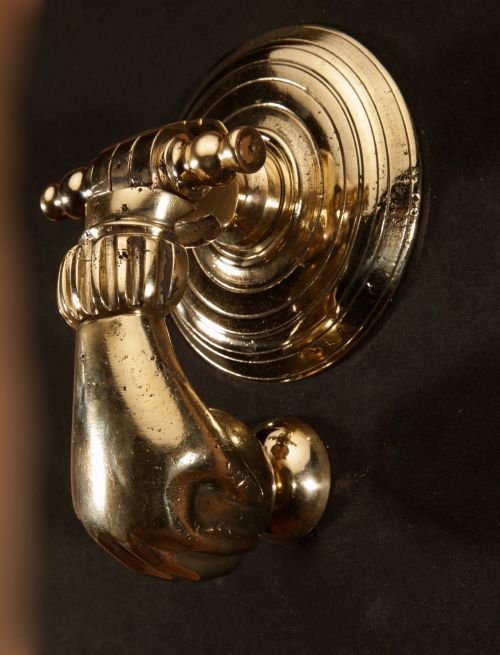
Several heavy bronze knockers take the exact shape of a human hand, ready to rap firmly on your behalf.
What varies in quality
The distinction between standard utility fixtures and superior examples lies in the crispness of the cast detail and the depth of the metal relief. Sculptural elements like hands, animal masks, and floral wreaths show greater artistic conviction on higher-grade specimens.
Completeness also dictates quality, particularly with pairs of handles, matching push plates, or integrated letter boxes and pull handles that retain their original matching components.
The Bronze Door Hardware Glossary
- Bronze
- A copper alloy typically containing tin, prized for its durability, corrosion resistance, and capacity to hold fine cast detail. It develops a rich patina over centuries of handling.
- Centre pull
- A decorative and functional handle mounted in the middle of a door rather than on the edge, often used on grand entrance doors.
- Push plate
- A protective metal plate affixed to a door around the handle area to prevent wear and finger marks on the wood finish.
- Lion mask
- A classical decorative motif depicting the face of a lion, frequently utilised on heavy door knockers from the Victorian period and earlier.
- Art Deco
- A design style popular in the 1920s and 1930s characterised by sleek geometric shapes, streamlined forms, and modern industrial materials like bronze paired with crystal.
Bronze Door Hardware: Frequently Asked Questions
How do I clean old bronze?
Most antique bronze benefits simply from gentle dusting and occasional cleaning with a soft cloth to preserve the accumulated patina.
Avoid harsh chemical metal polishes that strip away historical surface character and leave the metal unnaturally bright.
Are these fittings still usable today?
Many items in this category remain robust enough for daily installation on modern or period entrance doors.
Check the dimensions, fixing points, and spindle mechanisms to ensure compatibility with your specific door setup before fitting.
What is the difference between bronze and brass?
Bronze is an alloy of copper and tin, while brass is an alloy of copper and zinc.
Bronze generally possesses a deeper, warmer brown tone and greater tensile strength, whereas brass leans towards a brighter yellowish hue.
How do I date a door knocker?
Dating relies on stylistic clues such as Neoclassical motifs, Victorian revival details, or 1920s Art Deco geometric lines.
Construction marks, the method of casting, and the type of metal fasteners also provide clear indicators of period origin.