


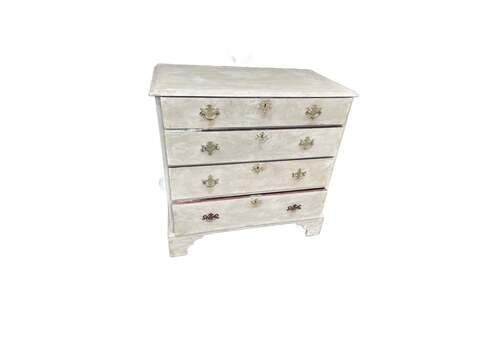
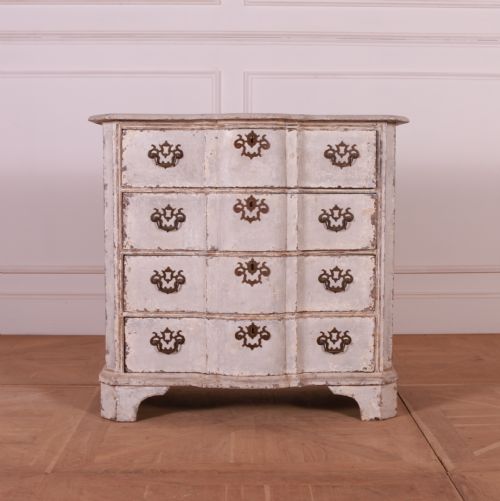


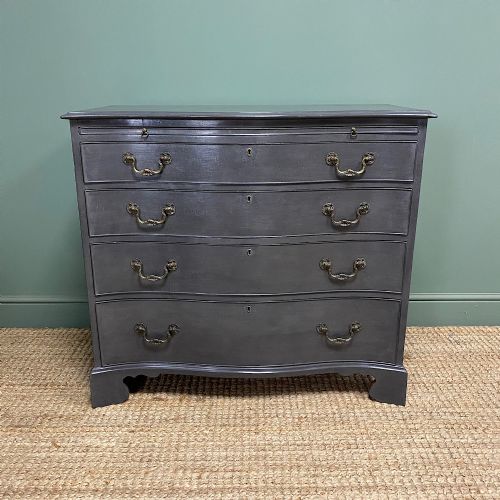
Brass Handle Grey Chest
These brass handle grey chests bring functional storage and continental elegance to a room through painted timber and polished metal.
Brass Handle Grey Chest
When you search for a brass handle grey chest, you encounter continental European commodes and chests of drawers finished in muted painted wood.
The pieces on this page span the eighteenth and nineteenth centuries, taking forms such as French Provincial commodes, Dutch serpentine chests, and tall semainiers.
You are most likely to meet nineteenth-century painted examples featuring marble tops and characteristic brass hardware.
How they were made
Cabinetmakers constructed these chests primarily from oak, cherrywood, and painted timber, often shaping the carcase into serpentine or bombe contours.
Surfaces received layers of paint, whilst tops frequently incorporated fitted marble slabs, and drawers were secured with cast brass handles.
Brass Handle Grey Chest Retail Price Guide 2026
Typical asking prices for brass handle grey chest among the pieces listed under this phrase on Sellingantiques today, from the lower quarter to the upper quarter. They describe what is for sale here now, not the wider market.
Regional variations on this page include French provincial commodes and Dutch serpentine chests.
What varies in quality
Quality rests in the precision of the cabinetwork and the subtlety of the painted finish, where softer patination and harmonious proportions separate finer examples from simpler provincial work.
The weight and detail of the brass handles, alongside the integration of fitted marble tops, signal the standard of the original workshop.
Edwards and Roberts
The Brass Handle Grey Chest Glossary
- Serpentine
- A front shape curving outward at the ends and inward at the centre, creating a gentle undulating line. Cabinetmakers utilised this profile to add movement to commodes.
- Semainier
- A tall, narrow chest traditionally containing seven drawers, one for each day of the week. These pieces maximise vertical storage space.
- Bombe
- A swollen, bulging contour typical of eighteenth-century Dutch furniture. This curved profile requires advanced woodworking skill to construct.
- Directoire
- A transitional French neoclassical style dating to the late eighteenth century, characterised by restrained lines and classical motifs.
Brass Handle Grey Chest: Frequently Asked Questions
What rooms suit a painted chest?
These chests work well in bedrooms and hallways where surface space and drawer storage are both required.
The neutral painted finishes allow them to sit comfortably alongside various interior colour schemes.
How do I care for marble tops?
Wipe marble surfaces gently with a damp cloth and mild soap, avoiding acidic cleaners that etch the stone.
Using coasters and placemats protects the polished surface from moisture marks and staining.
Are these chests heavy to move?
Solid timber construction makes these pieces substantial, and those featuring fitted marble tops carry significant additional weight.
Lifting the marble slab separately makes repositioning the commode much safer and easier.
How do I identify a Dutch commode?
Dutch pieces often display prominent bombe profiles or serpentine fronts executed in oak or painted timber.
Their proportions tend to be robust, accompanied by sturdy brass hardware.